Do Shrink Bands Count as an Amazon FBA Double Seal?
A heat shrink band is on Amazon's list of secondary seals, so it can be the second seal. Whether your bottle still needs a poly bag depends on the closure and on rules Amazon has changed more than once.
 Lena Schmidt

In this guide
- What does Amazon mean by a double seal?
- So when does the band let you skip the bag?
- What is the drop test?
- How should the band sit on flip tops, disc tops and pumps?
- Band, induction seal or bag: which should you choose?
- A worked example: 8 oz lotion with a disc top
- What should the band itself be like?
- Does this apply outside Amazon?
- A bench test before you send stock
- Where to buy the bands
- Common mistakes
- FAQ
- References
Quick answer. Amazon’s FBA prep guidance lists a heat shrink plastic band among the accepted secondary seals for liquids, next to induction seals, safety rings, clips and boxing. A band only counts when the cap underneath is tight, the band actually holds the closure shut, and the product survives a 3-foot drop test without leaking. Flip-top, disc-top and pump closures need the band placed so the opening itself cannot pop. Rules for hazardous liquids, glass and large sizes differ and are revised from time to time, so read the current Seller Central page before you ship.
What does Amazon mean by a double seal?
Amazon’s general FBA prep page says products need a secondary seal to prevent leakage and names the types: induction seal, safety ring, clips, heat shrink plastic band and boxing [1]. It then points to the definition on its page about packaging liquids, pastes, gels and creams.
An older copy of that page, republished by a payments company several years ago, gives the definition itself: a tightened lid that cannot be easily opened, plus one further seal. Among its examples it describes a safety ring as a plastic band sealing the cap to the container, and a plastic wrap band as tight plastic film around the opening of the product [2]. Packaging distributor O.Berk quotes the same definition in its e-commerce guide [3].
Put the two together and the first seal is your cap, done up properly. The band is the second. A band over a loose cap is one seal, not two.
So when does the band let you skip the bag?
The archived table is the clearest statement found, with the warning that it is old. For liquids that are not regulated as dangerous goods, in non-fragile containers, it asks for a poly bag, and then adds that no bagging is required if the liquid is double sealed and passes a drop test [2]. Glass is handled separately: bubble wrap at 4.2 oz or more, and no prep for smaller glass containers in that version of the table. For dangerous goods, the same table calls for a poly bag whatever else you do [2].
Secondary sources add a size limit. Berlin Packaging’s guide for brands says packages over 16 oz need a poly bag regardless of double seals [4], and a seller-tools blog repeats it [5]. It was not possible to confirm that line on an Amazon page, and the archived table does not show it. Treat 16 oz as a point to verify, not as settled.
| Your product | What the sources say | How firm the source is |
|---|---|---|
| Non-hazmat liquid, plastic bottle, tight cap plus shrink band, passes drop test | No bag required [2] | Archived Amazon text; recheck |
| Same, but no second seal | Poly bag with suffocation warning [2][3] | Consistent across sources |
| Glass, 4.2 oz or more | Bubble wrap; drop test still applies [2][4] | Archived text plus distributor |
| Over 16 oz | Bag regardless, say two secondary sources [4][5] | Not confirmed on Amazon |
| Regulated dangerous goods | Bag regardless [2] | Archived text; get current rules |
What is the drop test?
Amazon’s packaging requirements page describes a 3-foot drop onto a hard surface, made up of five drops: flat on the base, flat on the top, flat on the longest side, flat on the shortest side, and on a corner [6]. Berlin Packaging gives the same sequence and notes that glass bottles protected with bubble wrap and a box still have to pass it as prepared [4]. For liquids the pass mark is simple. Nothing leaks.
It is worth being clear about what the band contributes here. A thin film around a cap does not hold liquid in. What it can do is stop a cap backing off, or a hinged lid springing open, when the bottle lands. If your closure leaks through its own seal when squeezed or inverted, a band will not rescue it. That is reasoning rather than a quoted source, and it is the reason to test before relying on any band. Our guides to bottle cap torque testing and vacuum chamber leak testing cover the closure itself.
How should the band sit on flip tops, disc tops and pumps?
Dispensing closures are where bands most often fail the purpose. A disc-top cap opens when you press one side of the disc; a flip-top spout opens when it is lifted [7]. A band that circles only the skirt of the cap leaves the opening free to move.
A seller-tools summary of Amazon’s guidance puts the placement this way: seals go horizontally around screw caps, vertically over flip openings, and on pumps they should attach to the bottle on both sides. It adds that spray bottles without a locking mechanism need bagging instead of a cap seal [8]. It was not possible to check that wording against Amazon’s own page, so use it as a prompt for what to verify.
For a shrink band, “over the opening” means a band tall enough to fold across the top of the cap. TricorBraun’s sizing guide suggests the band should overhang the closure by about 5 mm at the top and at the bottom, so it grips the neck as well as the cap [9]. On a disc top, that top overhang is what pins the disc.
Two supplier details help with sizing. TricorBraun recommends a 45 mm lay-flat band for 24-410 continuous-thread finishes, and gives a general formula: measure the circumference, halve it and add 2 mm [9]. Disc-top caps are wider than plain caps of the same thread, and Wholesale Supplies Plus tells a customer that its 24/410 disc top takes a 50 x 55 mm band. The same answer carries a warning: if you want the band to cover the cap and reach down onto a wider bottle, you need a band wide enough to pass over the bottle [10]. See shrink band sizes for pump and spray bottles for more.
There is also a closure built for this problem. Berlin Packaging sells a 24-410 disc top with a twist-to-lock ring, described as designed for e-commerce transit, with threads meant to resist backing off [11]. A locking closure is not on Amazon’s list of secondary seals as the list reads, so it would complement a band or liner, not replace one.
Band, induction seal or bag: which should you choose?
All three can satisfy the rule. They differ in cost, look and what the customer experiences.
-
Poly bag. Always available and needs no equipment. O.Berk notes the bag must be transparent, at least 1.5 mil thick and marked with a suffocation warning [3]. It hides your packaging and adds a step for every unit.
-
Shrink band. O.Berk suggests a shrink sleeve around the neck as a way to meet the rule while keeping the look of the pack, and points out that it covers tamper evidence too [3]. It needs a heat gun and the right size.
-
Induction seal or peel-off liner. O.Berk calls a peel-off safety seal under the cap the best way to satisfy both customers and shipping rules [3]. A maker of induction sealers says Amazon recommends a safety seal of this kind [12]; that is a vendor’s statement. A liner seals the mouth of the bottle itself, which a band cannot do.
Many small brands use two of these together. A craft supplier tells customers that plenty of people add a press-and-seal liner as well as a shrink band, and that very thin liquids should be tested in the actual packaging [10]. For a fuller comparison see shrink bands vs induction seals.
Whatever you pick, O.Berk’s last piece of advice applies: torque the cap to the manufacturer’s stated figure [3]. The definition starts with a tightened lid.
A worked example: 8 oz lotion with a disc top
Take a common case, an 8 oz plastic bottle with a 24-410 neck and a disc-top cap, holding a lotion that is not a regulated dangerous good. It is plastic and under 16 oz, so on the sources above it can avoid the bag if it is double sealed and passes the drop test [2][4].
The first seal is the cap, tightened. For the second, a craft supplier’s answer points to a 50 x 55 mm band for this style of cap [10]. Check the height against your cap: the band should run from a few millimetres above the disc to a few millimetres below the cap skirt, so that it folds over the top and bites onto the neck [9]. If your bottle’s shoulder is wider than the cap and you want the film to reach it, you need a wider band, as the same supplier warns [10].
Shrink it, then press the disc through the film. If the disc still tilts, the band is not doing its job as a second seal. Go taller, or add a liner under the cap and treat the band as the visible extra.
What should the band itself be like?
-
Perforated, unless you have a reason. The buyer has to get in without tools.
-
Tall enough to cover the top edge of the closure and reach the neck [9].
-
Clear of the barcode. Amazon’s packaging page expects a scannable barcode on the outside of the unit [6]. Keep film and wrinkles off it.
-
Named film and thickness. Stock bands are usually 2 mil PVC; ask whether PETG or a thicker film is worth specifying.
Nothing in the sources sets a minimum thickness for a band used as a double seal. The 1.5 mil figure that appears in guides refers to poly bags [3].
Does this apply outside Amazon?
Only as good practice. O.Berk notes that FedEx, UPS and USPS each have their own requirements for liquids [3], and nothing here was review those. If you ship your own orders, the same logic holds: a tight cap, a second barrier and a drop test on your own floor will catch most leaks before a customer does.
A bench test before you send stock
This routine is put together here, built from the sources above. It is not an Amazon procedure and passing it is no guarantee, but failing it tells you something cheaply.
-
Fill ten units to your normal level with the real product. Cap them to your usual tightness and apply the band.
-
Lay each one on its side on paper towel for 24 hours. Then stand them upside down for an hour.
-
Squeeze each bottle firmly, as a packer might when grabbing it.
-
Drop five of them from 3 feet onto a hard floor in the order Amazon describes: base, top, longest side, shortest side, corner [6].
-
Shake each one hard for a few seconds. A seller-tools guide mentions a vigorous shake test alongside the drop test [8].
-
Inspect. Any wet towel, any liquid under the band, any cap that has turned, counts as a fail.
-
Photograph the results and keep them with your shipment records.
If units fail, fix the closure first: a liner, a better cap or more torque. Add the band last.
Where to buy the bands
The listing below is the stock band shape this page describes, sold clear and perforated.
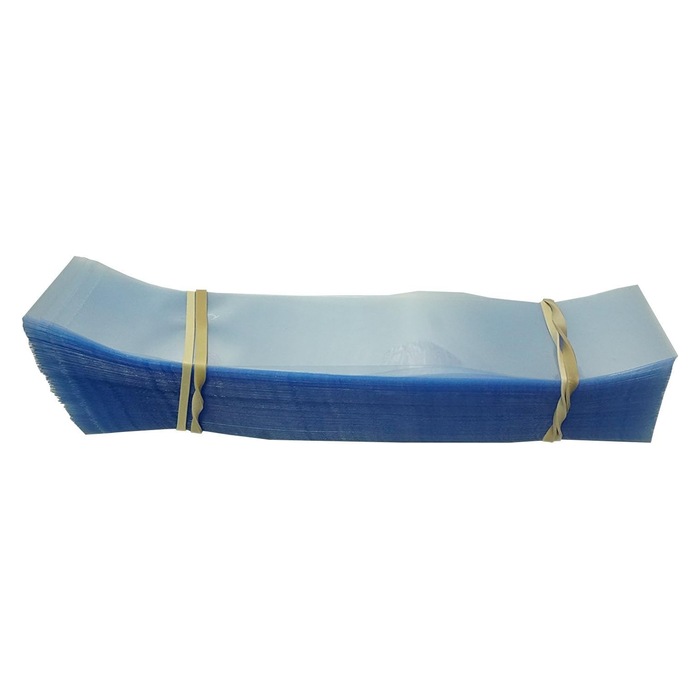
190 x 28 mm clear perforated shrink bands
A stock clear perforated band, 190 mm lay-flat by 28 mm tall, for caps around 4 11/16 inches across.
- Role: Amazon consumer option
- 190 x 28 mm
- Perforated
- 250 pack
- MOQ: Check current listing
Common mistakes
-
Band on a loose cap. The cap is the first seal. Tighten it.
-
Band too short. It circles the cap but does not reach the neck, so the cap and band unscrew together. Use a taller band [9].
-
Non-perforated band on a retail product. It may pass prep, and then the customer needs scissors. See perforated vs non-perforated shrink bands.
-
Assuming a band covers hazmat. The archived table bags regulated liquids regardless [2]. Flammable and other regulated products have their own programme rules.
-
Trusting an old blog. Including this one. Amazon edits its prep pages. Read the current one before every new product.
FAQ
Does a tamper-evident sticker count?
It is not among the secondary seals named on Amazon’s prep page [1]. We would not rely on one.
Is a double seal the same as a legal tamper-evident requirement?
No. This is a fulfilment rule about leaks. Legal tamper-evident rules are separate; see are shrink bands required by law.
Do creams and gels count as liquids?
Amazon’s page title covers liquids, pastes, gels and creams together [1].
Do I need a band if my bottle has a foil liner under the cap?
An induction seal is on the same list of secondary seals [1], so a properly sealed liner plus a tight cap should meet the definition. A band then becomes a customer-facing choice.
Will Amazon tell me if I got it wrong?
The sources reviewed run to no description of how compliance is checked. Do not treat an accepted shipment as proof.
References
- Amazon Seller Central, Prepare your products for FBA shipping (help reference 201021850). sellercentral.amazon.com (platform policy page, public excerpt).
- Archived copy of Amazon’s “Packaging liquids, pastes, gels, and creams” page, republished by LianLian Global, several years old. global.lianlianpay.com (third-party copy; may be out of date).
- O.Berk, Packaging Crash Course: Ecommerce Packaging Requirements and Considerations. oberk.com (packaging distributor).
- Berlin Packaging, Grow Online: Make Your Package Amazon-Friendly. berlinpackaging.com (packaging distributor).
- AMZScout, Amazon packaging requirements. amzscout.net (seller-tools blog; secondary source).
- Amazon Seller Central, Product packaging requirements (help reference 200141500). sellercentral.amazon.com (platform policy page, public excerpt).
- SKS Bottle & Packaging, Selecting a Cap. sks-bottle.com (packaging supplier).
- Threecolts, Amazon packaging rules every seller must know. threecolts.com (seller-tools blog; secondary source).
- TricorBraun, Shrink Bands for Bottles & Jars: A Sizing Guide. tricorbraun.com (packaging distributor).
- Wholesale Supplies Plus, 24/410 Natural Smooth Disc Top Cap, product page Q&A. wholesalesuppliesplus.com (craft-supply retailer).
- Berlin Packaging, 24-410 PP Plastic Locking Disc Top Cap. berlinpackaging.com (product page).
- Enercon Industries, Tips for Shipping Liquids on Amazon. enerconind.com (induction sealer maker; commercial source).
Continue reading
Foamer Pumps: Dilution, Viscosity and Bottle Fit Guide
A foamer pump does not make foam from a thick liquid. It mixes air into a thin one, and the dilution is decided before the pump is ever fitted.

Shrink Bands vs Tamper-Evident Caps: Which Costs Less?
A band costs a cent or two and a tamper-evident closure costs five. The minimum order is what usually decides it, not the unit price.
Clear, Black or Printed Stock Shrink Bands: Which to Buy?
The colour of a band changes four things: what the customer notices, what it hides, which sizes you can get, and whether it tears open cleanly.