Foamer Pumps: Dilution, Viscosity and Bottle Fit Guide
A foamer pump does not make foam from a thick liquid. It mixes air into a thin one, and the dilution is decided before the pump is ever fitted.
 Lena Schmidt
In this guide
- How does a foamer pump make foam?
- How thin does the liquid need to be?
- What do published dilution ratios say?
- What else stops a foamer from foaming?
- Which foamer fits which bottle?
- Foamer or lotion pump: which one for your product?
- How far does a litre of concentrate go?
- What do they cost, and how much do you have to buy?
- A two-day trial
- Where to buy the pumps
- Questions to ask the supplier
- Common mistakes
- FAQ
- References
Quick answer. A foamer pump mixes air with a thin liquid in a mesh chamber, so the liquid has to be thin. Silgan, a pump maker, asks for under 100 cps and a pH between 3 and 12; a US patent prefers 1 to 300 cps. In practice that means diluting a regular liquid soap: published home ratios run from 1 part soap to 3 parts water up to 1 to 6, and they disagree, so test your own. Foamer pumps also use a bigger neck (usually 40 or 43 mm) and a short, bottle-specific dip tube, so they do not fit a 24/410 lotion bottle. Before ordering a case, fill five bottles with your real formula, count the strokes to first foam, and leave them for two days to see whether the mesh clogs.
How does a foamer pump make foam?
A foam pump dispenses doses of the liquid as foam, and the foam is created in a chamber where the liquid and air are mixed and then pushed through a nylon mesh [8]. Nothing foams later on the hand; the foam is made before it leaves the nozzle. That is why the mesh is fine and the channels narrow.
It is also why the pump cannot do much about the liquid. If the liquid is too thick to pass the mesh, the pump either does not foam or feels stuck, as a cosmetic-ingredient supplier explains in a formulation Q&A about a hand-wash base [4]. If the liquid has particles in it, they collect at the mesh. A lotion pump, in contrast, only has to push the liquid out.
How thin does the liquid need to be?
Different sources give different ceilings, and it helps to see them side by side.
| Source | Viscosity guidance | Notes |
|---|---|---|
| Silgan Dispensing (pump maker) [1] | Under 100 cps | Also pH 3 to 12, clear and homogeneous, few hydrophobic ingredients |
| US patent 5,364,031 [2] | About 1 to 300 cps; preferred 20 to 130; most preferred 50 to 100 | Patent for a foam nozzle; a design statement, not a spec for any one pump |
| US patent 8,622,252 [3] | Traditional foamers: 100 cps or less; up to 300 cps has been used | Describes a higher-viscosity formula built for a foaming dispenser |
cps is centipoise, the usual unit for liquid thickness; water is about 1 cps. Quoted figures are paraphrased from the cited pages.
Taken together, the safe zone for a standard foamer is roughly water-thin to about 100 cps, with 300 cps as the outer edge that some designs reach. Most liquid hand soaps are well above that as sold, which is why every home recipe starts with water. If you sell a branded soap, ask your pump supplier for its viscosity tolerance in writing. A cosmetic-ingredient supplier notes that mesh size and tolerance differ between pump brands, so the workable thickness depends on your head [4].
The patents are useful for the order of magnitude, but a patent describes what an invention can do, not what a pump you buy has been rated to do. Silgan is the most direct source here because it makes the pumps; even so, its figure comes from a formulation-services page and applies to its own range.
What do published dilution ratios say?
If you start from a finished soap, dilution is how you get under the ceiling. Published recipes vary.
| Source | Soap : water | Notes |
|---|---|---|
| Dr. Bronner cheat sheet [5] | 1 : 3 | For a foaming hand-soap dispenser, castile soap |
| Dr. Bronner support page about Sal Suds [5] | 1 : 6 | Says undiluted soap would clog; its soaps do not suit plain pump dispensers |
| The Easy Homestead blog [6] | 1 : 4 to 5 | Castile soap 1 : 5 to 6; mentions 1 : 3 if the soap is too watery |
| The Art of Doing Stuff blog [7] | 1 : 4 to 6 | More water saves money but gives less foam |
Ratios as stated by each source for their own soap; none of them states a viscosity in cps.
The disagreement is the point. A concentrated castile soap, a liquid dish soap and a hand soap with added thickener do not start at the same thickness, so one ratio cannot fit all of them. One reader of the blog tried the 1 to 4 mix with a dish soap and called the result too watery [7], while another comment on the Dr. Bronner page said 1 to 3 did not work with castile in a foaming pump [5]. These are anecdotes, but they match the underlying problem: the recipe depends on the soap.
The arithmetic is easy to check. One part soap in four parts water is 1 in 5, so 20 percent soap; 1 to 3 is 25 percent; 1 to 6 is about 14 percent (the arithmetic here). Dilution also dilutes the active ingredient, so a brand making cleaning claims needs to look at the strength of the finished product and not only at the foam. And above about half water, a mix without a preservative can spoil, which is why one supplier advises adding a preservative at about 1 percent once the formula passes 50 percent water [4]. That figure is one supplier’s advice for its own base. Check preservative needs with your own formulator.
What else stops a foamer from foaming?
Silgan lists the properties of a formulation that foams well: clear and homogeneous, no visible particles, no separation, not too dense or sticky, and few hydrophobic ingredients [1]. It also says some vegetable and essential oils are not compatible [1]. The Q&A page above puts the limit for fragrance and oil at 3 percent or less for its base, warning that too much oil can weaken the foam or raise viscosity [4], and recommends mixing thoroughly because undissolved base or fragrance can clog the mesh [4].
Another gap is the surfactant itself. A non-foaming surfactant will pass through the pump as liquid and will not turn into foam [4]. If a formula was built for squirting, it may not be built for foaming.
The practical lesson for a small brand is to treat the formula and the pump as a pair. A scented body wash that foams well in a pump tested in a lab can fail after a fragrance change, so retest whenever the formula changes.
Which foamer fits which bottle?
Foam pumps use a larger neck than lotion pumps; the usual sizes are 40 and 43 mm [8]. A 24/410 lotion pump will not screw onto them, and the reverse is true. The pump also has to match the bottle in height, because the dip tube is short. Compare what sellers list.
| Foamer as listed | Neck | Output | Dip tube and bottle |
|---|---|---|---|
| Berlin Packaging F2-style, white [9] | 43 mm | 0.8 cc | 1.93 in; 250 ml cylinder bottle |
| Kaufman Container, natural [10] | 43 mm | 1.6 cc | 67 mm straight tube |
| Container and Packaging, white PP [11] | 40 mm | 1.6 cc | 4.625 in tube |
| O.Berk F3, white [12] | 43 mm | 1.2 or 1.5 ml | Dome hood; plastic foamer bottles |
| Berlin Packaging F2 L11, white [14] | 43 mm | Not stated | 7 3/8 in tube; includes clear overcap |
Doses and tube lengths as listed by each seller; dip tubes are cut to bottle height, so they differ widely.
Two things stand out. The tubes range from under 2 inches to more than 7, so the listing for the pump and the listing for the bottle have to be read together. And the output ranges from 0.8 to 1.6 cc. The Silgan catalogue shows a similar spread: foam engines with outputs of 0.75, 1.2 and 1.5 ml [13]. Sellers also say which bottle the pump pairs with. Berlin matches its 43 mm foamer to 250 ml cylinder bottles [9], and O.Berk says its 43 mm pump pairs specifically with plastic foamer bottles [12]. Kaufman recommends a particular 250 ml PET cylinder foamer bottle for one of its pumps [10].
The output figure is for liquid dispensed per stroke, so the volume of foam is larger. Even so, you can compare the amount of soap per use. At 1.5 ml per stroke and 20 percent soap, each stroke carries about 0.3 ml of soap (the arithmetic here), which is why a foaming dispenser can look generous while using little product. A 250 ml bottle at 1.5 ml per stroke gives about 167 strokes, ignoring residue.
Foamer or lotion pump: which one for your product?
Choose by the liquid, not by the look. A thin, water-based cleanser such as a hand wash, face wash or pet shampoo suits a foamer, because the format needs a thin liquid anyway [1]. A cream, lotion or conditioner that is thick by design belongs under a lotion pump, and thinning it until it foams would change what the product is. Our page on [lotion pump specs] covers that side. If you want a thick product to foam, the supplier route is the one patent describing a higher-viscosity formula built for a foaming dispenser [3], which is a formulation project and not a closure swap.
How far does a litre of concentrate go?
Brands that sell a refill often want to know what a litre makes. At one part soap to four parts water, a litre of concentrate makes five litres of finished product. At 1.5 ml per stroke, that is about 3,300 strokes (the arithmetic here, ignoring what stays in the bottle and tubing). At one to six, the same litre makes seven litres, but the finished product is thinner and the foam may be wetter, and the cheaper dilution is only a saving if the foam still meets the customer expectation [7].
A related point for the label. Dilution changes the strength of the product the customer uses, so a claim written for the concentrate, such as a cleaning or antibacterial claim, does not carry over to the diluted mix without checking. This is a regulatory question for your market and your product type, and the pump sources here do not address it.
What do they cost, and how much do you have to buy?
Prices vary a great deal by channel. Berlin Packaging shows a VIP price of $0.97 for a 43 mm F-2 natural foamer pump for 210 ml cylinder bottles, with a request-a-quote option [14]. Kaufman Container shows a $2,500 minimum order [10]. O.Berk lists a 43 mm F2 foamer as a special order with a minimum of 100,000 [12]. So the cheapest path to a first run is a catalogue item from a distributor that sells a matched pump and bottle, not a special-order pump that happens to look right.
A two-day trial
-
Choose a pump and a matched bottle from the same seller, and ask for five sets.
-
Mix your real formula, with fragrance and colour, and measure its thickness if you can. If you have no viscometer, compare the flow of the mix to water in a cup.
-
Fill the bottles, fit the pumps, and count the strokes to first foam. Record the number.
-
Check the foam: does it hold its shape for a few seconds, or collapse? Is it too wet?
-
Weigh ten strokes of liquid (not foam) from each pump to find the real output, and compare it to the listing.
-
Leave the bottles upright for two days at room temperature, then try again. Look for clogging, separation or a pump that has started to stick.
-
Lay one filled bottle on its side overnight to look for leaks at the neck.
If foam is weak, change one thing at a time: first add water, then check mixing, then reduce fragrance. If the pump sticks, rinse it with warm water before blaming the formula; a home-recipe blog suggests this as a first step for a sluggish pump [6].
Keep a one-page record of each trial: pump and bottle codes, the formula and its thickness, strokes to first foam, weighed output, and the state of the mesh after two days. If a pump fails, that page is what the supplier needs to help. Vague complaints such as “it does not foam” get vague answers, while a record that says the same mix foamed at one to five and failed at one to three points straight at viscosity. Change the batch size only after the small trial passes, and repeat the two-day check on the first production lot, since fragrance and colour batches can differ from the sample.
Where to buy the pumps
The listing below pairs the pump with the bottle, which is how foamers are usually bought: the pump and the bottle are matched at the factory.
Questions to ask the supplier
-
What viscosity range does this pump head tolerate, in cps?
-
What is the output per stroke, and was it measured with liquid or with foam?
-
Which bottle, with which dip tube length, is this pump designed for?
-
Is the pump compatible with my surfactants and my fragrance level?
-
Can I have samples of the pump and the bottle together?
-
What is the minimum order for the standard item?
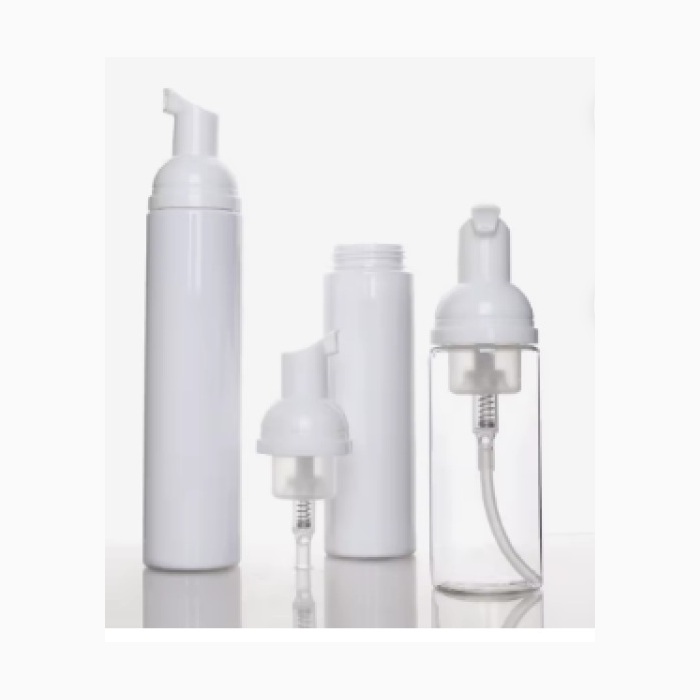
Foam pump bottles, 2, 4 and 10 oz
PET bottles supplied with a foamer pump head already fitted, in 2, 4 and 10 oz sizes, sold by the carton of 408.
- Role: Alibaba sourcing candidate
- 2, 4 and 10 oz
- Pump included
- Carton of 408
- MOQ: From 408 pieces
Common mistakes
-
Using a regular soap and hoping. Foamers need a thin liquid [1][4].
-
Copying one recipe for every soap. The published ratios disagree for a reason [5][6][7].
-
Ordering a 24/410 pump for a foamer bottle. The neck is different [8].
-
Ignoring the tube length. It is cut for a specific bottle [9][11][14].
-
Skipping the retest after a fragrance change. Oils can clog the mesh or change thickness [4].
FAQ
Can I use my existing lotion pump bottle?
Usually not. Foam pumps use a larger neck, typically 40 or 43 mm [8].
What ratio should I start with?
Published starting points run from 1 to 3 to 1 to 6 [5][6]. Start in the middle and adjust.
Why does the pump feel stuck?
A mix that is too thick for the mesh was the cause in one supplier Q&A [4].
Do I need a special bottle?
Sellers pair foamers with specific cylinder bottles [9][10][12]; ask for the matched one.
Is it cheaper to dilute my own?
It reduces the amount of soap per use, but see the strength and preservative points above before making claims.
References
- Silgan Dispensing, Foam formulation services. silgandispensing.com (pump manufacturer).
- US Patent 5,364,031, Foam dispensing nozzles and dispensers employing said nozzles. uspto.gov (patent; preferred viscosity ranges).
- US Patent 8,622,252, Personal care composition foaming product and foaming dispenser. uspto.gov (patent; background on viscosity).
- MySkinRecipes, Troubleshooting SweetWash Hand base with foaming pumps (expert Q&A). myskinrecipes.com (cosmetic ingredient supplier).
- Dr. Bronner, Dilutions cheat sheet for castile soap, and a Dr. Bronner support page on pump and foaming dispensers; one reader comment. drbronner.com and drbronner.gorgias.help (soap maker).
- The Easy Homestead, How to make foaming hand soap (13 Mar 2026). theeasyhomestead-com.pages.dev (home-recipe blog; mirror domain).
- The Art of Doing Stuff, How to make foaming soap. theartofdoingstuff.com (home-recipe blog; includes a reader comment).
- Foam pump. Wikipedia (neck sizes 40 or 43 mm; general description).
- Berlin Packaging, 43 mm F2-style white foamer pump, 0.8 cc, for 250 ml cylinder bottles. berlinpackaging.com (packaging distributor).
- Kaufman Container, 43 mm natural foamer pumps (1.6 cc, 67 mm tube; $2,500 minimum). kaufmancontainer.com (packaging distributor).
- Container and Packaging, white PP 40 mm foamer pump, 1.6 cc, 4.625 in tube. containerandpackaging.com (packaging distributor).
- O.Berk, 43 mm white smooth side F3 and F2 foamer pumps. oberk.com (packaging distributor).
- Silgan Dispensing, Foam brochure (2021). silgandispensing.com (pump manufacturer; outputs 0.75, 1.2, 1.5 ml).
- Berlin Packaging, 43 mm F2 L11 white foamer pump with 7 3/8 in tube, and 43 mm F-2 natural foamer pump for 210 ml bottle ($0.97 VIP price as displayed). berlinpackaging.com (packaging distributor).
Continue reading
Shrink Bands vs Tamper-Evident Caps: Which Costs Less?
A band costs a cent or two and a tamper-evident closure costs five. The minimum order is what usually decides it, not the unit price.
Clear, Black or Printed Stock Shrink Bands: Which to Buy?
The colour of a band changes four things: what the customer notices, what it hides, which sizes you can get, and whether it tears open cleanly.
Shrink Bands vs Shrink Wrap Bags: Which Should You Use?
A band is an open tube and a bag is a closed one. Most of the decision follows from that, and so does the equipment you need.