Shrink Bands vs Shrink Wrap Bags: Which Should You Use?
A band is an open tube and a bag is a closed one. Most of the decision follows from that, and so does the equipment you need.
 Lena Schmidt
In this guide
- What is the physical difference?
- Which jobs suit a band?
- Which jobs suit a bag?
- What equipment does each one need?
- Does the film itself differ?
- What about moisture?
- How does the customer open each one?
- Mistakes worth avoiding
- What does each one cost per piece?
- Which should you choose?
- Can you combine them?
- Where to buy the bags
- A quick trial before you commit
- FAQ
- References
Quick answer. Use a shrink band when the product is already in a closed container and you want a tamper signal, or when a bare product such as cured soap should stay partly open to the air. Use a shrink wrap bag when a loose product has to be covered on every side, as a bath bomb or a gift set does. Bands need only a heat gun. Bags usually need an impulse sealer as well, and the common bag film, polyolefin, shrinks at a higher temperature than PVC band film. Bands are also thicker, typically 2 mil against 0.75 to 1 mil for bags.
What is the physical difference?
A shrink band is a short tube of film, open at both ends. You slide it over the product and heat it. It tightens around the middle and curls in a little at each edge, but the two ends stay open. Bramble Berry, a soap supply company, says as much when it describes medium and large shrink wrap bands as packaging with openings that let in air [1].
A shrink wrap bag is a flat pouch, closed on three sides. The product goes in, the open side is sealed, the spare film is trimmed away and the whole thing is heated. One maker’s instructions read: use an impulse sealer to seal the excess bag off, then shrink with a heat gun [2]. The result encloses the product completely, apart from tiny vent holes.
Those vent holes are deliberate. A packaging equipment seller notes that polyolefin shrink bags come with a pre-made vent hole [3], and an industrial packaging guide explains why: small perforations let air escape during shrinking, so the film ends up smooth instead of ballooning [4]. A bag is therefore a full cover, not a perfectly airtight one.
Which jobs suit a band?
-
A tamper signal on a container. A jar, tin or bottle is already closed. The band bridges lid and body, and has to be torn to open it. A bag would do this too, but it hides the whole pack and takes longer.
-
Soap that should breathe. Bramble Berry advises letting soap cure fully before wrapping, because trapped moisture can cause problems, and points to bands as an option precisely because they are open [1].
-
Keeping a label clean. A band over the middle of a bar or tube protects the label and leaves the ends free for a customer to smell.
-
Round products with a clear “waist”. Retailers size bands for bath bombs by mould diameter: 95 x 55 mm for a 1.75 inch mould and 135 x 55 mm for a 2.75 inch mould, in one supplier’s chart [5].
That last use needs a caveat. A band on a sphere covers the equator and leaves both poles exposed. One customer put the obvious question to a retailer: how do you shrink wrap a bath bomb without leaving holes in the wrap [6]? With a band, you do not. If the holes matter, you want a bag.
Which jobs suit a bag?
-
Bath bombs that must be covered. Bramble Berry calls shrink wrapping ideal for selling or shipping bath bombs because the extra layer protects them [7]. A retailer answering a customer about 3 inch bath bombs offers both routes, a 120 x 55 mm band or a 4 x 6 inch shrink bag [6].
-
Products that shed crumbs or glitter. Full cover keeps the mess inside.
-
Gift sets and bundles. Several items wrapped as one need film on every side.
-
Odd shapes with no waist. Hearts, stars and moulded figures give a band nothing even to grip.
Bag sellers give size guidance much as band sellers do. One lists a 4 x 6 inch polyolefin bag for soap, bubble bars and bath bombs up to 2.5 inches across, and a 6 x 6.5 inch bag for larger items [2]. A buyer of 5 x 6 inch PVC bags found them right for 2.5 inch bombs and thought anything bigger would be difficult [8].
What equipment does each one need?
| Shrink band | Shrink wrap bag | |
|---|---|---|
| Heat source | Heat gun; some sellers accept a hair dryer | Heat gun. One retailer says hair dryers typically do not get hot enough for polyolefin [9] |
| Sealer | None | Impulse sealer to close and trim the open side [2][3] |
| Steps per item | Slide on, heat | Insert, seal, trim, heat |
| Typical film | PVC, 2 mil [6] | Polyolefin at 75 gauge, or PVC at 100 gauge [2][8] |
| Start-up cost | A heat gun | One seller puts a sealer, heat gun and bags at under $200 for up to 200 bath bombs a day [3] |
The sealer is the dividing line. A packaging equipment seller states the rule simply: fully enclosed wrapping needs a sealer, while tubing and similar formats may need only a heat source [10]. If you do not want another machine on the bench, that alone may decide it.
Technique differs too. With a band you can aim at the film and turn the product. With a bag, one maker tells buyers to start at the corners and seams and move quickly, and warns that heat held on the flat faces will burn through [2]. A reviewer of the same bags agrees that the trick is to keep the gun moving at all times [2].
Does the film itself differ?
Yes, in three ways that matter at the bench.
Thickness. Craft bands are 2 mil; one retailer confirms that all of its shrink wrap bands are that gauge [6]. Bags are thinner: 75 gauge for a popular polyolefin bag and 100 gauge for a PVC one [2][8]. Since 100 gauge is 1 mil, a band is two to nearly three times as thick as a bag. That is why a band feels like a firm collar and a bag feels like a skin, and why bags burn through more easily.
Material. Bands in small packs are nearly always PVC. Bags come in PVC or polyolefin. A packaging seller’s side-by-side list describes PVC as crinkly before heating, hard and brittle afterwards, with an odour during sealing and shrinking, and not approved for direct food contact. It describes polyolefin as soft before and after, odourless, approved for direct food contact, and needing more heat, over 300°F [11]. A craft retailer gives 280 to 320°F as the shrink range for its polyolefin bags [9].
Scent. Soap and bath sellers care whether a customer can smell the product. Two suppliers say polyolefin lets scent through [2][9], and one adds that it takes about 24 hours after shrinking before you can smell the product through the film [2]. Buyers are less sure. One wished more smell came through, and another reported none at all [2]. A band sidesteps the question, because the ends are open.
If your concern is PVC itself, see [PVC vs PETG shrink bands]. That page covers the band-side alternative.
What about moisture?
This is where expectations run ahead of evidence. Bath bombs react with moisture in the air, and suppliers agree they must be thoroughly dry before any wrapping. Bramble Berry suggests drying overnight or up to 24 hours [7]. Another supplier explains that bath bombs give off carbon dioxide as they dry, and that sealing them too early leaves the gas nowhere to go [12].
Beyond that, the claims thin out. Sellers describe shrink wrap as protecting bath bombs from humidity [7][12], and one mould listing says a band around the body of the sphere keeps moisture out even in humid regions [13]. No source was found for a measurements behind either statement. A band leaves two openings and a bag has vent holes, so neither is a sealed barrier. A fair reading is that both slow the exchange of air, a bag more than a band, and that neither replaces dry storage. A lifestyle site makes the complementary point that shrink wrapping bath bombs is not strictly necessary at all, and that its main purposes are a moisture barrier and holding in fragrance [14].
For products that must stay dry for months, an airtight jar or a heat-sealed barrier bag is a different class of packaging, and outside this comparison.
How does the customer open each one?
A craft band normally has a perforation. Retailers describe their bands as perforated for easy removal [6], so the buyer tears a line and the film comes away. A stock shrink bag has no tear line. The buyer pinches the film and rips it, or reaches for scissors, and with a brittle PVC bag the tear can run in sharp-edged strips. One polyolefin seller makes a selling point of film that shrinks without sharp edges [2]. If your buyers include children, or people with limited grip, try opening both formats yourself with dry and with wet hands before you choose.
Mistakes worth avoiding
-
Wrapping too soon. Soap that has not cured and bath bombs that are not fully dry are the two cases suppliers warn about most [1][12]. Film does not fix a wet product. It traps the problem inside.
-
Buying a bag and owning no sealer. The open side will not close itself under a heat gun. It curls back and leaves a ragged mouth.
-
Buying a band for full cover. Two open ends are part of the design.
-
Using band heat on a bag. Bag film is thinner and burns through if the gun lingers [2]. Polyolefin also needs more heat than PVC to shrink [11], so the right approach is hotter air kept moving, not cooler air held close.
-
Assuming film means long shelf life. Nothing in the sources supports that. Store stock cool and dry whatever it is wrapped in.
What does each one cost per piece?
For bands there are figures: a craft retailer sells 50 bands of 135 x 55 mm for $3.30, about 7 cents each [6]. No comparable per-bag price was captured from a citable source, so none is guessed here. What can be said is that bags are thinner film in a simpler shape, and that the larger cost of the bag route is the sealer and the extra handling. One equipment seller is frank that the hand method gives the same finished look as costlier systems but takes more time per product [3]. Our how much do shrink bands cost has more band prices.
Which should you choose?
| Your product | Start with |
|---|---|
| Jar, tin, bottle or tube that is already closed | Band |
| Cold process soap bar | Band, after a full cure [1] |
| Melt and pour soap, which one supplier says should be wrapped immediately [1] | Bag, or full cling wrap |
| Bath bomb sold at a dry indoor stall, scent matters | Band |
| Bath bomb shipped by post or sold in a humid place | Bag |
| Gift set, bundle or irregular shape | Bag |
| You own a heat gun and nothing else | Band |
Two rows are judgment, not instruction and not a supplier’s instruction: the split between stall and postal bath bombs, and the last row. They follow from the open ends and the sealer, as described above.
Can you combine them?
You can. A bag over the product for cover, then a paper label or belly band on top, is common on soap. A band over a boxed product adds a tear-to-open signal to packaging that otherwise opens freely. What makes little sense is a shrink band over a shrink bag on the same bare product. You would pay for two films and two heating steps to do one job.
Where to buy the bags
The listing below is the bag side of this comparison: polyolefin, 4 x 6 inch, in a 500-piece pack.
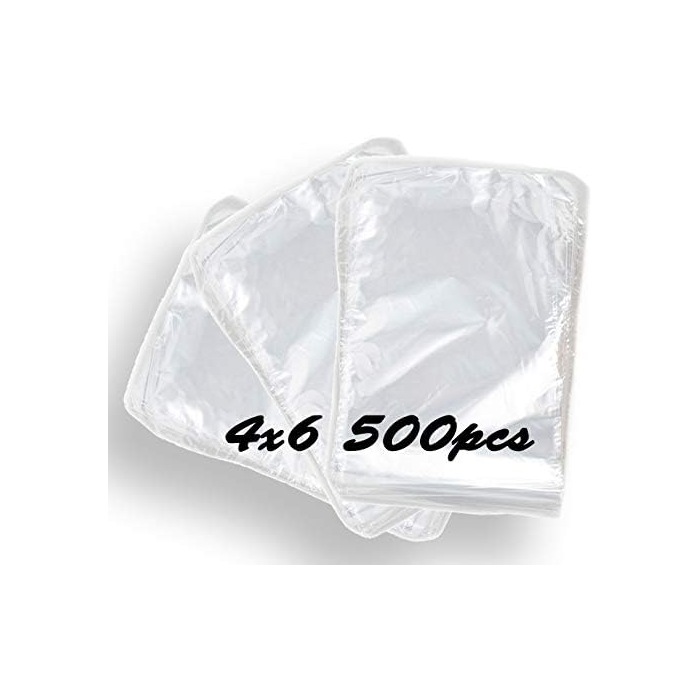
4 x 6 inch polyolefin shrink wrap bags, 500 pack
Clear polyolefin bags sized for a bar of soap or a single bath bomb, sold 500 to a pack.
- Role: Amazon consumer option
- 4 x 6 in
- Polyolefin
- 500 pack
- MOQ: Check current listing
A quick trial before you commit
-
Buy the smallest pack of each format in the size the seller recommends for your product.
-
Wrap six of each. Time yourself.
-
Leave three of each in the room where you store stock and three in the most humid room you have, for a week.
-
Compare them for looseness, cloudiness, scent and, for bath bombs, any swelling or soft spots.
-
Hand one of each to someone else and watch them open it.
The trial is a suggestion, not a standard test. It will tell you more about your own product and climate than any listing can.
FAQ
Is a shrink bag tamper-evident?
It has to be torn to reach the product, so in the everyday sense yes. Because stock bags are plain and easy to buy, the same limits apply as for plain bands; see are shrink bands required by law.
Can I seal a bag without an impulse sealer?
Every source reviewed pairs bags with a sealer [2][3]. No source was found for a supplier describing a reliable alternative.
Do bands work on square soap?
Yes. They are sized by the distance around the bar, not by diameter. One retailer points to a 102 x 102 mm band made for cold process bars [6].
Will a hair dryer shrink a bag?
One retailer says hair dryers typically do not reach the temperature polyolefin needs, and suggests testing [9].
Should the customer remove the wrap before using a bath bomb?
Yes. Film does not dissolve.
References
- Bramble Berry, How to Store Handmade Bath Products. brambleberry.com (soap supply company).
- Two Wild Hares, polyolefin shrink bags 4 x 6 in, 75 gauge, marketplace listing with instructions and buyer reviews, viewed via Desertcart. desertcart.com (seller text and individual reviews).
- U.S. Packaging & Wrapping, How to Professionally Package Bath Bombs. uspackagingandwrapping.com (packaging equipment seller).
- Industrial Packaging, Guide to Shrink Film (PDF) and related blog posts. industrialpackaging.com (packaging distributor).
- Northwood Candle and Craft, 95 x 55 mm and 135 x 55 mm Shrink Wrap Bands, product pages with size chart. northwoodcandleandcraft.com (craft-supply retailer).
- Wholesale Supplies Plus, Shrink Wrap Bands 65 x 55, 120 x 55, 135 x 55, 155 x 55 and 170 x 55, product pages with customer Q&A. wholesalesuppliesplus.com (craft-supply retailer; price as displayed).
- Bramble Berry, How to Package Bath Bombs. brambleberry.com.
- Marketplace listing and buyer review, 5 x 6 inch PVC heat shrink wrap bags, 100 gauge, viewed via Desertcart. desertcart.com (seller text and one individual review).
- Wholesale Supplies Plus, Polyolefin Shrink Wrap Bags 6 x 6, product page with customer Q&A. wholesalesuppliesplus.com.
- U.S. Packaging & Wrapping, Shrink Packaging Roll Tips: Vital Shrink Equipment Info Before Buying. uspackagingandwrapping.com.
- U.S. Packaging & Wrapping, Polyolefin Shrink Wrap category page (PVC vs polyolefin comparison). uspackagingandwrapping.com (seller of both films).
- Northwood Candle and Craft, How to Keep Bath Bombs Fresh: Tips for Packaging and Storing Bath Bombs. northwoodcandleandcraft.com.
- Marketplace listing for bath bomb moulds mentioning 135 x 55 shrink bands, viewed via Desertcart. desertcart.com (seller text; unverified claim).
- RusticWise, Eco-friendly bath bomb packaging ideas. rusticwise.com (lifestyle site; opinion).
Continue reading
Foamer Pumps: Dilution, Viscosity and Bottle Fit Guide
A foamer pump does not make foam from a thick liquid. It mixes air into a thin one, and the dilution is decided before the pump is ever fitted.
Shrink Bands vs Tamper-Evident Caps: Which Costs Less?
A band costs a cent or two and a tamper-evident closure costs five. The minimum order is what usually decides it, not the unit price.
Clear, Black or Printed Stock Shrink Bands: Which to Buy?
The colour of a band changes four things: what the customer notices, what it hides, which sizes you can get, and whether it tears open cleanly.