Shrink Bands vs Tamper-Evident Caps: Which Costs Less?
A band costs a cent or two and a tamper-evident closure costs five. The minimum order is what usually decides it, not the unit price.
 Lena Schmidt
In this guide
- What kinds of tamper-evident cap are there?
- What does each route cost per bottle?
- Why can minimum orders flip the answer?
- What does each method show a shopper?
- Which one looks better, and who decides?
- What changes if you switch later?
- What do the regulations say?
- How should a small brand decide?
- A cost sheet that takes ten minutes
- Where to buy the bands
- Questions to ask a cap supplier
- Common mistakes
- FAQ
- References
Quick answer. On the one stock example that could be priced, a tamper-evident ring cap costs about the same as a plain cap, so a plain cap plus a band costs roughly a third more per bottle. That gap shrinks or reverses once you add the labour of shrinking, or hit the minimum order that many cap makers set. Choose a ring cap if your bottle finish has a stock version and you fill thousands of units. Choose a band if you have a plain cap you like, run small batches, want print on the evidence, or need the evidence to cover a lid that is not a screw thread. The two are not exclusive.
What kinds of tamper-evident cap are there?
Most fall into two families. The first is the plastic cap with a ring that is connected to the skirt by thin bridges. When you unscrew the cap the bridges break and the ring stays on the neck. Uline describes its version simply: the ring seal breaks when the cap is removed [1]. A laboratory supplier says the same of its tamper-evident bottle, where opening breaks the safety ring and shows signs of interference [9].
The second is the aluminium roll-on cap, known as ROPP or ROPE. It arrives as a smooth shell and is threaded onto the bottle by a machine. A closure maker says the breaking bridges on its version show the first opening, and offers an optional non-refill fitment against piracy [5]. This family belongs to wine, spirits and some pharmacy bottles, and it is the hardest for a small brand to use. One supplier states plainly that an industrial machine is required [6]. A hand-applied pre-threaded type exists, but its seller adds that a sealing tool is needed to tuck the skirt under the ring [6].
There is also the flip-top that arrives with a tear band, covered on its own page, [flip-top caps and tamper evidence]. For the rest of this page, “tamper-evident cap” means the plastic ring type, since that is the one a small brand can buy in small quantities.
What does each route cost per bottle?
Take a common neck, 38/400. Uline lists a white ribbed polypropylene cap with a foam liner at $0.09 each for one case of 150 and $0.08 each from three cases [2]. Its white LDPE tamper-evident cap in the same finish is priced identically, $0.09 and $0.08 [1]. A 66 x 25 mm clear perforated band was listed at $7.99 for 250, and a taller 66 x 50 mm one at $8.99 [3]. That is about 3.2 and 3.6 cents each.
| Route, 38/400 neck | Cap | Band | Total per bottle |
|---|---|---|---|
| Plain ribbed cap + 66 x 25 mm band | $0.09 [2] | $0.032 [3] | about $0.122 |
| Plain ribbed cap + 66 x 50 mm band | $0.09 [2] | $0.036 [3] | about $0.126 |
| Tamper-evident ring cap | $0.09 [1] | none | $0.09 |
Prices as displayed, one case of 150 caps and one bag of 250 bands; bands shown before tax and shipping. The arithmetic is ours.
On paper the ring cap wins by roughly 3 to 3.6 cents, or about a quarter of the combined cost. The choice would not stop there, for four reasons.
-
The caps are not like for like. One is polypropylene with a foam liner. The other is LDPE, a softer plastic, and its listing mentions neither a liner nor a foam seal [1][2]. If you need a liner under the cap you may have to add one.
-
The ring cap is sold for beverage bottles and milk jugs [1]. Check it against your own bottle and product before you assume it fits a jar of sauce or a bottle of oil.
-
Labour counts. A band has to be slid on and shrunk. If that takes ten seconds a bottle, an hour of it covers about 360 bottles, and the wages may outweigh the film.
-
The film is optional in a different way. You can add it only to the bottles that go to retail and skip it for direct sales. A ring cap goes on every bottle.
A closure maker interviewed by a packaging magazine says the cost gap between a tamper-evident cap and a standard one is not vast, and that adding the feature from the outset carries no extra cost, while leaving it out of the original design can mean extra tooling later [4]. That is a manufacturer talking about moulded closures at volume, not a small brand buying a case, but it agrees with the Uline prices.
Why can minimum orders flip the answer?
The Uline example is a stock item sold by the case. Many closures are not. One container supplier sets a $2,500 minimum order on its plain 28-400 caps [7]. Another describes its tamper-evident stock moulds as special orders, available in four to twelve weeks, subject to a minimum quantity [7]. A manufacturer of aluminium caps states a production minimum of 500 kg, although it adds that stock products can be bought in small quantities [7]. A flip-top with its own tear band, described on its own page, was a special order too [flip-top caps and tamper evidence].
So the ring cap is cheap only if someone holds it in stock in your finish. A band bag is about as easy to get as paper. For a first run of a few hundred bottles that availability matters more than three cents.
Finish matters as well. Uline’s tamper-evident list names four 38 mm versions, 38/DBJ, 38/Ratchet, 38/400 and 38/ISS, with different prices [1]. A cap has to match the thread on your bottle, and the ring has to sit where the neck expects it. Read your bottle’s finish before you read the price.
What does each method show a shopper?
A ring cap puts its evidence on the bottle. After opening, the broken ring stays on the neck, so the next person can see that the bottle has been opened. The evidence lasts as long as the bottle does.
A band puts its evidence on the front of the pack. The shopper sees film wrapped around the cap and neck, which is easy to read from a distance. Once torn, the band is thrown away and nothing remains on the bottle to say it was opened. That matters for a product opened and closed many times, such as a cooking oil or a lotion. For one-time use it hardly matters.
Neither is proof. A closure maker notes that ring-type caps can be made with slit bands, where blades cut the bridges after moulding, which are more reliable and usually easier to open than moulded bands [4]. That is a point about how well the cap works, not about security. Anyone determined enough can get past a ring or a film.
Which one looks better, and who decides?
A band can carry print and colour. A shrink-sleeve manufacturer quoted in the same magazine says sleeving lets a brand use one standard cap colour and extend its design over the cap [4]. That is a seller’s claim, but it makes sense: a printed band can turn a white cap into a brand surface. Our page on [custom printed shrink bands] covers it.
A ring cap’s look is the cap’s look. The ring shows as a thin line near the bottom of the skirt. Some buyers like how clean that is. Others prefer the film, because it tells a stranger at a glance that the pack has not been opened.
What changes if you switch later?
Brands often start with film because it needs no commitment, then look at ring caps once volumes grow. Plan for three knock-on effects. The first is torque. A cap with a ring tends to need its own tightening setting, because the ring has to seat without snapping while the bottle is closed. Our page on [cap torque testing] explains how to set and check it. The second is stock: a spare bag of bands for the old cap is a bag you may have to throw away. The third is the look of the shelf, since the new cap may change the colour and gloss of the closure.
Volume also moves the cap price itself. Uline lists the plain 38/400 cap at $0.07 in a bulk pack of 3,750, against $0.09 in a case of 150 [2]. A bulk pack of the tamper-evident version may exist for some finishes, but the page the sources read showed only case prices for it [1]. Ask for the quantity you will really buy before you compare.
What do the regulations say?
For most food, cosmetics and household goods the question is whether your channel or retailer expects a tamper-evident feature, not what the law says. Our page on [whether shrink bands are required by law] covers that.
For over-the-counter drugs the rule is stricter. FDA’s compliance policy guide lists examples of technologies that can meet the requirement, among them shrink bands and breakable caps, and says that using one of them does not by itself make a package compliant [8]. The guide adds that bands should carry a distinctive design, such as a pattern, name, trademark, logo or picture [8]. A plain clear band may not qualify in that setting, and a ring cap may. Confirm this with the closure supplier or a regulatory adviser, not with a blog.
How should a small brand decide?
-
Under a thousand bottles a month, plain cap already chosen: a band. It needs no minimum order and no change of closure.
-
Several thousand a month, a common finish with a stock ring cap: price the ring cap. The gap above grows with volume.
-
Glass bottle for wine, spirits or liqueur: talk to a supplier about aluminium roll-on caps or capsules. Our page on [wine bottle capsules] covers the band-like option.
-
Sold directly and by post: a band is visible in a photograph. A ring is hard to see on a listing image.
-
Product used over weeks: a ring cap leaves evidence behind. A band does not.
-
Both: common on supplements. The cap shows the first opening; the band signals it before sale.
A cost sheet that takes ten minutes
-
Write down the exact neck finish, including the second number such as 400 or 410.
-
Get the price per cap for a plain version and a ring version at your realistic order size, not the single-case price.
-
Add the band cost per piece in the size you tested. Add your own labour time per bottle at your hourly rate.
-
Add minimum-order or special-order costs and divide them by the number of bottles you will really fill in a year.
-
Compare per-bottle totals. If they sit within a cent or two, pick the one that is easier to source.
Where to buy the bands
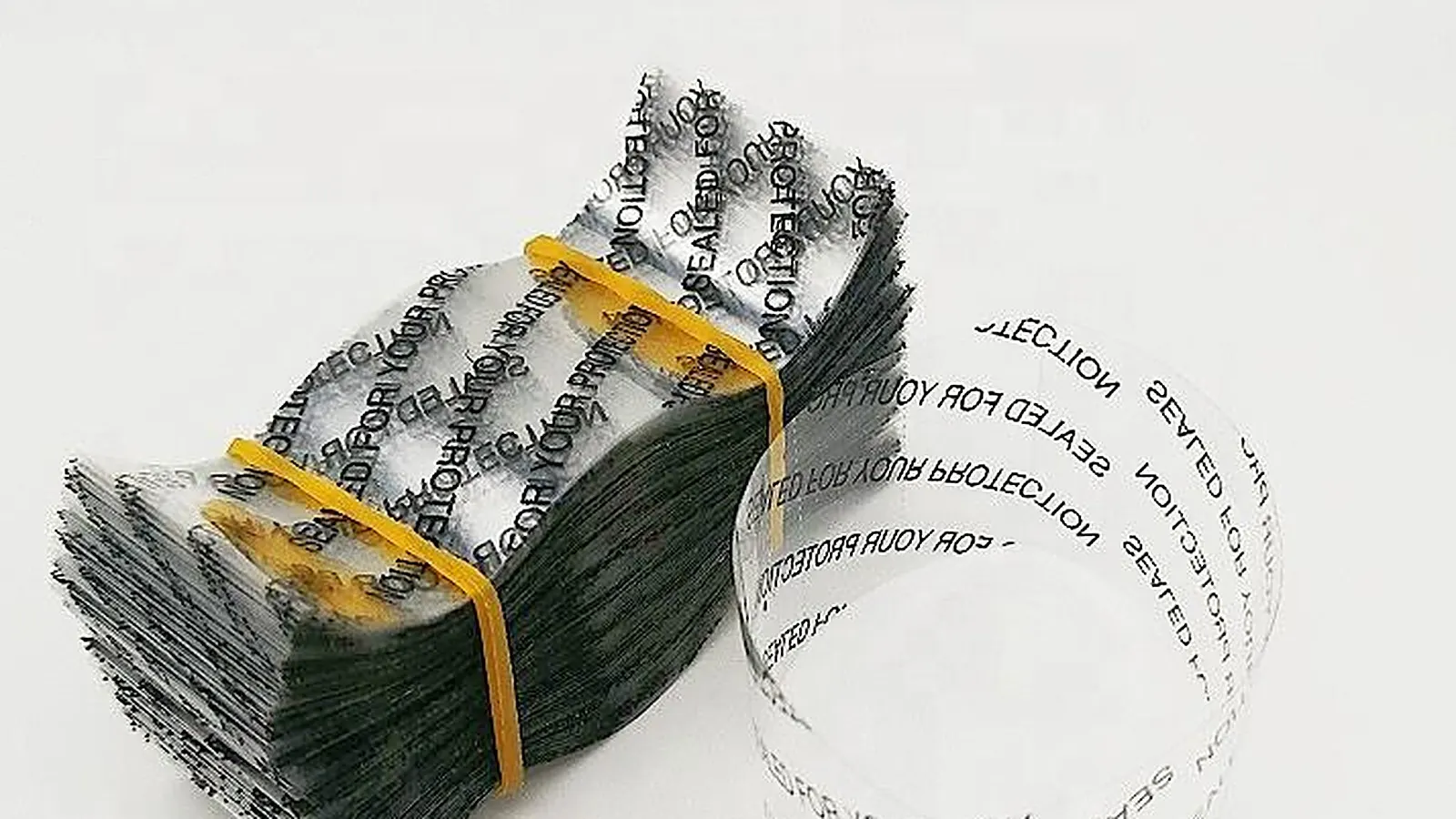
The listing below is the band side of the comparison: clear perforated PVC, sold by the ten thousand.
Questions to ask a cap supplier
-
Is this tamper-evident cap a stock item in my finish, and what is the minimum?
-
What is the liner, and is it the same as on the plain cap?
-
Is the ring moulded or slit, and how hard is it to open for an older customer?
-
Has it been tested on my bottle neck, and where does the ring sit?
-
Will it work with an induction liner underneath?

Clear perforated PVC shrink bands
Plain clear PVC bands with a perforation line, priced by quantity rather than by the bag.
- Role: Alibaba sourcing candidate
- Clear PVC
- Perforated
- From 10,000 pcs
- MOQ: From 10,000 pieces
Common mistakes
-
Comparing a case price with a bag price. Convert both to cost per bottle.
-
Forgetting the minimum order. It can turn a cheap cap into an expensive first run.
-
Assuming the ring is the same kind of evidence as a band. One stays on the bottle. The other is torn off.
-
Ignoring the finish. A 38 mm cap is not a 38/400 cap.
-
Treating either as a regulatory shortcut. FDA says the technology alone does not make a package compliant [8].
FAQ
Is a tamper-evident cap cheaper than a shrink band?
On the Uline example priced here, the ring cap costs the same as a plain cap, so it undercuts plain cap plus band by about 3 cents [1][2][3]. Minimums and special orders can change that.
Can I use both?
Yes. Many supplements use a ring or liner under the cap and film on top.
Does a band replace an induction seal?
No. See [shrink bands vs induction seals].
Which is easier to open?
The sources reviewed show no comparison. A closure maker says slit bands are usually easier to open than moulded ones [4]. Test with the people who will use it.
Which do shoppers trust more?
The sources reviewed show no study. Test it on your own customers.
References
- Uline, Tamper-Evident Caps (subgroup 2806) and model S-25947, 38/400 white. uline.com (supplier catalogue; prices as displayed 18 November 2026).
- Uline, Ribbed Polypropylene Caps, model S-18061 and price list. uline.com (supplier catalogue; prices as displayed).
- WebstaurantStore, 66 x 25 mm and 66 x 50 mm clear perforated shrink bands for 38 mm caps. webstaurantstore.com (food-service supplier; prices as displayed).
- Des King, “Tampering with the evidence”. nspackaging.com (trade analysis; undated; quotes from Bericap, Fuji Seal and others).
- Bericap, 28X38 D EPE aluminium roll-on closure. bericap.com (manufacturer product page).
- Berlin Packaging, 30 x 60 Tin Tamper-Evident ROPE Caps; Vigo Presses, 28 x 18 mm Pre Threaded Aluminium Closures. berlinpackaging.com, vigopresses.co.uk (supplier pages).
- Kaufman Container, 28-400 White PP Plastic Caps; Oberk, 28 mm Black Rib Side tamper-evident closure; Chalco, 8011 aluminium cap. kaufmancontainer.com, oberk.com, chalcoaluminum.com (supplier pages; minimums as stated).
- U.S. Food and Drug Administration, CPG Sec. 450.500, Tamper-Resistant Packaging Requirements for Certain OTC Human Drug Products. fda.gov (regulatory guidance; partly read).
- CalPac Lab, Dynalon Tamper Evident Bottles, single-use tear-off cap ring. calpaclab.com (supplier listing).
Continue reading
Foamer Pumps: Dilution, Viscosity and Bottle Fit Guide
A foamer pump does not make foam from a thick liquid. It mixes air into a thin one, and the dilution is decided before the pump is ever fitted.
Clear, Black or Printed Stock Shrink Bands: Which to Buy?
The colour of a band changes four things: what the customer notices, what it hides, which sizes you can get, and whether it tears open cleanly.
Shrink Bands vs Shrink Wrap Bags: Which Should You Use?
A band is an open tube and a bag is a closed one. Most of the decision follows from that, and so does the equipment you need.