Shrink Bands for Pump and Spray Bottles: What to Seal and What Size
A pump or sprayer is not a cap, so the band has to bridge a collar seam, cover a hood, or be skipped entirely. Here is where the band goes, what suppliers recommend, and where the published advice runs out.
 Lena Schmidt
In this guide
- Why a pump is not a cap
- Four ways to seal a pump or sprayer
- What a major supplier tells its own customers
- Sizes sellers publish for 20 and 24 mm tops
- The shoulder problem
- Locked pumps and the extra height
- Sprayers with hoods and built-in evidence
- Heat near pumps and sprayers
- A five-bottle trial
- When to skip the band
- Questions to ask a supplier
- What the customer does when the bottle arrives
- Where to buy a sample pack
- What the bands cost
- Keeping the fit consistent between orders
- FAQ
- References
Quick answer. Decide first what the band is meant to seal. On a pump or fine-mist sprayer you can band the collar-to-neck seam, band over a hooded sprayer, or skip the band and ship the pump separately under a plain cap, which is what Wholesale Supplies Plus suggests for its 20/410 lotion pump. Published sizes for 24/410 tops are small: US Plastic lists 48 mm wide bands in 25 mm and 52 mm heights for roughly 24 mm caps, and Wholesale Supplies Plus lists a 57 x 55 mm band for 24/410 caps and notes it may not clear the bottle shoulders. The finish numbers describe the thread, not the pump head, so measure the widest part you want covered, then test five bottles.
Why a pump is not a cap
The sizing arithmetic for caps assumes a closure with a flat or domed top: a flat or domed top that a band can cover completely. A lotion pump or fine-mist sprayer is a different object. It has a collar that threads onto the neck, a stem and a head that moves, and in many cases an overcap or hood. A band that fits the collar will not cover the head, and a band wide enough to cover the head may not fit the collar. You have to choose which part of the closure the customer must break to get in.
The thread code on the product page does not settle this. One supplier guide explains that in a code like 24/410 the first number is the neck diameter in millimetres, and that a 24/410 pump will not fit a 24/400 bottle even though the diameter is the same. That is useful for buying the pump. It says nothing about how wide the collar or head is on the outside, and that is the number a band depends on.
Four ways to seal a pump or sprayer
The table sets out the options sellers describe or imply. Which one suits you depends on whether the bottle is shipped, sold in person or given as part of a kit.
| Approach | How it works | Trade-off |
|---|---|---|
| Band the collar-to-neck seam | A short band shrinks over the collar and the top of the bottle | Needs a bottle with a neck or shoulder for the film to grip; leaves the head uncovered |
| Band over a hooded sprayer | Band covers the clear overcap and the collar | Needs a taller band; check the overcap stays seated |
| Ship the pump separately | Bottle gets a plain cap and band; pump goes in the box | Wholesale Supplies Plus recommends it; customer must fit the pump |
| Use a closure with built-in evidence | Some sprayer listings include a break-off band or tamper feature | Read the listing; terms vary by supplier |
What a major supplier tells its own customers
Wholesale Supplies Plus has answered this question in public, and its answers are the most useful primary evidence found. Asked whether it has a shrink wrap for its 20/410 lotion pump tops, it recommended packaging the pump separately and using a basic cap on the lotion bottle, because shrink wrap is easier to apply to a bottle with a cap. That is a candid statement that its own pump is awkward to band.
Asked about a 20/410 fingertip mist sprayer, it said that if you are shrinking just the cap, a 40 x 40 mm band works best, and that if you are shrinking part of the bottle as well, you need a size large enough to fit over the bottle. Asked about a 24/410 spray mist closure on a 2.5 oz aluminum bottle, it pointed to its 57 x 55 mm band. For a sprayer top on a 4 oz Boston round bottle, it pointed to 80 x 55. The pattern is clear: the size depends on how much of the bottle you want covered.
Reviewers add a few real-world notes. One uses the 48 x 27 mm band on pump lotion bottles and likes that it is small and discreet. Another shrinks the 57 x 55 band around the tops of spray and pump bottles. These are individual comments, and they say the bands work for them, not that the bands are right for your bottle.
Sizes sellers publish for 20 and 24 mm tops
The table lists the sizes that tie to a stated cap or jar size, with the minimum lay-flat width from the rule used throughout the series (pi times diameter, divided by two) and the resulting slack. The ranges are the suppliers’ own wording, and they describe jars and caps, so treat them as a starting point for a pump collar, not a match.
| Band (supplier) | Stated fit | Min. lay-flat | Spare | Unshrunk dia. |
|---|---|---|---|---|
| 48 x 25 mm (US Plastic) | About 24 mm cap | 38 mm | 27% | 31 mm |
| 48 x 52 mm (US Plastic) | About 24 mm cap | 38 mm | 27% | 31 mm |
| 48 x 52 mm “Sealed” (US Plastic) | 20 to 26 mm cap | 31 to 41 mm | 53% to 18% | 31 mm |
| 57 x 55 mm (Wholesale Supplies Plus) | Jars 1.1 to 1.25 in; 24/410 cap | 44 to 50 mm | 30% to 14% | 36 mm |
| 50 x 55 mm (Wholesale Supplies Plus) | Jars 0.75 to 1 in | 30 to 40 mm | 68% to 25% | 32 mm |
Stated fit from supplier listings; minimum lay-flat, spare width and unshrunk diameter are calculated from the lay-flat figures. Part sizes are read as millimetres, width by height.
Notice how generous the spare width is compared with the 4 to 15 percent typical of neck-band pairings. The supplier ranges cover a spread of cap diameters, so the same band has plenty of slack at the small end. That is fine for a smooth cap and forgiving in practice, and it may produce more wrinkles on a narrow collar. A tighter match is worth testing if the first batch looks loose.
The shoulder problem
The Wholesale Supplies Plus answer on its 57 x 55 band carries a warning that matters for pump bottles: it fits over a 24/410 basic cap, but depending on the bottle, the shrink wrap may not fit over the shoulders. A band tall enough to cover a collar and neck may sit on the shoulder, where the glass or plastic widens. Film that is stopped by the shoulder either rides up and wrinkles or does not slide on.
Short bands, such as the 25 mm and 27 mm heights listed above, are one way around this. A short band stays on the collar and the neck, above where the bottle begins to widen. It cannot cover the head, but it can still show that the collar has been turned. A taller band suits a bottle with a straight, narrow neck. Look at your bottle’s side profile before you choose a height, and place the band on the empty bottle to see where the film would stop.
Locked pumps and the extra height
Many lotion pumps have a lock. Wholesale Supplies Plus lists a 24/410 saddle pump with the distance from the bottle top to the locked pump top at three quarters of an inch, about 19 mm, and to the unlocked pump top at one and a half inches, about 38 mm. That difference of roughly 19 mm is the stroke of the head.
If you want a band that covers the head as well as the collar, the locked height is the number that matters, because that is how the product will sit on the shelf. If the lock fails or the customer presses the head through the film, you will have a defect, not a fault in the band. This is reasoning from the listed heights, not a supplier recommendation. For pumps with a twist-lock ring, test that the lock still turns after banding and that the film does not trap the ring.
Sprayers with hoods and built-in evidence
Fine-mist sprayers are often sold with a clear overcap or hood. One bottle packaging distributor describes a 24-410 fine mist sprayer with a clear overcap and, in the same listing, a lock-on tamper-evident break-off band. The listing does not say exactly what that band is, so check the description before assuming it is a shrink band. If the closure already includes a break-off feature, an extra shrink band may be redundant, and it adds cost.
Where the sprayer has only a loose hood, a band that grips the hood and the collar both keeps the hood from being lifted off. Industrial lines do the same thing with machines: Deitz Co. describes a neck bander that applies bands to spray bottles, with the tunnel shrinking them downstream. For a small seller the principle is the same, only done by hand.
Heat near pumps and sprayers
The general technique for heat applies here: start far away, keep the gun moving, rotate the bottle. A pump adds two concerns. First, most collars and heads are plastic, and TricorBraun warns that excess heat can melt or deform plastic bottles, jars and closures. Second, a pump has a spring and a seal inside. No supplier source reviewed gives a safe temperature for either, so what follows is a precaution, not a rule: lock the pump before heating, keep the gun away from the head, and test that the pump still primes and the lock still works afterwards.
Check a banded bottle for leaks by laying it on its side for an hour on a paper towel. A pump that leaked after banding is a pump you should stop heating.
A five-bottle trial
Buy a sample of two heights, one short seam band and one taller. Take five empty bottles with the real pumps, locked. Slide each band on, shrink it, and check that it sits flat, grips both the collar and the neck, and tears cleanly. Then check the pump: does it unlock, does it prime, does it leak. Record the result next to the band size and the heat setting.
If the short band holds and the pump works, you have your answer. If the band slides, the bottle may lack a neck bead, which no heat will fix, and a plain cap with a band and a separate pump may be the better design.
When to skip the band
A band adds a few cents and a few seconds. For a pump bottle sold in a box with the pump separate, it may be the only tamper evidence you need. For a bottle with a built-in break-off band, it may add nothing. For a mist sold in person where the customer wants to test the spray, a band defeats the purpose, and a sticker across the hood may do better. Our comparison of bands and tamper stickers covers that choice.
Questions to ask a supplier
Ask for the outer width of the collar and the head in millimetres, not just the thread code. Ask whether the closure has a built-in tamper feature. Ask for the lay-flat width and height of any band they recommend, and whether the film suits a heat gun. And ask for samples of the pump and the band together, so you can test the pair.
What the customer does when the bottle arrives
A band on a pump bottle changes the first thirty seconds of use. The customer has to find the tear line, remove the film, unlock the pump if it has a lock, and prime it. If the band covers the head and the tear line is hard to find, the first impression is a struggle. Tell people what to do: a small line on the label or a card in the box saying “tear the band at the notch, then twist the collar to unlock” costs nothing and heads off a complaint.
Think also about what happens to the film afterwards. A customer who tears a band off a pump bottle is left with a small loop of plastic, and the more you add to a product, the more there is to throw away. Our recyclability guide covers what suppliers and standards bodies actually say about that, and it is worth reading before you make any green claim about a band.
Where to buy a sample pack
The trial above needs two band heights in small quantities, which is what a mixed sample pack is for rather than a case of one size.
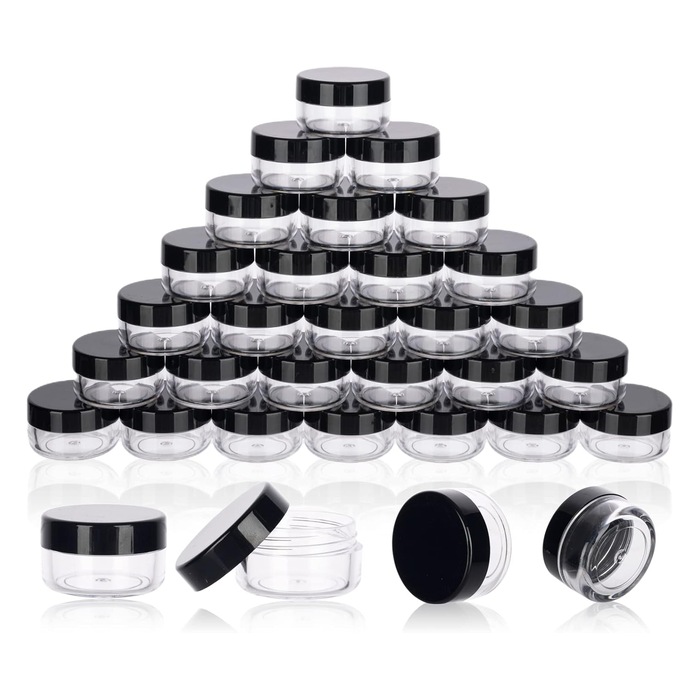
Shrink band assorted sample pack, small and medium
A mixed pack of small and medium bands, sold for containers in this size range.
- Role: Amazon consumer option
- Assorted sizes
- Small and medium
- Sample pack
- MOQ: Check current listing
What the bands cost
Wholesale Supplies Plus shows the 48 x 27 mm band at 100 pieces for 2.28 dollars, which it states as 2 cents each, and the 50 x 55 mm band at 50 pieces for 8 cents each. The 57 x 55 mm band is listed at 2.98 dollars, and the page excerpt does not state the quantity, so a per-piece price cannot be given. These are retail small-pack prices and will differ from wholesale or factory quotes.
On a pump bottle that sells for a few dollars, a band at 2 to 8 cents is a small line item. The cost that matters more is the batch you lose to a bad fit, and for a pump the more important saving is not buying a case of the wrong height. That is why the five-bottle trial comes before the case.
Keeping the fit consistent between orders
Pumps are injection-moulded parts, and two production runs of the same 24/410 pump can differ in collar width, ribbing and head shape. Keep one finished bottle from every batch with a note of the pump supplier, the band size and the heat setting. When you reorder pumps, measure the collar of a few from the new case before you reorder bands. If you change pump supplier, treat the band as untested again, even if the thread code is the same.
FAQ
What size shrink band fits a 24/410 lotion pump?
Suppliers list 48 mm wide bands for roughly 24 mm caps and a 57 x 55 mm band for 24/410 caps. Treat them as starting points and test with your pump.
Can you shrink-wrap over a pump head?
Only with a tall enough band, and the lock should be engaged. No supplier document reviewed states it for a specific pump.
Does a 24/410 band fit a 20/410 neck?
Not necessarily. Wholesale Supplies Plus suggests a 40 x 40 mm band for a 20/410 mist sprayer cap.
Is it better to ship the pump separately?
One supplier recommends it for its 20/410 pump, because banding a plain cap is easier.
References
Continue reading
Shrink Bands for Child-Resistant Caps: How to Size Them
A push-and-turn cap is wider than a plain screw cap, so the band that fits the thread size usually does not fit the closure.
Shrink Capsules for Wine Bottles: Sizes, Heat and Fit
A capsule is sized by diameter, not lay-flat width, and that one difference causes most wrong orders. Here are the sizes sellers publish, how to measure your own bottle, which heat source works by hand, and what goes wrong.
Shrink Bands for Lip Balm Tubes: Sizes and Perforations
The width is the easy part. Height and the direction of the perforation decide how the tube opens and whether the cap comes off cleanly, and listings rarely say which you are buying.