Shrink Capsules for Wine Bottles: Sizes, Heat and Fit
A capsule is sized by diameter, not lay-flat width, and that one difference causes most wrong orders. Here are the sizes sellers publish, how to measure your own bottle, which heat source works by hand, and what goes wrong.
 Lena Schmidt
In this guide
- How is a capsule different from a shrink band?
- Which sizes are sold, and what do sellers say they fit?
- How do you check your own bottle?
- Do you need a capsule at all?
- Which heat source works best by hand?
- What goes wrong, and how do you fix it?
- A simple routine for a case or two
- What do capsules cost?
- PVC, polylaminate or tin?
- Where to buy the capsules
- What should you look for in a listing?
- FAQ
- References
Quick answer. Most cork-finished 750 ml wine bottles take the capsule sellers call “standard”, listed as 30 x 55 mm or within half a millimetre of it. Bottles with a thick lip need the 32 x 60 mm size, and screw-cap or bar-top bottles are usually sold a 31 mm capsule. Those first numbers are diameters, so do not compare them with shrink band widths. Capsules shrink with a quick dip in boiling water, a hair dryer or a heat gun on low. No source reviewed says a capsule is legally required; it is a finish, and a modest tamper signal.
How is a capsule different from a shrink band?
Three things matter in practice.
It is sized by diameter. A shrink band is sold by lay-flat width, which is the width of the flattened tube. A capsule is sold by the diameter of the opening and its height. A capsule of 30.5 mm diameter has a circumference of about 96 mm, so flattened it would measure roughly 48 mm across. Someone who reads “30 mm” as a lay-flat width will expect something far smaller than what arrives.
It has a top. A band is an open ring. A capsule is a cup with a disc on top, so it covers the cork as well as the neck. Air has to escape as it shrinks, which is why one packaging maker offers optional holes in the top to release air during application [8].
It is slightly tapered. One distributor lists its 30 x 55 mm capsule as 30.5 mm across the top and 32 mm across the bottom [2]. The wider skirt helps it slide over the lip. It also means the number in the product name is the narrow end.
Which sizes are sold, and what do sellers say they fit?
| Listed size | What the seller says it fits | Source |
|---|---|---|
| 29.5 x 55 mm | Standard wine bottles and corks | Homebrew retailer [5] |
| 30 x 55 mm | Standard cork-finished bottles; one brand adds screw tops and T-top corks | Presque Isle Wine Cellars [1], LD Carlson listing [3] |
| 30.5 x 55 mm (32 mm at the skirt) | Standard wine bottles | The Cary Company [2] |
| 30 x 60 mm | Cork finish, longer skirt | Presque Isle Wine Cellars [1] |
| 31 x 55 mm | Screw-cap bottles and some cork-finish bottles closed with a bar top | Presque Isle Wine Cellars [1] |
| 32 x 60 mm | Bottles with thick necks and wide lips; the seller says most 1 litre bottles | Homebrew retailer [5] |
| 34 x 123 mm | Champagne and sparkling bottles | Creopack [9] |
Notice the first three rows. “Standard” is 29.5, 30 or 30.5 mm depending on who is selling. The half millimetre is rarely the problem, because the film shrinks far more than that. The step that matters is from the 30 mm family to 31 or 32 mm, which exists for closures and lips that the standard capsule will not pass over.
One more caution comes from a buyer of a bargain multi-colour pack, who reported that the gold capsules were several millimetres wider than the black and burgundy ones in the same order [7]. It is a single review, but it is a good reason to slide a few capsules from each colour onto a bottle before a bottling day.
How do you check your own bottle?
No source was found a supplier table that maps bottle models to capsule sizes, so measure. You need calipers, or a strip of paper and a ruler.
-
Close the bottle the way you will sell it: cork driven flush, bar top seated, or screw cap on.
-
Measure the widest point the capsule has to pass. On a corked bottle that is the glass lip. On a bar-top bottle it may be the head of the stopper.
-
Pick the capsule whose listed diameter is a little larger than that figure. The capsule has to slide on without force, and the shrink takes up the slack.
-
Measure from the top of the closure down to where you want the skirt to end. A 55 mm capsule ends higher on the neck than a 60 mm one. If the fill level shows below the skirt and that bothers you, choose the longer size.
A reviewer makes the point about step one bluntly: make sure the cork is flush, and the result looks professional [7]. A cork standing proud leaves a bump under the top disc that no amount of heat will hide. Our general shrink band size guide covers the paper-strip method if you have no calipers.
Do you need a capsule at all?
Probably not for any legal reason. No source states that capsules are required on wine, and the page on whether shrink bands are required by law explains which products do carry a federal tamper-evident rule. Wine is not among them in the sources reviewed. We did not research alcohol labelling rules, which are a separate subject.
What a capsule does is more modest. A wine club’s explainer says the original purpose was to keep rodents and insects away from the cork in long storage, and that capsules also catch drips and decorate the bottle [12]. A South African trade magazine goes further and calls the modern capsule’s role largely aesthetic and symbolic [13]. A distributor quoted in a US trade magazine adds tamper evidence to the list for heat-shrink PVC capsules [10].
There is one piece of law in the capsule’s history. Capsules used to be made of tin-coated lead foil, and FDA prohibited those on wine bottles from 8 February 1996 because lead could end up in the wine [11]. If you reuse very old bottles, remove any old metal foil completely and wipe the lip before filling.
Which heat source works best by hand?
Suppliers list the same handful of methods, and they do not fully agree on which is best.
Boiling water. Presque Isle says a quick immersion in boiling water works [1], and the LD Carlson listing leads with it [3]. One buyer describes the routine: hold the capsule down on the bottle with a silicone oven mitt and dip the neck into water that is almost boiling [7]. Water heats every side at once, which is why it tends to give an even result. Keep the dip short and dry the bottle before labelling.
Hair dryer. Listed by several sellers [3], and WineMaker magazine counts a blow dryer among the three ways to apply PVC capsules [6]. It is slow. That can be a virtue: one reviewer found a heat gun on low pulled capsules crooked and went back to a hair dryer for a straight finish [7].
Heat gun. Presque Isle specifies a heat source of 350 to 400°F and names a paint-stripping gun as one option [1]. A buyer of 31 x 45 mm capsules reports that the lowest setting on a heat gun is enough [7]. Start low, keep the gun moving around the neck, and work from the top down so air can leave through the open skirt.
Heat tunnel or bench capsuler. Presque Isle calls a tunnel the best method for a smooth result [1], and the WineMaker author prefers one too [6]. It is a purchase for people bottling hundreds at a time. Our heat gun vs hair dryer vs heat tunnel comparison covers when that step makes sense.
A tip that appears in more than one review: press down lightly on the top of the capsule, or pull the skirt down, while the first heat goes on, so the disc sits flat on the cork before the sides grip [7].
What goes wrong, and how do you fix it?
-
Crooked capsule. Usually heat from one side. Rotate the bottle, lower the setting, or switch to hot water.
-
Wrinkled or flared skirt. The bottom edge got less heat than the top. Finish with a slow pass around the skirt.
-
Domed top. Air was trapped under the disc. Hold the top down as you start, and consider capsules with vent holes [8].
-
Splits or burst tops. One buyer of a cheap pack reported thin film, no tear tab and tops that arrived broken [7]. A seller of Italian-made capsules claims thicker film resists tearing better; that is a seller’s claim it was not possible to check [5].
-
Will not slide on. The lip or stopper is wider than the capsule. Move up to 31 or 32 mm.
If a capsule goes wrong, cut it off and use a new one. Reheating a badly shrunk capsule rarely improves it. More symptoms are covered in shrink band problems and fixes.
A simple routine for a case or two
This is the suggested order of work, assembled from the supplier instructions and reviews above. It is not a tested procedure, so try it on three bottles first.
-
Bottle and close everything, then wipe the necks dry. Label later; water and steam can lift a fresh label.
-
Stand the bottles upright for a few minutes after corking so the corks settle, and check that each one is flush.
-
Drop a capsule on every bottle before you heat any of them. A capsule that will not slide on is easier to deal with now than with a kettle in your hand.
-
For hot water, bring a small pan to the boil and take it off the heat. Hold the capsule down, invert the bottle and dip the neck for a second or two until the film grips [1][7]. For a heat gun or hair dryer, hold the top down, heat the top edge first and then circle downward.
-
Stand each bottle upright and leave it alone until the film has cooled. Handling a warm capsule can twist it.
-
Check the tear tab on the first few. It should lift without a knife.
Keep spare capsules in their box, out of sunlight and away from heat. They are thin, hollow and easy to crush, and a dented capsule will not shrink round. Our guide on how to store shrink bands applies here too.
What do capsules cost?
Small packs are priced for hobbyists. Two homebrew listings offered 100 standard or large capsules for $11.95 and $12.95, which is 12 to 13 cents each [5]. A 30-pack at $10.33 works out near 34 cents each [4]. A trade magazine quotes the wholesale picture for wineries: $25 to $40 per thousand for PVC, $40 to $60 for polylaminate and $275 to $450 for tin [10]. So PVC is about 3 to 4 cents a bottle at volume, and the hobby premium is mostly packaging and postage. Prices were as displayed at the time of checking and will move.
PVC, polylaminate or tin?
If you are applying by hand, the choice is made for you. WineMaker notes that tin, polylaminate and aluminium capsules are applied with a spinner, a machine that rolls the metal onto the neck, while PVC is the type home winemakers use because it shrinks with simple heat [6]. Tin sits on expensive bottles; the wine club’s explainer says many wineries selling at $20 or less have moved to plastic [12]. A UK supplier also lists PET capsules alongside PVC [14]. If avoiding PVC matters to you, ask for those, and ask what changes under heat.
Where to buy the capsules
The listing below is the type the sizes above describe: 30 x 60 mm and 35 x 55 mm PVC capsules, sold customised with your own print.
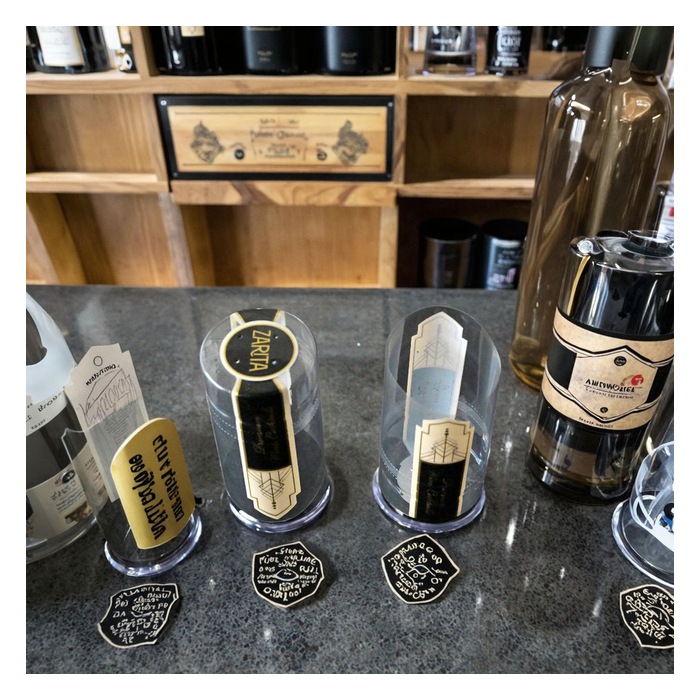
Custom-printed PVC wine bottle capsules, 30 x 60 mm
PVC capsules in the 30 x 60 mm and 35 x 55 mm sizes that cover standard wine, spirits and champagne finishes, supplied with your own print.
- Role: Alibaba sourcing candidate
- 30 x 60 mm
- 35 x 55 mm
- Custom print
- MOQ: From 10,000 pieces
What should you look for in a listing?
-
Diameter and height in millimetres, and whether the diameter is the top or the skirt.
-
The closure it is meant for: cork finish, bar top or screw cap.
-
A tear tab. Most listings mention one [3]; a capsule without it has to be cut off with a knife.
-
Vent holes in the top, if you have had domed tops before.
-
Pack size and how it ships. One seller makes a point of boxing capsules so they arrive uncrushed [5].
-
A top disc you can live with. Many stock capsules carry a grape motif or a pattern that may not suit mead, oil or vinegar.
FAQ
Will a standard capsule fit a 375 ml or 1.5 litre bottle?
One listing says its capsule fits standard 375 ml, 750 ml and 1,500 ml bottles [4]. Neck finishes vary by maker, so measure before trusting it.
Can I use a capsule on a screw-cap bottle?
Sellers offer a 31 mm capsule for that purpose, and one brand says its 30 mm capsule fits screw tops too [1][3]. Check that the capsule clears the cap’s knurled edge.
Does a capsule stop the cork drying out or leaking?
No source reviewed claims a shrink capsule seals the bottle. It covers the cork; the cork does the sealing.
Can I use capsules on sauce or vinegar bottles?
At least one seller markets them for vinegar and sauce as well as wine [5]. Measure the lip as above.
Is boiling water safe for the wine?
The dip lasts a moment and touches only the neck. No source was found for a source measuring any effect, so keep it brief.
References
- Presque Isle Wine Cellars, Plastic Heat-Shrink Capsules, cork finish (30 x 55 and 30 x 60 mm) and screw cap finish (31 x 55 mm) product pages. piwine.com (winemaking supplier).
- The Cary Company, Gold PVC Capsules, 30 x 55 mm, case of 100. thecarycompany.com (packaging distributor).
- LD Carlson PVC shrink capsules, regular size 30 x 55 mm, as listed on Walmart Marketplace and homebrewing.org (brand and retail listings).
- Walmart Marketplace listings for PVC shrink capsules: Home Brew Ohio 30-count pack and a 30.5 x 55 mm capsule-and-stopper kit. walmart.com (marketplace listings; price as displayed when checked).
- Hobby Homebrew and the same seller’s storefront, Winery Quality Shrink Caps 29.5 x 55 mm and Large 32 x 60 mm capsules. hobbyhomebrew.com (homebrew retailer; seller claims).
- WineMaker Magazine, article on capsule types and application for home winemakers. winemakermag.com (hobby trade magazine).
- Buyer reviews of PVC shrink capsules on marketplace listings, viewed via Desertcart. desertcart.com (individual reviews; each cited point rests on one reviewer).
- Hauser Packaging, PVC Capsules product page. hauserpack.com (packaging maker).
- Creopack, shrink capsule product pages (34 x 123 mm champagne capsule and others). creopack.se (packaging supplier).
- The Grapevine Magazine, There’s a Closure for That. thegrapevinemagazine.net (trade magazine quoting distributors).
- U.S. Food and Drug Administration, Tin-Coated Lead Foil Capsules for Wine Bottles, final rule, 61 FR 4816, 8 February 1996; 21 CFR 189.301. govinfo.gov (government).
- The California Wine Club, What Are Wine Bottle Capsules? cawineclub.com (wine retailer blog).
- WineLand Magazine, The overlooked aesthetics of wine capsules. wineland.co.za (trade magazine).
- Croxsons, Capsules. croxsons.com (packaging supplier).
Continue reading
Shrink Bands for Child-Resistant Caps: How to Size Them
A push-and-turn cap is wider than a plain screw cap, so the band that fits the thread size usually does not fit the closure.
Shrink Bands for Lip Balm Tubes: Sizes and Perforations
The width is the easy part. Height and the direction of the perforation decide how the tube opens and whether the cap comes off cleanly, and listings rarely say which you are buying.

Shrink Bands for 10 ml Roller Bottles: Reading Size Listings Without Guessing
Roller-bottle bands are listed in confusing ways: width and height swap places, and the thread code tells you nothing about the cap. Here is how to read a listing, what sellers publish, and what to test.