Squeeze Tubes: Fill Size and Sealing for Small Brands
A tube is filled from the open tail, not the cap end. That one fact decides the size you buy, the sealer you need and where the leaks appear.
 Lena Schmidt
In this guide
- How do you choose a tube size?
- How is the open end sealed?
- Which tube material and cap?
- What does the equipment cost?
- Where to buy the sealing equipment
- What goes wrong at the seal?
- Filling the tube by hand
- Tubes with a foil seal under the cap
- A trial before you buy a machine
- Questions to ask the supplier
- Common mistakes
- FAQ
- References
Quick answer. A plastic squeeze tube arrives open at the bottom. You fill it through that end, then weld the walls together. Hot-air sealers do this on most plastic and laminate tubes, ultrasonic sealers can seal through a little product in the seam, and impulse sealers are cheap but rarely give a neat finish. Pick the size by diameter and length: a 19 mm tube between 60 and 90 mm long holds about 7 to 15 ml, and 35 mm tubes hold roughly 53 to 118 g depending on length (Daiwa Can). A manual hot-air sealer on one maker’s sheet does up to 300 tubes an hour. Before buying equipment, fill ten tubes by hand, seal them on a borrowed or contract machine, and squeeze-test them for leaks and burst.
How do you choose a tube size?
Two numbers decide the capacity: the diameter and the length. Suppliers list these together, though they do not all measure content the same way. Daiwa Can gives content volume in grams, with a 19 mm round tube between 55 and 105 mm long holding 9 to 22 g, a 25 mm tube 21 to 44 g, and a 35 mm tube 53 to 118 g [10]. Emballator lists a 19 mm extruded tube at 60 to 90 mm long for volumes of 7 to 15 ml [11]. A listing from the supplier La Cazadora puts 19 mm tubes at 60 mm for 10 ml, 106 mm for 22 ml and 141 mm for 30 ml [12].
| Tube diameter | Length range | Stated content | Source |
|---|---|---|---|
| 19 mm | 55 to 105 mm | 9 to 22 g | Daiwa Can [10] |
| 19 mm | 60 to 90 mm | 7 to 15 ml | Emballator [11] |
| 25 mm | 70 to 120 mm | 21 to 44 g | Daiwa Can [10] |
| 35 mm | 90 to 160 mm | 53 to 118 g | Daiwa Can [10] |
| 19 mm aluminum | 85 to 130 mm | 15 to 25 ml | Alltub [13] |
Ranges as stated by each maker. Grams and millilitres differ by the density of the product, so do not mix the units without checking.
Read the table with care. The ranges for the same 19 mm diameter overlap but do not match, because makers count the neck and the crimped end differently. A tube sold as 15 ml holds that much with a normal headspace; if you fill it to the brim there is no clean zone for the seal. Ask for the filling volume, not only the nominal size, and confirm it with your own product by filling a sample.
Diameter also decides what else fits. Tuboplast lists diameters of 19, 22, 25, 30, 35, 40, 50 and 56 mm with a capacity of 5 to 350 ml, flip-top caps from 30 mm, and a foil seal on the orifice for diameters from 25 mm up [15]. C. L. Smith lists squeeze tubes from 0.5 to 2.375 inches in diameter and 0.125 to 13.5 fluid ounces [16]. The orifice and the cap are what the customer touches, so pick them for the product: a thin gel wants a small orifice, and a paste wants a wide one. Tuboplast lists orifices from 1 mm to 14.4 mm, though not all of them for every diameter [15].
How is the open end sealed?
Plastic tubes are normally sealed by heat or ultrasonic welding after the product has been put in through the open end, according to A Packaging Group [1]. The common methods differ in speed, finish and cost.
| Method | How it works | Notes from the sources |
|---|---|---|
| Hot air | Hot air blown into the open end softens the walls, then jaws crimp them together [2] | The most common method and used on most materials [4]. Hot air can raise the temperature of the fill slightly [5] |
| Ultrasonic | Vibration creates local heat in compatible plastics [1] | Needs fewer change parts and can seal through some product contamination, but is slower [3]. Poor on foils and laminates [4] |
| Hot jaw | Heated jaws clamp the outside of the tube [3] | Less efficient than hot air [3]; suits plastic-only tubes [5] |
| Impulse | Heat and pressure from a sealing bar [4] | Lightweight and portable but typically used for lab testing and not the most attractive seal [4] |
| Fold and crimp | Mechanical folding of the end, no heat [8] | Only for aluminum tubes; less refined than hot air [5] |
Two points stand out. First, the tube material decides the method. Ultrasonic works well on plastics but not on foils and laminates [4], while hot air handles most types [4]. So the sealer you buy has to match the tube you buy. Second, hot air has a small side effect: a little hot air goes into the tube and can warm the fill [5]. If your product is a heat-sensitive balm or an emulsion that separates on warming, that is worth testing, and it is a reason to leave the seal zone clear.
An equipment maker adds that each diameter needs its own change parts on a hot-air machine [3]. If you plan to sell in more than one diameter, count those parts in the cost.
Which tube material and cap?
Material choices change both the feel and the sealing. Emballator lists extruded tubes in HDPE, MDPE, LDPE, LLDPE, bio-based PE, coextruded and recycled-content versions [11], and Tuboplast offers all-PP, coextruded (from 19 mm), monolayer and recycled options [15]. La Cazadora sells the same 19 mm size as a monolayer or a coextruded tube [12]. A softer material squeezes easily; a coextruded wall can add a barrier layer. MSD notes that tube material may come with or without an EVOH barrier and that each material reacts differently to hot air [5], so the choice is also a sealing decision. Ask the supplier which sealing method it has proven on the structure you pick.
Caps vary by diameter. Tuboplast lists flip-top caps from 30 mm, a membrane flip-top at 50 mm, a safety cap at 50 mm, metal caps only at 35, 40 and 50 mm, and standard screw-on caps [15]. A small 19 mm tube therefore has fewer cap choices than a 35 mm tube. If you have a design in mind, check the cap is offered at your diameter before you fall in love with it.
Put the choices on one page before you order: diameter, length, material, orifice, cap, seal method, filling volume and the net content you will print. Any supplier worth keeping will fill in the gaps, and the page becomes the spec you reorder from.
What does the equipment cost?
Prices at the low end are scattered, and many listings omit them. A few reference points.
| Equipment as listed | Output | Price or note |
|---|---|---|
| Axomatic AXO 30, manual hot-air sealer [7] | Up to 300 tubes per hour | No price stated |
| Adelphi Vesta 1C laboratory sealer [6] | Up to 4 per minute; 10 to 50 mm tubes | No price stated; seals, trims and codes |
| Manual tube sealers, Indian marketplace listings [18] | 200 to 300 tubes per hour (one listing) | About 24,500 to 28,000 rupees for the manual models listed (marketplace; unverified) |
| Zonesun automatic fill and seal machine [8] | Automatic | From $13,899, as displayed |
Prices as displayed on the cited pages. The marketplace listings are from sellers with no verified specifications; treat them as a rough floor, not a quote.
The gap between a manual sealer and an automatic line is large, and the forum view of the problem is blunt. A cosmetic chemist community thread says that most contract manufacturers will not take orders under 5,000 units and that start-ups often cannot afford their own sealing equipment, because a professional-looking tube seal needs specialised machinery [9]. That is one opinion in a discussion, not data, but it matches what the equipment listings show.
For a first run, three routes are realistic. You can buy a manual hot-air sealer if your volume is a few hundred tubes a week. You can rent time on a contract filler, the kind of flat-fee service the thread author was asking whether anyone needs [9]. Or you can start with a product in a jar or bottle and move to tubes when volume justifies the machine. The right answer depends on volume, and it cannot be computed without your numbers.
Where to buy the sealing equipment
The listing below is the machine side of the decision: a semi-automatic ultrasonic sealer for tube tails, priced by the unit.
What goes wrong at the seal?
Most seal failures trace to three causes. Product in the seal zone is the first: with a hot-air sealer the walls must be clean and dry where they meet, and the one source that says ultrasonic can seal through contamination [3] suggests, as our inference, that the others cannot. Wrong settings are the second, since each tube material reacts differently to hot air [5], so a setting that works on a monolayer tube may scorch a coextruded one. The third is fill height, because a tube filled to the top leaves no room for the crimp.
The finish matters too. A neat seal conveys care to the buyer, as one equipment maker puts it [5], and a flat-pressed, trimmed seal with a batch code is what retail tubes show. Several machines include a coding jaw: the Adelphi unit supplies coding jaws that hold up to four figures or letters for batch marking [6]. If you need traceability, ask whether the sealer can code.
Filling the tube by hand
The sealer is half the job. Filling a tube by hand works for pastes and gels with a piping bag or a syringe, and the idea is the same as for airless bottles in our page on [airless pump bottles]: fill without bubbles and leave a clean zone. For melted products such as balms, A Packaging Group suggests heating the mixture until smooth and easy to fill and standing the tubes upright on a stable surface [17]. Machines use different dosing: piston pumps for thicker products such as hand cream, gels or foundation, and ceramic pumps for small volumes such as serums [8].
Whatever you use, weigh the fill. Ten tubes should vary by only a small amount, and if they do not, the seal zone will vary too. Record the average fill weight in grams, because it is the number printed as net contents and the number your seal height depends on.
Tubes with a foil seal under the cap
Some tubes have a second closure at the neck. Container and Packaging sells a 6 oz LDPE tube with a flip cap and a heat induction seal liner over a 5 mm orifice, which it says gives a secure closure during transit [14]. Tuboplast lists a foil seal for diameters from 25 mm up [15]. That seal protects the product between the factory and the customer, and it is separate from the sealed bottom of the tube. If your product needs tamper evidence, the induction seal is the tool, and the pages on induction liners cover it.
A trial before you buy a machine
-
Order ten tubes of the size and material you intend to use, plus a few spares, with the exact orifice and cap.
-
Fill ten tubes by hand to a set weight, leaving the seal zone clean.
-
Have them sealed on a contract or borrowed hot-air machine, and ask what setting was used.
-
Squeeze-test each one by pressing the tube flat in your hand for several seconds and look at the seal. Then lay them on a rack overnight and inspect for oil or product at the end.
-
Check the seal after a heat cycle, such as a day in a warm room, if your product will travel in summer.
-
Cut one tube open to see the weld across the width. A weld with gaps or thin spots should not ship.
Keep the sealing settings with the lot number. If a customer reports a leaking tube, the record tells you whether it was a one-off or a setting.
A quick planning example, with the arithmetic here. A run of 500 tubes at 15 ml needs 7.5 litres of finished product before any waste. At the 300 tubes an hour that one manual sealer is stated to reach [7], the sealing alone is under two hours; real throughput will be lower once you count loading, trimming and failed seals. Hand filling is likely to be the slower step, so time ten tubes in the trial and scale from that number, not from the machine sheet.
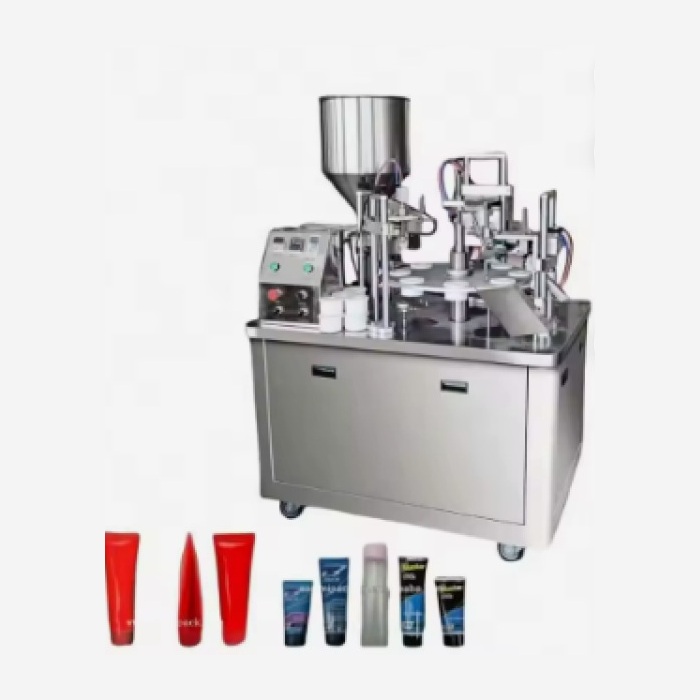
Ultrasonic tube tail sealer, semi-automatic
A semi-automatic ultrasonic sealer for tube tails, rated to about 25 tubes a minute.
- Role: Alibaba sourcing candidate
- Ultrasonic weld
- About 25 per minute
- Semi-automatic
- MOQ: From 1 unit
Questions to ask the supplier
-
What is the filling volume of this tube with a normal headspace, in ml or g?
-
Which sealing method suits this material, and which do you not recommend?
-
What are the diameter and length of the crimped end?
-
Can the tube be supplied pre-printed, and what is the minimum order?
-
Does the sealer need change parts for each diameter?
-
Can I have samples to test with my product?
Common mistakes
-
Buying tubes before choosing a sealer. The material limits the method [4].
-
Filling to the brim. There is no clean zone for the weld.
-
Assuming grams equal millilitres. Makers use both [10][11].
-
Trusting an impulse seal for retail. Sources call it lab-grade and not attractive [4].
-
Ignoring heat on the fill. Hot-air sealing can warm the contents [5].
FAQ
Can I seal tubes with a hair dryer or a clothes iron?
The sources reviewed show no source recommending this, and the choice would not suggest it for a product you sell.
Are aluminum tubes easier?
They are folded and crimped without heat [8], but the finish is less refined than a hot-air seal [5].
How many tubes can a manual sealer do?
One maker states up to 300 an hour [7].
Which size is best for a balm or eye cream?
The tables list 16 and 19 mm as the smallest diameters, which cover the smallest volumes [10][11]; choose by the capacity you need.
References
- A Packaging Group, How do you seal plastic cosmetic tubes? apackaginggroup.com (packaging supplier blog).
- O.Berk, Packaging Crash Course: the anatomy of a tube. oberk.com (packaging distributor).
- VKPAK, Tube sealing: the ultimate guide. vkpak.com (equipment maker).
- Sigma Equipment, An overview of tube fillers. sigmaequipment.com (equipment dealer).
- MSD Ltd, Plastic tube sealing guides (hot air, folding, hot jaw). msd-ltd.co.uk (equipment supplier; several pages).
- Adelphi, Tube processing laboratory brochure (Vesta 1C sealer). adelphi.uk.com (equipment maker).
- Axomatic (Marchesini Group), AXO 30 manual tube sealer, via making.com. making.com (equipment listing).
- Zonesun, Squeezable tube filling and sealing machines. zonesuntech.com (equipment maker; price as displayed).
- Chemists Corner, Flat-fee filling service for small batches (forum thread). chemistscorner.com (forum; opinion).
- Daiwa Can Company, Plastic tubes size and specification. daiwa-can.co.jp (tube maker).
- Emballator, Extruded tube 19 mm and plastic tubes catalogue. emballator.com (tube maker).
- La Cazadora, 19 mm PE squeeze tubes (10, 15, 22, 30 ml listings). Supplier listings via a reseller site (single seller).
- Alltub, Aluminum tubes data sheet. alltub.com (tube maker).
- Container and Packaging, 6 oz LDPE tube with flip cap and HIS liner. containerandpackaging.com (packaging distributor).
- Tuboplast via DirectIndustry, plastic tube range. directindustry.com (trade directory of a tube maker).
- C. L. Smith Company, Squeeze tubes. clsmith.com (packaging distributor).
- A Packaging Group, How do you fill lip balm squeeze tubes? apackaginggroup.com (packaging supplier blog).
- IndiaMART, Plastic tube sealer machine listings (manual models, prices in rupees). m.indiamart.com (marketplace; unverified sellers).
Continue reading

Stand-Up Pouches: Fill Weight, Gusset and Usable Height
A pouch is listed by three numbers and none of them is the fill volume. Width, height and gusset describe a flat sheet of film, not the space left after the seal.
Spice Shaker Caps: Hole Size, Fit and Product Match
A shaker cap is three parts that are usually sold separately: the base, the rotating or flapping lid, and the liner. Buy them apart and the hole size is the last thing you check.

Metal Balm Tins: Fill Weight, Lid Type and Label Area
The ounce stamped on a balm tin is a trade size, not a fill weight. A 1 oz tin holds about 28 g of wax, and a little less of anything with oil in it.