Fine Mist Sprayers: Output, Neck Size and Dip Tube Guide
A fine mist sprayer is specified by three numbers, and only one of them is usually printed on the listing: output per press, neck finish and dip tube length.
 Lena Schmidt
In this guide
- How much does one press deliver?
- What do the neck codes mean?
- How long should the dip tube be?
- What do they cost, and what is the minimum?
- Hoods, clips and metal collars
- Fitting the sprayer to the bottle
- What kinds of products suit a fine mist?
- What goes wrong, and how do you fix it?
- Where to buy the sprayers
- A trial before a bulk order
- Questions to ask the supplier
- Common mistakes
- FAQ
- References
Quick answer. Fine mist sprayers (the small finger-press kind used on perfume, hair and room sprays) deliver about 0.12 to 0.18 cc per press, according to O.Berk, with Berlin Packaging giving 0.16 ml as the low end of sprayer doses generally. They come in 18-410, 18-415, 20-410 and 24-410 necks, with dip tubes that are often supplied long and cut to size. Catalogue sprayers cost roughly 90 cents to a dollar each in small quantities at U.S. Plastic, while custom ones can carry a 25,000 minimum. They suit thin, clean liquids; thick or crystallising formulas block the orifice. Before ordering a case, fill ten bottles with your real formula, count presses to first spray, and leave them upright for a week.
How much does one press deliver?
Berlin Packaging says sprayer doses typically range from 0.16 ml for a fine mist up to 1.5 ml per stroke, with high-output sprayers delivering up to 4 ml in one spray [1]. O.Berk says fine mist sprayers are often measured in microlitres or cc, and are commonly offered between 0.12 and 0.18 cc [2]. Here is what individual listings say.
| Sprayer as listed | Output | Neck | Seller |
|---|---|---|---|
| Mark VI rib-side, clear round hood [3] | 0.14 or 0.16 ml | 18-415 | O.Berk |
| Euromist Heaven rib-side [4] | 140, 160 or 190 mcl | 20-410 | O.Berk |
| White rib-side, clear dust cover [5] | 0.15 cc | 20-410 | O.Berk |
| White PP fine mist sprayer, sample [7] | 160 mcl | 20-410 | Berlin Packaging |
| Metal finger sprayer, swirl collar [6] | 0.15 mL | 18/415 | U.S. Plastic |
| Smooth fine mist sprayers [8] | 0.14 to 0.16 ml | 20/410, 22/410, 24/410 | SKS Bottle |
Doses as listed by each seller. A microlitre (mcl) is a thousandth of a millilitre, so 160 mcl is 0.16 ml.
The spread is narrow for standard sprayers: from 0.14 to 0.19 ml. For mini vials it drops further. SKS lists mini sprayers for 3, 5, 10 and 15 ml cylinders with outputs of 0.06, 0.07, 0.09 and 0.11 ml per spray [8]. That tells you something about design: a sprayer made for a 3 ml vial is deliberately smaller than one made for a 50 ml bottle, so the dose is part of the size match and not just a preference.
Doses matter when you promise something. A 30 ml bottle at 0.15 ml a press gives about 200 presses, and a 100 ml bottle gives about 667 (the arithmetic here, ignoring residue). A 10 ml vial at 0.09 ml gives about 111. If you print a number of sprays on the carton, weigh the output on your formula first, because the listed dose belongs to a standard test liquid and not to your blend.
What do the neck codes mean?
The neck code has two numbers, as with lotion pumps: the diameter in millimetres, and a thread style. O.Berk says fine mist sprayers should have an industry-standard neck finish such as 18-410, 20-410 or 24-415 [2]. FH Packaging lists 18-410 and 20-410 as the common finishes and says 18-410 suits smaller-format, portable, functional products [9]. Sellers list 18/415 as well [3][6].
Be careful about the last three digits. As with 24/410 pumps, the thread style (410 against 415) is part of the code, and a sprayer from one code will not seat properly on a bottle from the other. Our page on lotion pump specs explains the same point for pumps. The safe route is to read the code off the bottle seller’s drawing, then buy the sprayer with the same code, and test one before ordering a case.
How long should the dip tube be?
A Packaging Group says the tube should reach the bottom of the bottle so the sprayer can draw product efficiently [10]. Listings show the variety. U.S. Plastic sells 18/415 metal sprayers with 2.76 inch (70 mm) and 3.07 inch (78 mm) tubes [6]. Berlin Packaging sells 20-410 sprayers with 3.5 inch and 4 inch tubes [7]. FH Packaging says tube lengths run from 80 to 110 mm to fit different bottle profiles [9]. SKS lists a range from 2 7/8 to 7 1/16 inches across its sprayers [8].
O.Berk supplies some sprayers with the tube uncut. One 20-410 listing has a 10 inch tube that can be cut to a specific length to fit your bottle, with a carton of 1,000 [5], and another comes with a cut-to-size tube [4]. If you receive an uncut tube, measure the bottle and cut it yourself; the O.Berk method for pumps works the same way, and the page on lotion pump specs shows it. Cary notes that the usable length of a dip tube differs from its total length and from the length measured from the underside of the cap [11], so measure the same way every time.
For a round vial, an angled cut helps the tube draw the last of the liquid. That is general practice and not something the sources prove. Test it on your bottle.
What do they cost, and what is the minimum?
Small-quantity prices are modest. U.S. Plastic lists 18/415 metal finger sprayers with swirl collars at $0.90 for the silver and $0.99 for the gold, as displayed in November 2026, with discounts of 5 percent at 100, 10 percent at 200 and 15 percent at 600 [6]. Berlin Packaging lists a 20-410 sprayer as a sample item and says bulk pricing is not available for it online, and to contact customer service [7].
Customised parts are another matter. O.Berk lists its 18-415 Mark VI sprayer and its 20-410 Euromist Heaven as special orders with a minimum of 25,000 [3][4], while the 20-410 0.15 cc version with a 10 inch tube is marked as in stock locally [5]. For a small brand the pattern is clear: choose a stocked item, even if the look is less distinctive, and treat a special order as a later project.
The Mark VI sprayer is offered with narrow, medium or wide spray patterns and with a rounded or flat hood [3]. If the spray pattern matters to the feel of your product, ask for samples of each pattern before committing, since the pattern is chosen at the order stage and not afterwards.
Hoods, clips and metal collars
The part that protects the sprayer in a bag or a parcel is the hood. SKS says its clear styrene hoods prevent unwanted discharge when the sprayer is not in use [8], and Berlin Packaging sells its 20-410 sprayer with a clear overcap [7]. The Mark VI is offered with a rounded or flat hood [3]. A flat hood stacks and packs more neatly in a carton, and a rounded one looks softer; no source here confirmsompares them, so judge by a packed sample.
Metal sprayers add another detail. U.S. Plastic’s metal finger sprayers come with a swirl-design collar and an overcap with a plastic insert so the metal does not scratch the outside of the sprayer, plus a removable plastic clip that stops the sprayer from being pressed [6]. That clip is the useful part for shipping: a sprayer that cannot be depressed cannot discharge in transit. If you use a clipless design, test a filled bottle in a sealed bag, laid flat overnight, before you ship any.
Fitting the sprayer to the bottle
A sprayer is a screw closure, so the usual closure habits apply. Fit it snugly, but do not crank it: a cracked collar or a distorted gasket will leak at the neck even when the sprayer itself works. Our pages on [how to control screw cap torque] and [torque testing] cover how to set a tightening range for caps, and the same logic holds here. Check the gasket sits flat in the collar before you thread it on, and check the bottle’s neck is clean and dry.
Then look at the bottle neck itself. A sprayer for a 18-415 neck on a 18-410 bottle may seem to thread and still leak; a bottle with a chipped or uneven finish is another source of leaks. Run your leak test with the bottles tipped, because a bottle that holds when standing may weep when laid flat in a bag. The neck seal is the part that matters most for a perfume, where evaporation through a poor seal is a quiet loss.
What kinds of products suit a fine mist?
Berlin Packaging says a mist spray produces a fine mist of tiny droplets, suited to hair care, sunscreen, perfume and other personal care products [1]. FH Packaging adds pet care and household functional sprays as categories [9]. What they share is a thin liquid. Repair sites that explain spray pumps say the pump is calibrated for liquids with a viscosity close to water, and that thicker liquids resist the vacuum and give a weak stream or none at all [12]. A gel, a lotion or a heavy oil will not mist.
Alcohol and fragrance matter in a second way. A bottle-supply blog warns that alcohol-based liquids can dry out seals and degrade cheap plastic, and recommends well-made sprayers rinsed after use [14]. That is a general caution. If your formula is high in alcohol, ask the supplier which materials the gasket and the plastic body use, and test a sample.
What goes wrong, and how do you fix it?
| Symptom | Likely cause | What sources suggest |
|---|---|---|
| Nothing comes out | Lost prime, a loose dip tube, or a clogged filter screen at the tube end [12] | Prime with several firm presses; check the tube is attached [12] |
| Weak or sputtering spray | Dried product in the orifice [12]; formula too thick [12] | Soak the head in warm water, then clear gently [12][13] |
| Drips instead of misting | Dried fragrance blocking the nozzle [13] | Run warm, not hot, water through the tube and head; clear the opening with a clean pin [13] |
| Stops after sitting unused | Crystallisation in the fine orifice [12] | Flush and prime; the crust forms while the bottle sits unused [12][13] |
Advice from repair sites and brand help pages, not from sprayer makers. None of these fixes were tried here.
A brand help page for an atomiser says that, on rare occasions, the super-fine mist nozzle can become blocked by dried residue or small particles, and that flushing with warm water clears it [13]. For a product that you sell, the more useful point is prevention: filter the formula before filling so that particles do not reach the nozzle, and tell customers what to do if a bottle clogs. A removable head and a short care line on the insert cost almost nothing.
Where to buy the sprayers
The listing below is the sprayer on its own: a 0.14 cc pump in the three neck finishes that cover most small bottles.

Fine mist sprayers, 0.14 cc, 18/410 to 24/410
A polypropylene fine mist sprayer listed at 0.14 cc per press, in 18/410, 20/410 and 24/410 necks.
- Role: Alibaba sourcing candidate
- 0.14 cc per press
- 18/410 to 24/410
- PP body
- MOQ: From 10,000 pieces
A trial before a bulk order
-
Order ten complete sets of the bottle, sprayer and hood, and ask for the dip tube uncut if the seller offers it.
-
Measure the bottle and cut the tubes, noting the cut length.
-
Filter your formula, fill the bottles, and fit the sprayers.
-
Count the presses to first spray on each bottle and record the number.
-
Weigh ten sprays per bottle and divide by ten to find the real dose.
-
Look at the spray against a dark surface: is it a fine cloud, or does it spit?
-
Leave the bottles upright for a week, test again, and check for drips and blocked nozzles.
-
Lay two on their sides overnight to check the neck seal.
Keep the cut length, the dose and the number of presses to prime in your spec sheet. If a later lot behaves differently, those three numbers tell you where to look first.
Questions to ask the supplier
-
What is the output per spray, in mcl, and with what test liquid?
-
What is the neck code, and what is the thread style?
-
What is the tube length as supplied, and can you cut it for me?
-
What materials are the gasket, spring and body, and are they suited to my alcohol level?
-
Is the spray pattern fixed, and are narrow, medium and wide patterns offered?
-
Is this a stocked item or a special order, and what is the minimum?
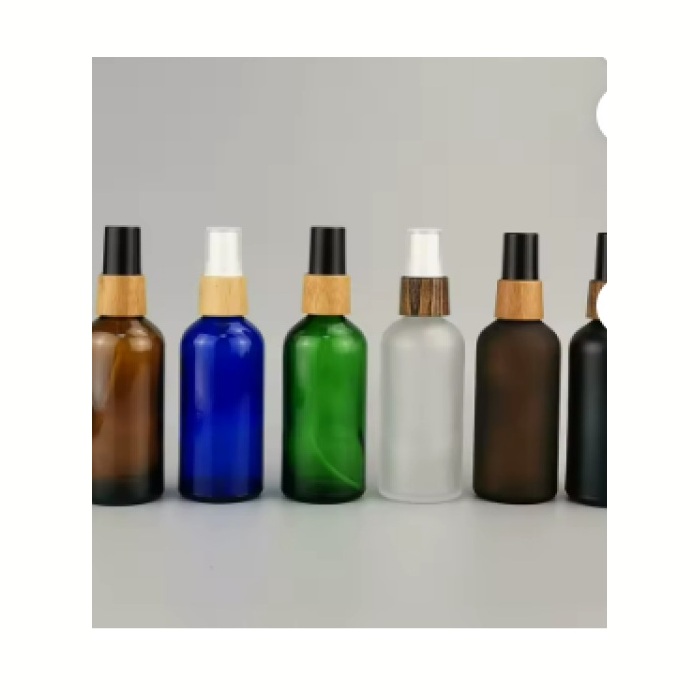
100 ml glass spray bottles with 18/415 sprayer
The bottle side of the same decision: a 100 ml glass bottle supplied with an 18/415 sprayer already fitted, in amber, blue, green and clear.
- Role: Alibaba sourcing candidate
- 100 ml
- 18/415 sprayer
- Five colours
- MOQ: From 120 pieces
Common mistakes
-
Mixing 410 and 415. The thread style is part of the code [2][3][9].
-
Using a mist sprayer for a thick product. The pump is built for thin liquids [12].
-
Skipping the filter. Particles block the nozzle [13].
-
Choosing a special order for a first run. Minimums of 25,000 are listed [3][4].
-
Promising a number of sprays you have not weighed. Doses vary by formula.
FAQ
Is a fine mist sprayer the same as a trigger sprayer?
Distributors cover both in one guide [1][11], but the finger-press mist type gives about 0.14 to 0.16 ml, while Cary describes trigger sprayers at 0.22 to 1.5 ml per squeeze [11].
Can I use one on a 15 ml vial?
Yes, if the neck matches. SKS lists a mini sprayer for 15 ml cylinders with a 0.11 ml output [8].
What dose is right for perfume?
Most standard sprayers deliver about 0.14 to 0.16 ml [3][5][7][8]. The right dose depends on your product and customers.
Do I need a hood?
A clear overcap or hood prevents unwanted discharge [8]; some sprayers include one and some do not, so check the listing.
References
- Berlin Packaging, 5 tips for selecting mist and trigger sprayers. berlinpackaging.com (packaging distributor).
- O.Berk, What is inside a fine mist sprayer and how does it work? oberk.com (packaging distributor).
- O.Berk, 18-415 black rib-side Mark VI fine mist sprayer, 0.14 or 0.16 ml. oberk.com (product page; special order, minimum 25,000).
- O.Berk, 20-410 white rib-side Euromist Heaven fine mist sprayer (140, 160 or 190 mcl). oberk.com (product page; special order, minimum 25,000).
- O.Berk, 20-410 white rib-side fine mist sprayer, 0.15 cc, 10 inch cut-to-size tube. oberk.com (product page; in stock locally).
- U.S. Plastic Corp., fine mist metal finger sprayers with swirl collars, 0.15 mL. usplastic.com (packaging distributor; prices as displayed Nov 2026).
- Berlin Packaging, 20-410 white PP fine mist sprayers X351W (160 mcl, 3.5 in tube) and X352W (4 in tube). berlinpackaging.com (product pages).
- SKS Bottle, The Packaging Rap (issue 69) and a product spotlight on smooth fine mist sprayers. sks-bottle.com (packaging supplier; newsletter and spotlight).
- FH Packaging, How personal care brands can choose the right nasal sprayer and fine mist sprayer. fhpkg.com (packaging distributor blog).
- A Packaging Group, How do you choose the right fine mist sprayer for cosmetics? apackaginggroup.com (packaging supplier blog).
- The Cary Company, Guide to mist and trigger sprayers. thecarycompany.com (packaging distributor).
- EngineerFix, several articles on spray bottles that will not spray. engineerfix.com (repair information site; not a manufacturer).
- Koh, Atomiser spray bottle has stopped spraying; Kirri, My room spray nozzle is dripping. help.koh.com and kirri.gorgias.help (brand help pages).
- The Bottle Depot, How to use and maintain sprayers for bottles. thebottledepot.co (bottle retailer blog).
Continue reading

Stand-Up Pouches: Fill Weight, Gusset and Usable Height
A pouch is listed by three numbers and none of them is the fill volume. Width, height and gusset describe a flat sheet of film, not the space left after the seal.
Spice Shaker Caps: Hole Size, Fit and Product Match
A shaker cap is three parts that are usually sold separately: the base, the rotating or flapping lid, and the liner. Buy them apart and the hole size is the last thing you check.
Metal Balm Tins: Fill Weight, Lid Type and Label Area
The ounce stamped on a balm tin is a trade size, not a fill weight. A 1 oz tin holds about 28 g of wax, and a little less of anything with oil in it.