Spice Shaker Caps: Hole Size, Fit and Product Match
A shaker cap is three parts that are usually sold separately: the base, the rotating or flapping lid, and the liner. Buy them apart and the hole size is the last thing you check.
 Lena Schmidt
In this guide
Quick answer. Match the hole to the largest piece in your product, then check the jar finish. Container and Packaging tested its own sifters by hand: an 11-hole fitment with 0.135 inch holes (about 3.4 mm) passed cumin and sesame seeds but not peppercorns, a 3-hole lid at 0.23 inch passed peppercorns and chili flakes, and a 0.3 inch lid passed cloves and dried black beans but not chocolate chips. The same source advises smaller holes for salt and garlic so they do not pour too fast. Fitments are sold separately from caps, a 43 mm fitment needs the right cap height and jar finish, and a short flow test of ten shakes will tell you more than any catalogue.
Three parts, sold separately
A spice closure is often a system of parts and not a single lid. C.L. Smith describes spice caps as solid caps with a smooth top and an inside stacking ring, which often accompany a sifter fitment that attaches to the container before the cap goes on; the fitment impedes the flow of the product and stays in the bottle after the closure is removed [8]. The same supplier lists a separate family of shaker caps, hinged on one side so that lifting the lid exposes the orifice, with sift-and-spoon or pour-and-spoon styles, and notes that they are typically made for containers with a very specific neck finish [8].
So you can end up with three different purchases: the jar, a fitment that snaps into the jar mouth, and a cap that covers it. U.S. Plastic Corp sells 43/400 and 43/485 spice caps alongside a 43 mm natural polypropylene sifter fitment with five 0.25 inch holes, and recommends testing the fitments with the jars for the best fit [4]. Tricorbraun describes its 43 mm snap-on fitment, also five holes of 0.25 inch, as fitting jars with a 43-485 finish [5]. Berlin Packaging’s 43 mm HDPE sifter fitment has 1/8 inch holes, must be used with a 485-height cap, and is compatible only with glass jars that have a fitment finish [6].
The pattern is consistent: a fitment is not universal, the cap has to clear it, and the jar has to be made for it. Aaron Packaging adds a further limit, saying its sifter fitments work with its simple spice caps but not with its flip-top dispenser caps, which are a different system, and that it does not carry sifters for its 48 mm neck [7]. If you are buying jars and closures from different suppliers, put the fitment and the cap on the same sample order as the jar.
What the bench tests found
Container and Packaging’s tests give the clearest picture of what hole size does. We converted the diameters to millimetres ourselves. Here is the combined result from three of its test pages [1][2][3].
| Closure tested | Holes | Hole diameter | What passed and what failed |
|---|---|---|---|
| Natural snap-on sifter | 11 | 0.135 in (about 3.4 mm) | Peppercorns and whole coriander failed; cumin and sesame seeds passed [1] |
| Natural snap-on sifter | 5 | 0.25 in (about 6.4 mm) | Sunflower seeds, dried rosemary and chocolate sprinkles passed [1] |
| L620BK lid | 3 | 0.23 in (about 5.8 mm) | Peppercorns and red chili flakes passed; spoon opening fits a half teaspoon [2] |
| L630Y lid | not stated | 0.3 in (about 7.6 mm) | Cloves, split peas and dried black beans passed (beans about the limit); chocolate chips failed [2] |
| L454 flip-top | 5 | 0.313 in (about 8.0 mm) | Cloves, split peas and black beans passed; chocolate chips failed; no spoon opening [3] |
| L456 flip-top | 7 | 0.202 in (about 5.1 mm) | Powders, peppercorns, chili flakes and sesame passed; tablespoon measures fit the spoon opening [3] |
Pass and fail as reported by Container and Packaging from informal tests; millimetre figures are a conversion here. No flow rates or repeat trials are reported.
Two things stand out. First, the hole diameter is the gate, and the product’s largest piece is the key. Peppercorns failed at 0.135 inch and passed at 0.23 inch, so the threshold lies between them, at roughly 3.4 to 5.8 mm for that product; the choice would not draw a finer line from one tester’s pepper. Second, a bigger hole is not simply better. The same source says that for strong ingredients such as salt or garlic a sifter with smaller holes is the better pick so they do not pour too quickly [2].
The 11-hole fitment is described as suited to products about sesame-seed size or smaller, and the author names sugar and salt among them [1]. That agrees with the logic of the catalogue: smaller holes for fine grains, larger for flakes and whole spices. It also shows why you cannot choose by jar size. The same 43 mm jar can carry a fine-salt fitment or a coarse-flake one.
Matching the hole to your product
Group your products by what the dispensing needs to do, not by name. Our grouping, built from the test results above, is a starting point rather than a rule.
| Product type | What the tests suggest | Our caution |
|---|---|---|
| Fine salt, sugar, fine powders | Small holes; the 11-hole 0.135 in fitment is described as suited to sesame-sized and smaller [1] | Salt and garlic can pour fast through bigger holes [2]; check for caking in humid storage |
| Ground spice blends with flakes | Mid-size holes: the 0.202 in lid passed chili flakes and sesame [3] | Blends with one large piece (dried herbs, sea salt flakes) set the hole size, not the average |
| Cracked pepper, whole peppercorns, sunflower or large seeds | 0.23 in passed peppercorns [2]; 0.25 in passed sunflower seeds and dried rosemary [1] | A hole that suits the largest piece may pour fine powder too fast |
| Whole cloves, split peas, dried beans | 0.3 in or larger [2][3] | Shaker is a poor fit for chunky items; consider a pour spout |
Built from the cited bench tests; none was run on your blend.
The blend that causes trouble is the mixed one: a rub with fine paprika, coarse salt and a few dried herb leaves. Its largest piece sets the minimum hole, but its fine fraction sets the pour rate. You cannot satisfy both with one hole size, which is why a dual lid with a shaker side and a spoon side exists. Webstaurant’s dual-purpose lids, for example, label one side for shaker use and one for spoon access, in 3-hole extra-coarse, 7-hole and 13-hole coarse versions on a 53/485 finish [9][10][11]. These are seller listings, so read them as examples of the format and not as test data.
Hole size, hole count and dose
The sources give hole diameter and hole count but not the amount that comes out per shake. The same lid can pour differently by jar angle, fill level and humidity. The Webstaurant 13-hole coarse lid, with 1/8 inch holes, and the 7-hole version, with 0.2 inch holes, differ in both count and size [9][11], and nothing in the listings says which delivers more. Hole area scales with the square of the diameter, so a 0.2 inch hole has about 2.6 times the area of a 0.125 inch one (the arithmetic here), and seven of them have about 1.4 times the area of thirteen of the smaller ones. That suggests the 7-hole lid pours faster for the same product, but it is a geometric estimate. Flow also depends on how the product bridges at the hole.
The practical consequence is to measure it. A ten-shake test with a scale gives you grams per shake for your actual product, jar and fill level, which is the number that matters on the shelf.
Liner, seal and spoon openings
Many shaker lids ship with an induction liner. Webstaurant’s 53/485 dual-flapper lids are listed with an induction-ready liner, and one listing describes it as a PET-friendly liner included [9][10][11]. If you plan to induction-seal the jar, the liner belongs in the same sample test as the shaker. Our [induction seal liner guide] and [induction liners for powder products] pages cover that decision; the shaker holes themselves are covered by the flap or the cap, not the foil.
Spoon openings are a separate dimension. Container and Packaging measured one lid’s spoon opening as fitting a half teaspoon and another as fitting a half tablespoon, and found that a flip-top with a hidden hinge accepted every 1-tablespoon measure it tried, while another flip-top with no spoon opening rejected measuring spoons [2][3]. If your label says “use a teaspoon”, test that a teaspoon fits.
When a shaker is the wrong closure
Some products do not belong behind holes at all. In Container and Packaging’s tests, chocolate chips failed on both lids they were tried with, the 0.3 inch lid and the 0.313 inch flip-top [2][3]. Dried black beans passed the 0.3 inch lid only just, and the author called them about the largest item it could handle [2]. If your product is chunkier than that, a shaker is a poor choice, and a wide pour spout or a sift-and-spoon lid is the better format. C.L. Smith notes that many spice caps offer a shaker-hole option or a flip-top for pouring [8], so the choice is between formats and not only between hole sizes.
Fill level matters as much as the cap. Our narrow-mouth auger page makes the point from the filling side: a dose that is acceptable by weight can still obstruct a shaker insert once the powder settles, so the fill test should be done with the actual insert and cap fitted. If the jar is filled to the shoulder, the powder sits against the underside of the fitment, and the first shakes may pack it rather than pour it. Leaving a little headspace under the fitment is a cheap way to avoid that, though no source here states how much, and you should find the figure by testing.
Colour is a small but real design tool. Container and Packaging suggests using lid colours to organise a spice cabinet, black for pepper and red for cinnamon or chili powder, for example [2], and Webstaurant sells its lids as a colour-coded system [9][11]. For a brand with several blends, a different cap colour for each hole size also stops a fine blend from being packed under a coarse lid at the filling table, which is a mix-up that costs a batch.
A ten-shake flow test
-
Fill five jars to your production level with the real blend, fitted with the candidate shaker and cap.
-
Hold each jar at a consistent angle over a weighed dish and give ten shakes of the same count and force. Weigh the dish, and divide by ten for grams per shake.
-
Repeat at three fill levels: full, half and nearly empty. The flow changes as the jar empties.
-
Repeat in a humid room or after leaving the jars open for an hour, if the product takes up moisture. Look for clumping at the holes.
-
Try the finest and coarsest batches you actually produce, because a blend varies between runs.
-
Record the weight per shake at each level and the hole size and count used. Choose the lid that gives a dose you are happy to describe on the label.
This is a test here, not a published method. Its value is that it is cheap, repeatable and tied to your product.
Where to buy the caps
The listing below is the closure on its own: a 53 mm flapper shaker cap with three holes, sold in volume without the bottle.
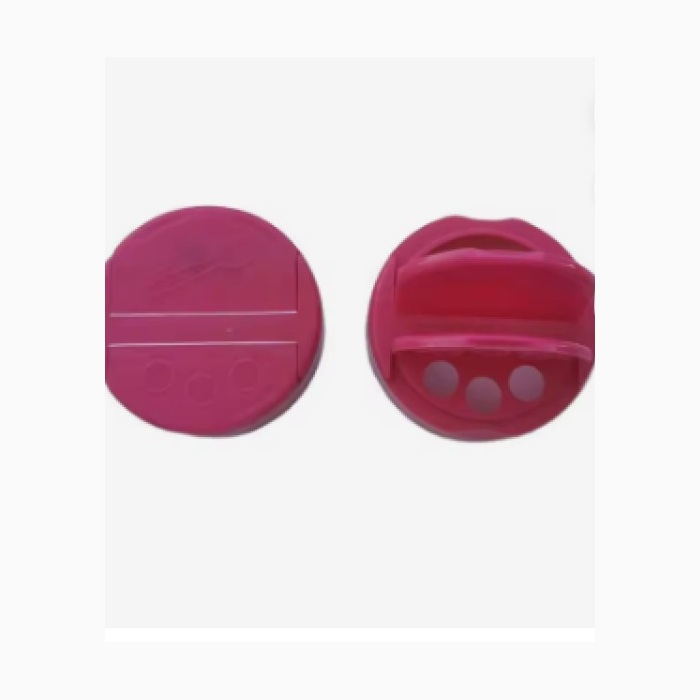
53 mm flapper shaker caps, three holes
A 53 mm plastic shaker cap with a hinged flapper lid and three dispensing holes.
- Role: Alibaba sourcing candidate
- 53 mm
- Three holes
- Flapper lid
- MOQ: From 10,000 pieces
What the caps cost
Prices on the listings the sources reviewed show are small, and they matter only at volume. U.S. Plastic Corp showed a 43/400 white spice cap at about 20 cents each and a 43/485 cap at about 24 cents, with a five-hole fitment at about 14 cents [4]. A Tricorbraun 11-hole fitment was shown on one distributor at $10.00 per hundred [12], and a pack of 100 red 53/485 lids with 13 holes at $51.99 [11]. These come from search snippets and may have changed, so check live prices. The point is that a fitment plus a cap is a few tens of cents, which is cheap enough to buy several versions for testing.
Questions to ask the supplier
-
What are the exact hole diameter and hole count, and are the holes measured on the fitment or the cap?
-
Which jar finish and cap height does this fitment require, and is it for glass only?
-
Does the cap come lined, and what is the liner material?
-
Is there a spoon or pour opening, and what measuring spoon fits it?
-
Is the material food-contact compliant, and can I have the specification sheet?
-
Can I have samples of two hole sizes for the same finish?
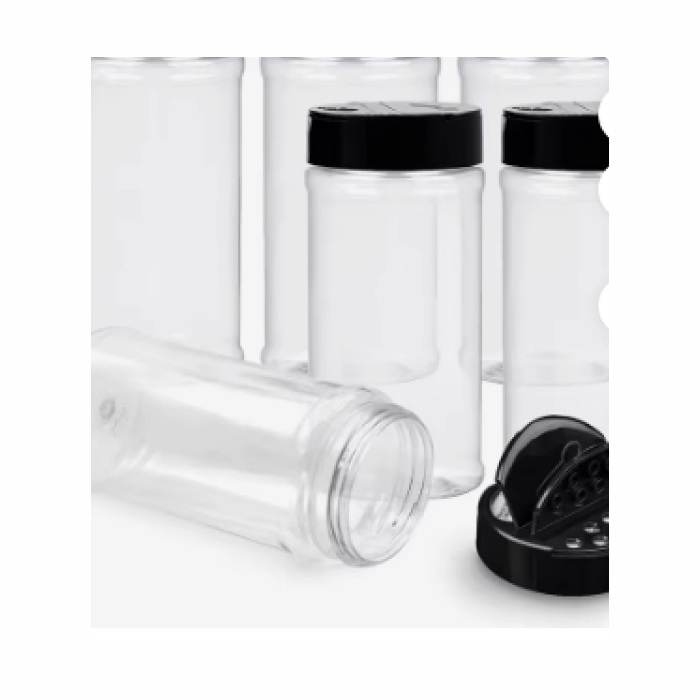
PET spice bottles with dual-opening shaker lids
The matched version: a clear PET spice bottle supplied with a dual-opening lid already fitted, from 50 to 330 ml.
- Role: Alibaba sourcing candidate
- 50 to 330 ml
- Dual-opening lid
- PET bottle
- MOQ: From 1,000 pieces
Common mistakes
-
Choosing by jar size. Hole size depends on the product, not the jar [1][2].
-
Ordering a fitment without its cap. The cap must clear the fitment and match the finish [4][6].
-
Using large holes for salt or garlic. They pour too fast [2].
-
Testing with one batch. Blends vary between runs; test the coarsest and finest.
-
Skipping the spoon check. A label that mentions a spoon must be tested with one [2][3].
FAQ
Will peppercorns go through a standard spice sifter?
In Container and Packaging’s tests, they failed at 0.135 inch holes and passed at 0.23 inch [1][2].
What size hole is right for salt?
Smaller holes, because strong ingredients such as salt and garlic can pour too quickly through large ones [2]; test with your grind.
Can I use a 43/400 cap on a 43/485 jar?
Finish codes matter: Berlin says its fitment must be used with a 485-height cap [6]. Confirm the pair with your supplier and test it.
Do I need an induction liner under a shaker lid?
Only if you want a first-open seal; some shaker lids ship with one [10][11].
References
- Container and Packaging, Sifter product testing part 1. containerandpackaging.com (supplier blog; informal bench test, Jan 2018).
- Container and Packaging, Sifter product testing part 2. containerandpackaging.com (supplier blog; informal bench test, updated Feb 2026).
- Container and Packaging, Sifter product testing part 3 (flip-top sifter lids). containerandpackaging.com (supplier blog; informal bench test).
- U.S. Plastic Corp, Polypropylene spice jar caps and sifters, and 43 mm sifter fitment item 67140. usplastic.com (distributor).
- Tricorbraun, 43 mm natural PP snap-on sifter fitment with 5 holes, for jars with a 43-485 finish. tricorbraun.com (distributor).
- Berlin Packaging, 43 mm natural HDPE sifter fitments, item 6006. berlinpackaging.com (distributor; listed out of stock at the time of checking).
- Aaron Packaging, Sifter fitments collection. aaronpackaging.com (distributor).
- C.L. Smith, Shaker closures and Spice caps. clsmith.com (closure supplier).
- WebstaurantStore, 53/485 dual-flapper spice lids with 3 and 7 holes (listings 641SPC53LIDW and 999L53485RI). webstaurantstore.com (retailer).
- WebstaurantStore, 53/485 dual-flapper induction-lined spice lid, 3-hole extra coarse, case listing. webstaurantstore.com (retailer).
- WebstaurantStore, 53/485 red 13-hole induction-lined lid, 100 pack. webstaurantstore.com (retailer).
- Zoro (Tricorbraun item 056117), 43 mm snap-on sifter fitment, 11 hole, 0.135 in orifice. zoro.com (retailer).
Continue reading
Stand-Up Pouches: Fill Weight, Gusset and Usable Height
A pouch is listed by three numbers and none of them is the fill volume. Width, height and gusset describe a flat sheet of film, not the space left after the seal.
Metal Balm Tins: Fill Weight, Lid Type and Label Area
The ounce stamped on a balm tin is a trade size, not a fill weight. A 1 oz tin holds about 28 g of wax, and a little less of anything with oil in it.
Empty Tea Bags: Size, Fill Weight and Seal Type Guide
A tea bag is sold by the flat size of the sheet, and tea is mostly air. The bag that holds 3 g of fine fannings will not hold 3 g of a whole-leaf oolong.