Empty Tea Bags: Size, Fill Weight and Seal Type Guide
A tea bag is sold by the flat size of the sheet, and tea is mostly air. The bag that holds 3 g of fine fannings will not hold 3 g of a whole-leaf oolong.
 Lena Schmidt
In this guide
- Weight does not tell you how much space tea takes
- How big a bag, for which tea
- Material: paper, PLA, hemp or plastic
- Heat seal or not: check before you buy
- Which closure for which product
- A bench test before you order a case
- Where to buy the bags
- What bags cost
- Questions to ask the supplier
- Common mistakes
- FAQ
- References
Quick answer. Choose the bag by how much volume your blend takes up, not by the grams on the label. One tea retailer lists a level teaspoon at about 1 g for a chamomile blend and about 4 g for a chai, and a supplier guide puts airy herbals in an 8 by 10 cm bag and standard black or green tea in a 6 by 8 cm bag. Fill a bag no more than about two thirds so the leaves can open. Check that the bag is actually heat-sealable before you buy, because filter papers come in heat-seal and non-heat-seal grades and one maker advises against heating its paper filters. Test with your own blend, brewed in boiling water, for leaks and seal failure.
Weight does not tell you how much space tea takes
The numbers you see on tea packaging are weights, and a bag holds a volume. Simple Loose Leaf, a tea retailer, lists one teaspoon of its blends at about 1 gram for a chamomile lavender, 1.5 grams for an Assam, 2 grams for a prickly pear herbal, 3 grams for a Formosa oolong and 4 grams for a simple chai [6]. It adds that tea bags usually contain 1.5 to 2.5 grams of tea dust or fannings [6]. Red Blossom Tea makes the same point with a bigger spread: a tablespoon of light white tea buds might weigh no more than 2 grams, while the same spoon of densely rolled oolong could weigh 6 or 7 [7].
Those are retailers’ figures for their own blends, not standards. They show something you can check on your bench: a bag that comfortably takes 3 grams of a dense rolled oolong may not close over 3 grams of dried mint. If you use one gram weight as your design rule across all blends, you will under-fill some bags and overstuff others.
| Blend (per level teaspoon) | Weight listed | Source |
|---|---|---|
| Chamomile lavender | about 1 g | Simple Loose Leaf [6] |
| Organic Assam | about 1.5 g | Simple Loose Leaf [6] |
| Formosa oolong | about 3 g | Simple Loose Leaf [6] |
| Simple chai | about 4 g | Simple Loose Leaf [6] |
One retailer, its own blends. Treat as an example of the range, not as reference values for other teas.
How big a bag, for which tea
Thés Traditions’ buying guide gives a simple size ladder: 6 by 8 cm for standard black or green tea, 8 by 10 cm for bulky herbal teas such as verbena or mint, and 10 by 12 cm for very airy blends and large flowers such as hibiscus or chamomile [1]. It advises filling a bag no more than two thirds full, and choosing a slightly oversized bag over a tight one so the leaves can open [1]. For the dose it suggests about 2 grams for a 200 ml cup, about 1.5 grams for voluminous leaves, and 2.5 to 3 grams for dense teas such as matcha leaf or Pu-erh [1].
Other sellers describe their bags differently. Special Tea Company sells 2 by 3 inch heat-seal bags that it says take 2.5 to 4 grams, and tells buyers to fill them about half full [2]. A seller on Walmart’s marketplace lists a 6 by 8 cm drawstring bag for 3 to 8 grams [3]. Adagio’s paper filter is 7 inches tall and 3 inches wide and, it says, holds up to 4 teaspoons, with about a teaspoon, 2 to 3 grams, for a standard 8 oz cup [5]. Frontier Co-op’s T-Sac #3 is 5.5 by 3.2 by 1 inches, holds about 7 teaspoons and suits a 3 to 8 cup teapot [4].
Put side by side, those are four different jobs. Two of them are single-cup bags, one is a long filter you can tie or fold and one is a teapot bag. Our arithmetic: 6 by 8 cm is about 2.4 by 3.1 inches, so Thés Traditions’ standard bag is close to Special Tea Company’s 2 by 3 inch bag, yet the first says to fill to two thirds and the second to half. Both can be right for their own paper and blends. The lesson is to fill your own sample.
| Bag | Size | Dose the seller gives | Fill advice |
|---|---|---|---|
| Special Tea Company [2] | 2 x 3 in | 2.5 to 4 g | Half full |
| Thés Traditions standard [1] | 6 x 8 cm | about 2 g per 200 ml cup | No more than two thirds |
| Marketplace drawstring [3] | 6 x 8 cm (2.36 x 3.15 in) | 3 to 8 g | Not stated |
| Adagio filter [5] | 7 x 3 in | up to 4 tsp; about 1 tsp per 8 oz cup | Fold or tie the top |
Sellers’ statements. The bag sizes are close but the stated doses range from 2 to 8 g.
Material: paper, PLA, hemp or plastic
Thés Traditions lists the common options. Biodegradable paper is the most common and gives a balanced price, about 1 to 3 cents a bag in packs of 200 to 1,000. Corn-fibre PLA is compostable and transparent so customers can watch the leaves open, at about 3 to 5 cents a bag in one section and 3 to 8 cents in its FAQ. Reusable non-woven or cotton bags are washable for roughly 5 to 50 uses at 50 cents to 2 euros each. Nylon and polypropylene are not biodegradable, and the guide advises avoiding them in very hot water because some plastics may release microparticles [1]. That is a seller’s caution and not a test result; make your own decision about plastic mesh.
Frontier Co-op describes its T-Sac as made in Germany from unbleached manila hemp fibre, chlorine free and compostable [4]. Adagio’s filters are wood and hemp fibres, chlorine-free bleached, also made in Germany, and the company says they do not contain epichlorohydrin or plastics [5]. The point for a brand is that the claim “compostable” or “plastic-free” should be backed by what the supplier states about the specific bag, because paper bags often have heat-seal fibres in them, as we explain below.
Heat seal or not: check before you buy
Filter paper is made in two broad grades. Magnera sells heat-sealable and non-heat-sealable tea filter papers for different machine platforms [8], and Ahlstrom likewise offers heat-seal and non-heat-seal tea bag materials, with the second family intended for non-heat-seal tea bag packing machines [9]. A non-heat-seal bag is closed by crimping, stitching, a staple or a string, not by melting anything.
Heat-seal paper needs fibres that melt. A patent describing heat-sealable tea bag paper says such papers normally consist of about 75 percent natural fibre and about 25 percent heat-sealing synthetic fibre [12]. That is patent background about industrial grades, so do not read it as a spec for any bag you buy, but it explains why a bag labelled compostable may still contain plastic-type fibre. Ask the supplier what the sealing fibre is if that matters to your claim.
The industrial conditions are far from a household iron. Patents on heat-sealable filter materials say sealing rolls on packing machines seal at roughly 150 to 230 degrees Celsius in well under a second, at speeds around 1,000 bags a minute [10]. One patent example seals bags on all four sides with a commercial sealer at 210 degrees for 0.5 seconds at 3 bar [11]. The same patents warn that seams can reopen on the machine or on contact with boiling water if the seal is weak [10]. A hand seal is gentler and slower. Special Tea Company tells buyers to press the bag with a household iron on the cotton setting or use a curling iron [2], and Thés Traditions says a low-heat iron makes a watertight closure suited to blends prepared in advance [1].
Not every paper filter should be heated. Adagio says it does not recommend heat-sealing its filters, because paper products in heated devices pose a fire risk, and suggests folding the top over the cup, tying it, or stapling it [5]. So the same “paper filter” can be sold for sealing or for folding, and the listing tells you which. If a listing does not say, ask.
Which closure for which product
| Closure | What the sources say | Suits |
|---|---|---|
| Heat seal | Watertight, single use; suits blends made in advance [1] | Gift sets, small runs |
| Drawstring | Closed by a sliding knot or string; practical and good for herbal teas that need volume [1] | Bulky herbals |
| Fold over | T-Sac: fold the top flap after filling [4]; Adagio: fold over the cup rim or tie [5] | Teapot or mug use |
| Stapled or tied | Customers use staples, string and toothpicks on Adagio filters [5] | Hand-assembled bags |
Summarised from seller statements; none is a standard.
A fold or staple closure lets leaves escape more easily than a seal, and staples in a food bag raise a question you should ask your local food rules about; we have not researched it. If you want a hands-free brew with a clean cup, a heat seal or a drawstring with a tight knot is the more predictable choice.
A bench test before you order a case
-
Order a sample of each size and closure you are considering, about ten of each, and note the stated dose.
-
Weigh your blend into each size at three doses: a light, a standard and a heavy fill. Look at how full the bag is and whether it still closes.
-
Seal or close each bag, then press and shake it over a white dish. Note any leaves or dust that escape from the seam or through the paper.
-
Brew each in a cup of boiling water for the time you plan to put on the box, for example 3 to 5 minutes. Look for seams that open, leaves in the cup and a bag that stays folded tight.
-
Taste against a loose infusion of the same dose. If the bag paper adds a flavour, try the next material.
-
Record the bag, dose, fill level, seal and result in one line each. That table is your specification.
Fine cuts and broken leaf are the likely trouble. Simple Loose Leaf’s note that commercial tea bags often hold dust or fannings [6] suggests the trade copes with fine tea inside bags, but paper porosity varies, so any blend with fine particles needs its own leak check. Treat that as reasoning rather than a tested rule.
Print brewing guidance on the box that matches the bag. Thés Traditions suggests about 75 degrees Celsius for green tea, 90 for black and 95 for herbal blends, steeping 2 to 5 minutes, and notes that whole-leaf teas can be infused two or three times [1]. A bag that is too tight will brew weakly on the second infusion, so when you test fill levels, brew each bag twice and taste both cups. White tea or oolong at 90 degrees or above is where the same guide recommends unbleached paper or untreated cotton, which is worth asking your supplier about [1].
Where to buy the bags
The listing below is the small heat-seal bag: a PLA corn fibre filter with a drawstring, listed at 5.8 by 7 cm.
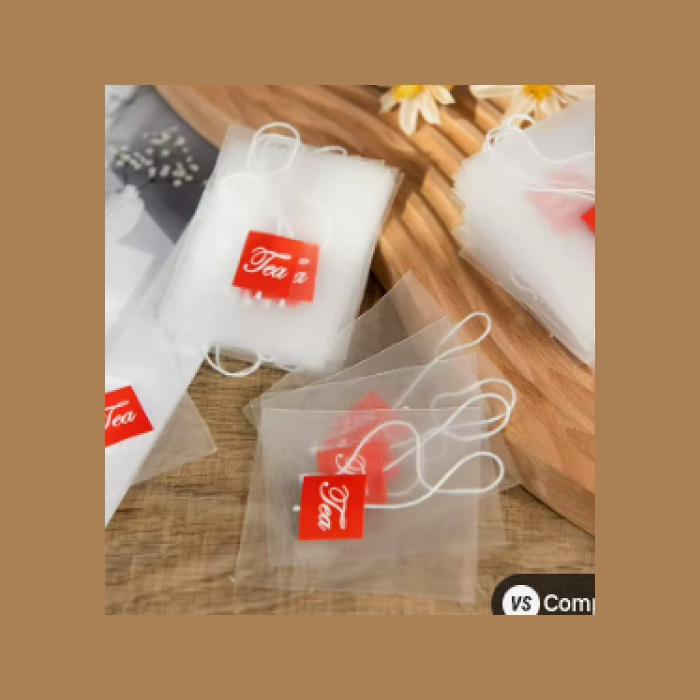
PLA corn fibre tea bags, 5.8 by 7 cm
A heat-sealable PLA corn fibre filter bag with a drawstring, at 5.8 by 7 cm.
- Role: Alibaba sourcing candidate
- 5.8 by 7 cm
- PLA fibre
- Heat seal
- MOQ: From 100 pieces
What bags cost
By Thés Traditions’ figures paper bags run about 1 to 3 cents each in packs of 200 to 1,000, and PLA about 3 to 5 cents [1]. Adagio sells 100 paper filters for $5, or 5 cents each by the arithmetic here [5], and a marketplace listing showed 100 bags of 5.5 by 4.7 inches for $12.99, about 13 cents each [13]. These prices come from seller pages and search results and may have changed. Bag cost is a small part of the product, but the dose in the bag, a gram more tea for every bag, is a larger cost on a run of a thousand.
Finished bags need an outer package. A paper filter bag is porous by design, so filled bags should go into a barrier pouch or tin; the pouch pages and [oxygen absorber page] cover that part.
Questions to ask the supplier
-
Is the paper heat-sealable, and at what temperature and time does it seal?
-
What are the exact dimensions, and is the size the flat bag or the opening?
-
What dose is the bag designed for, and at what leaf size?
-
What fibres are in it, and can you state compostability for the whole bag?
-
Is it food-contact approved, and chlorine free?
-
Can I have samples of two sizes?
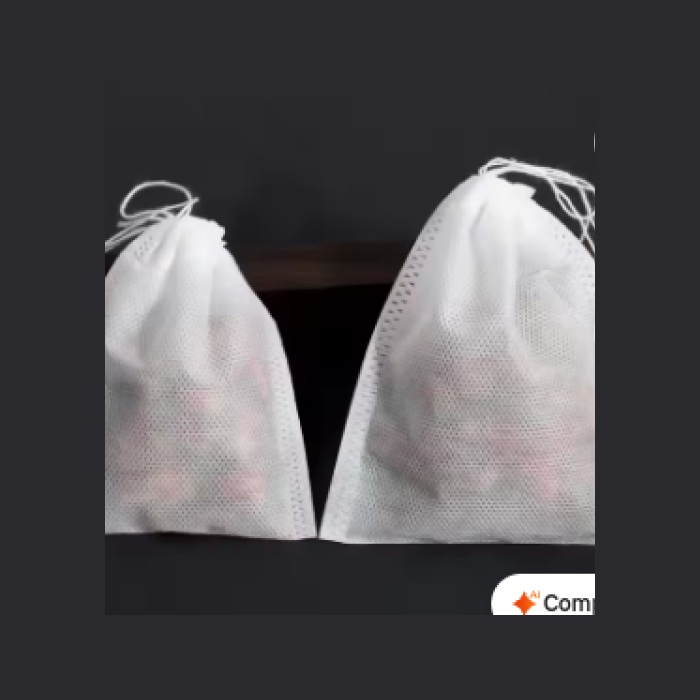
Non-woven drawstring tea bags, 8 by 10 cm
The larger, non-heat-seal option: a food-grade non-woven bag with a drawstring, in 8 by 10, 9 by 10 and 8 by 12 cm.
- Role: Alibaba sourcing candidate
- 8 by 10 cm
- Drawstring
- Non-woven
- MOQ: From 1 pack
Common mistakes
-
Sizing by grams alone. Volume decides the fit [6][7].
-
Filling to the brim. Leaves need room to open [1].
-
Heat-sealing a non-heat-seal paper. Check the grade [5][8][9].
-
Trusting “compostable” without asking. Seal fibres may be synthetic [12].
-
Skipping the boiling-water test. Weak seals can reopen in the cup [10].
FAQ
How many grams of tea go in a tea bag?
Sellers give anything from about 2 g to 8 g depending on bag size [1][2][3]. Thés Traditions suggests about 2 g for a 200 ml cup [1].
What size should a loose-leaf tea bag be?
A 6 by 8 cm bag is the standard for black and green tea; bulky herbals need 8 by 10 cm [1].
Can I seal tea bags with an iron?
Some sellers say yes for heat-seal bags [1][2], but one maker advises against heating its paper filters [5].
Are plastic mesh bags safe in hot water?
One seller advises avoiding nylon and polypropylene in very hot water [1]; nothing here was find an independent test.
References
- Thés Traditions, Empty tea bags buying guide. thes-traditions.com (tea retailer).
- Special Tea Company, 250 empty heat-seal tea bags, 2 x 3 in (listing). walmart.com (marketplace listing).
- Qweryboo, 500 empty tea filter bags with drawstring, 2.36 x 3.15 in (listing). walmart.com (marketplace listing).
- Frontier Co-op, T-Sac #3 tea filter. frontiercoop.com (retailer).
- Adagio Teas, Paper filters. adagio.com (tea retailer).
- Simple Loose Leaf, Guide to tea measurements. simplelooseleaf.com (tea retailer blog).
- Red Blossom Tea Company, 3 reasons to weigh your tea leaves. redblossomtea.com (tea retailer blog).
- Magnera, Tea filter paper. magnera.com (paper maker).
- Ahlstrom, Heatsealable and non-heat-sealable teabags. ahlstrom.com (paper maker).
- US patent literature on heat-sealable filter materials (sealing temperatures and cycle times), found via web search. Patent numbers not recorded; editor to add before publishing (patent background, industrial machines).
- US patent example describing four-side sealing at 210 C, 0.5 s, 3 bar, found via web search. Patent number not recorded; editor to add (patent example).
- US patent background on heat-sealable tea bag paper (about 75% natural fibre, 25% heat-sealing synthetic fibre), found via web search. Patent number not recorded; editor to add (patent background).
- Disposable tea bags for loose leaf tea, 100 pcs, 5.5 x 4.7 in, $12.99 (listing). walmart.com (marketplace listing; price displayed in search results).
Continue reading
Stand-Up Pouches: Fill Weight, Gusset and Usable Height
A pouch is listed by three numbers and none of them is the fill volume. Width, height and gusset describe a flat sheet of film, not the space left after the seal.
Spice Shaker Caps: Hole Size, Fit and Product Match
A shaker cap is three parts that are usually sold separately: the base, the rotating or flapping lid, and the liner. Buy them apart and the hole size is the last thing you check.
Metal Balm Tins: Fill Weight, Lid Type and Label Area
The ounce stamped on a balm tin is a trade size, not a fill weight. A 1 oz tin holds about 28 g of wax, and a little less of anything with oil in it.