Metal Balm Tins: Fill Weight, Lid Type and Label Area
The ounce stamped on a balm tin is a trade size, not a fill weight. A 1 oz tin holds about 28 g of wax, and a little less of anything with oil in it.
 Lena Schmidt
In this guide
- What the ounce on the tin means
- Fill-line weight is the number to use
- Shallow, deep, and the shape of the tin
- Lid types and what they trade
- Seamless tins and leaks
- Scent, colour and metal
- The label: lid, side or both
- What tins cost
- A two-week tin trial
- Questions to ask the supplier
- Where to buy the tins
- Common mistakes
- FAQ
- References
Quick answer. A balm tin’s nominal size is not its fill weight. CandleScience lists a 1 oz flat screw-top tin at 20 g to the fill line, and its 0.5 oz tin at 16 g, so the smaller tin’s fill line is more than the 0.5 oz in its name. Suppliers also disagree on dimensions for the same nominal size: a 1/2 oz tin is 1.5 inches wide at Uline and 1.7 inches at Specialty Bottle. Screw tops hold better than slip lids, seamless tins suit moist or oily products, and scented balms should be tested because fragrance can shift tin colour. Set your fill weight by filling a sample to the line you want and weighing it.
What the ounce on the tin means
Cosmetic and candle suppliers name tins by a nominal capacity, and the sources are open about the gap between name and contents. Sage’s technical note on containers explains that net means only what you can use, so a lip balm tube’s net weight is just the product above the pusher and not everything it can hold, and that FL OZ means fluid ounces, a measure of volume [8]. Berlin Packaging makes the same distinction for honey jars: a fluid ounce of water weighs one ounce, but honey is heavier, with a fluid ounce of honey about 1.5 net weight ounces [9]. Different products fill the same space with different weights, so there is no single weight for a “1 oz” tin.
Balm sits closer to water than honey does, but not at water’s weight. A hobbyist conversion sheet says a pound of beeswax occupies about 16 fluid ounces [16], which works out to roughly 0.96 g per mL (the arithmetic here, from a non-professional source). Oils and waxes in your own recipe will land somewhere near there, and you should measure it.
Suppliers also differ on what a nominal size looks like. The same “1/2 oz” flat screw-top tin is 1.5 by 5/8 inches at Uline [1], 1.5 by 0.63 inches at CandleScience [2], and 1.7 by 0.7 inches at Specialty Bottle [4]. A “1 oz” flat tin is 1 7/8 by 5/8 inches at Uline [1], 1.94 by 0.69 inches at CandleScience [2], and 1 7/8 by 3/4 inches at Mountain Rose Herbs for its push-top version [5]. These differences are small, but they are enough to change a label and a lid, which is why the sample comes first.
| Nominal size | Uline screw-top [1] | CandleScience screw-top [2] | Other supplier |
|---|---|---|---|
| 1/2 oz | 1 1/2 x 5/8 in | 1.5 x 0.63 in | Specialty Bottle: 1.7 x 0.7 in [4] |
| 1 oz | 1 7/8 x 5/8 in | 1.94 x 0.69 in | Mountain Rose push-top: 1 7/8 x 3/4 in [5] |
| 2 oz (shallow) | 2 1/2 x 7/8 in | not checked | Voyageur: 2 7/16 x 13/16 in [15]; Independent Can: 2 9/16 x 7/8 in [7] |
| 2 oz (deep) | 2 x 1 1/2 in | not checked | not checked |
Diameter by height as listed by each seller. Rows mix screw-top and push-top styles where noted, so read them as a spread, not a standard.
Fill-line weight is the number to use
CandleScience publishes the figure most small brands need, the weight to the fill line, on its tin pages. Its 1 oz flat screw-top tin, 1.94 inches wide and 0.69 inches tall, lists a base weight of 0.71 oz, or 20 g [2]. Its 0.5 oz tin lists 0.56 oz, or 16 g [2], which is more than the 0.5 oz in its name. The 0.25 oz slide-top tin lists 0.28 oz, or 8 g [2]. The reading here is that the names are loose volume labels and the fill-line weights are measured with a particular material, so the weights are only as good as the material behind them. CandleScience says on its container information page that such weights are estimates because fill levels and densities vary [3].
The same site shows how a fill line differs from brim capacity on a larger tin. Its 2 oz candle tin lists 1.50 oz, or 42.52 g, of wax to the fill line, and an overflow volume of 2.50 fl oz, or 71.03 mL [3]. Using 0.86 g per mL, a figure one calculator calls common for candle waxes [11], 42.52 g occupies about 49 mL, around 70 percent of the overflow volume (the arithmetic here, with an assumed density). A balm is denser and you may fill closer to the rim, but the lesson holds: the usable volume is not the brim volume, and the lid needs headspace.
Use the density method that cosmetic chemists use. Happi’s worked example finds density by dividing weight by volume in g per mL, then multiplies a container’s volume by it to get the fill weight [10]. For a tin, the steps below do the same job with a scale.
-
Weigh an empty tin with its lid. Note the weight, then weigh three more to see the spread.
-
Fill one with water to the line you want the balm to reach, leaving room for the lid. Weigh again; one gram of water is about one millilitre, so the difference is the usable volume.
-
Make a small batch of your balm. Pour three tins to the same line and let them set.
-
Weigh the set tins and subtract the empty weight. Divide by the water volume to get your balm’s density in g per mL.
-
Set the target fill weight from your set tins, and write it on the batch record. Check it again when you change a recipe, because oil and wax ratios change density.
Pour while the balm is warm and weigh after it sets. A balm can shrink as it cools, so a tin that looked full at the pour may sit lower the next day. That behaviour is an expectation here, not a sourced figure, but the set weight is the one that goes on the label.
Shallow, deep, and the shape of the tin
Container and Packaging separates deep tins, which range from 1 to 16 ounces and suit gifts, herbs and candles, from shallow tins, which run from a quarter ounce to 10 ounces and suit candies, lip balm and cosmetics [6]. Uline’s catalogue lists both under the same capacity names: a shallow 2 oz screw-top tin is 2 1/2 inches across and 7/8 inch high, while a deep 2 oz tin is 2 inches across and 1 1/2 inches high [1]. Our arithmetic on those outer dimensions gives about 4.3 cubic inches for the shallow and 4.7 for the deep, so they are similar in volume and quite different in footprint.
Lid types and what they trade
Container and Packaging describes three lid types for its round tins. The solid metal slip lid takes a label and can be pried off with a fingernail, but it holds on less securely than a screw top. The clear plastic slip lid has a metal ring around a clear centre, which shows the product and rules out a label over the plastic. The metal screw top offers the most security of the three and takes a label, but is harder to open with slippery hands [6].
Slide-top tins are a fourth option. CandleScience sells a 0.25 oz slide-top tin, seamlessly built, with a lid that opens and closes easily and seals securely [2]. Specialty Bottle suggests a twist-off or slider tin for lip balm so that customers can open it on the go and the lid is less likely to separate in a bag [14]. Independent Can lists Label Stick, hinged, slide-top and Clic-Clac closures as other options [7]. The sources reviewed show no independent test comparing how well they hold in a bag, so treat those descriptions as sales claims.
| Lid | What the sources say | Best for |
|---|---|---|
| Metal screw top | Most secure of the three; takes a label; harder with slippery hands [6] | Travel balms, oils that creep |
| Metal slip lid | Takes a label; opens with a fingernail; less secure [6] | Shelf product, stiff balms |
| Clear slip lid | Shows product; cannot take a label over the window [6] | Coloured or textured balms |
| Slide top | Opens and closes easily; seals securely, per the seller [2] | Pocket sizes, solid perfume |
Summary of seller descriptions; not an independent test.
Seamless tins and leaks
Independent Can says its tins are drawn and formed in one operation from tin-plated steel with no side or bottom seam, which it presents as suiting moist or fine products that could leak through the seams of other tins [7]. The same page gives no fill-level guidance and does not say how it measures capacity [7], so seamless construction is a point in favour of an oily or soft balm, not a guarantee. Uline’s screw-top tins are also described as tin plate with seamless construction and FDA compliant [1], and CandleScience describes its flat tins as seamlessly constructed with a screw-on lid that provides a secure seal [2].
Leaks usually show up in transit, after a warm shipment or a long wait in a car. If your balm is soft, the test is a day on its side in a warm place, with the lid on, followed by a look at the lid thread and the rim.
Scent, colour and metal
The tin is tin-plated steel, and metal and fragrance interact. CandleScience warns that components such as citrus oils, cinnamon oil and vanillin in fragrance oils can shift the colour of a candle tin, particularly at higher loads [12]. That is a candle supplier talking about candle tins, but a scented balm in a coloured tin is the same chemistry on a smaller scale, so test it. A Society of Cosmetic Chemists paper from the 1960s notes that tin corrodes in solutions of high acidity or alkalinity [13]. Most balms are anhydrous and not acidic, but a product with water, an acid or an alkali in it is a different case, and the paper is old, so we use it only as a reason to test your formula in a sample tin for a few weeks.
The label: lid, side or both
Tins offer little label space, and the suppliers give figures. CandleScience lists a maximum labelling area of 1.63 inches for its 1 oz tin and 1.38 inches for its 0.5 oz tin [2]. Mountain Rose Herbs says its 1/2 oz push-top tin can take a 1 1/4 inch circle label, its 1 oz tin a 1 1/2 inch label, its 2 oz tin a 2 inch label and its 4 oz tin a 3 inch label, and adds that the label size is a suggestion to be tested for your application [5]. Against the tin diameters listed above, those circles sit about 1/16 to 3/8 inch smaller, depending on the size; that gap is the margin the supplier chose.
If you label the lid, a screw top or a solid slip lid works and a clear lid does not [6]. If you plan a band, the [lip balm tin band page] covers film choice and lid height, and matching bands may be listed with the tin, as Specialty Bottle does with its 1/2 oz tin [4].
What tins cost
Prices reward volume. Specialty Bottle shows its 1/2 oz flat screw-top tin at $0.77 each for 1 to 299, $0.60 for 300 to 999, $0.54 for 1,000 to 4,999 and $0.45 for 5,000 to 10,000 [4]. Uline’s 1/2 oz shallow tins are sold by the carton of 48, at $32 for one carton, about 67 cents each by the arithmetic here, falling to $27 at four cartons [1]. Voyageur lists a 1 oz silver shallow screw-top tin at $1.20 [15]. These are prices displayed on seller pages, so verify them before you rely on them.
A two-week tin trial
-
Order a dozen of each candidate tin and lid style, from the same supplier, in the size you will sell.
-
Find the usable volume with water, then the fill weight with your balm, as above.
-
Fill ten tins and let them set for 24 hours. Weigh them again and note any sink or crack.
-
Leave five in a warm place for a week and five at room temperature. Look for oil on the lid and rim.
-
Put two on their sides in a bag or box for a day to see whether lids hold.
-
Open and close each tin twenty times, with dry hands and with slippery ones.
-
Apply the label and check that it stays flat on the lid and does not touch the thread.
Record the tin, lid, fill weight and results. That sheet is your spec for reorders.
Questions to ask the supplier
-
What is the measured capacity to the brim and the recommended fill line, and in what material?
-
What are the outside diameter and height with the lid on?
-
Is the tin seamless, and is it lined or bare tin plate?
-
What is the maximum recommended label diameter on the lid and on the side?
-
Do you list a matching shrink band, and for which lid style?
-
What is the minimum order, and are samples available?
Where to buy the tins
The listing below is the standard pack: a 15 ml aluminium tin with a screw lid, sold from 200 pieces.
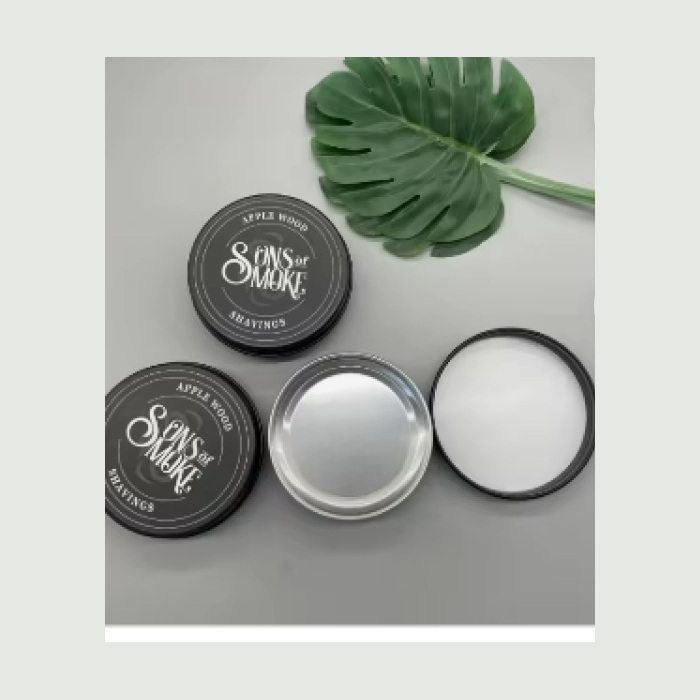
15 ml aluminium tins, screw lid
A round aluminium tin at 15 ml with a black screw lid.
- Role: Alibaba sourcing candidate
- 15 ml
- Screw lid
- Aluminium
- MOQ: From 200 pieces
Common mistakes
-
Filling by the nominal ounce. The name is not the weight [2][8].
-
Assuming sizes match across suppliers. They do not [1][2][4].
-
Using a clear lid and a lid label. The label blocks the window [6].
-
Skipping the scent test. Fragrance can shift tin colour [12].
-
Weighing before the balm has set. Weigh the set tin.
FAQ
How much balm fits in a 1 oz tin?
CandleScience lists 20 g to the fill line for its 1 oz flat tin [2]; your balm’s density and fill line will change that, so weigh your own.
Is a 1/2 oz tin really 1/2 oz?
The same supplier lists 16 g to the fill line for its 0.5 oz tin, which is more than 0.5 oz [2]. Treat the name as a label.
Which lid keeps balm in best?
Container and Packaging says the screw top is the most secure of its three round-tin lids [6].
Do seamless tins leak less?
Independent Can says they suit moist or fine products because there is no seam to leak through [7].
References
- Uline, Screw-top metal tins (shallow and deep, sizes and prices). uline.com (distributor; prices as displayed in search results).
- CandleScience, 1 oz, 0.5 oz and 0.25 oz tin product pages. candlescience.com (supplier; fill-line weights are estimates).
- CandleScience, 2 oz candle tin pages and container information page. candlescience.com (supplier).
- Specialty Bottle, 1/2 oz flat tin container with screw-top cover. specialtybottle.com (distributor).
- Mountain Rose Herbs, Push top tins. mountainroseherbs.com (retailer).
- Container and Packaging, Tinside out: meet the little tins. containerandpackaging.com (distributor blog).
- Independent Can, Seamless tins. independentcan.com (manufacturer).
- TheSage, One-minute technical support on containers: weight and volume. thesage.com (supplier technical note).
- Berlin Packaging, Calculating honey weight (Nov 2019). berlinpackaging.com (distributor).
- Happi, density and fill weight calculation. happi.com (trade magazine).
- Calculator Academy, Wax weight calculator. calculator.academy (calculator site; generic wax density).
- CandleScience, 4 oz candle tin (note on fragrance components and tin colour). candlescience.com (supplier).
- Society of Cosmetic Chemists, corrosion of containers, vol. 20 no. 1. library.scconline.org (journal archive, 1960s).
- Specialty Bottle, How to choose the best metal tin for your business. specialtybottle.com (distributor).
- Voyageur Soap and Candle, 1 oz and 2 oz screw-top metal tins. voyageursoapandcandle.com (retailer).
- BellaOnline, Candlemaking measurement conversions. bellaonline.com (hobbyist site; indicative only).
Continue reading
Stand-Up Pouches: Fill Weight, Gusset and Usable Height
A pouch is listed by three numbers and none of them is the fill volume. Width, height and gusset describe a flat sheet of film, not the space left after the seal.
Spice Shaker Caps: Hole Size, Fit and Product Match
A shaker cap is three parts that are usually sold separately: the base, the rotating or flapping lid, and the liner. Buy them apart and the hole size is the last thing you check.
Empty Tea Bags: Size, Fill Weight and Seal Type Guide
A tea bag is sold by the flat size of the sheet, and tea is mostly air. The bag that holds 3 g of fine fannings will not hold 3 g of a whole-leaf oolong.