Roller Bottles: Ball Material, Insert Fit and Leak Fixes
A roller bottle is three parts that have to agree: the vial, the insert and the ball. Buy them from different suppliers and the 18 mm that fits one does not fit the other.
 Lena Schmidt
In this guide
- What is in a roller bottle?
- Which ball material should you choose?
- Which vial and how big?
- Why two 18 mm parts may not fit
- How do you assemble it without leaks?
- What do you do when it leaks or sticks?
- A small bottle still needs a label that fits
- Testing the plastic parts against your blend
- What do the parts cost?
- A trial before a bulk order
- Questions to ask the supplier
- Where to buy the bottles
- Common mistakes
- FAQ
- References
Quick answer. A roller bottle has three parts: the vial, a ball-and-housing insert that presses into the neck, and a screw cap. Stainless steel balls glide more smoothly than generic plastic ones in one reviewer’s experience, and retailers say strong oils can pit plastic, but no source the sources reviewed show tested this. The insert should be pressed in until it clicks (Uline’s sheet says three clicks), with the rim dry and some headspace left; a loose or wet seat is the usual cause of leaks. Not every 18 mm insert fits every 18 mm vial, so match the insert, the neck and the cap together. Before ordering a case, assemble ten bottles, fill them with your real blend, and leave them on their sides overnight.
What is in a roller bottle?
AromaWeb lists the parts as a glass bottle, a ball, a ball housing that fits into the bottle, and a polypropylene cap that screws onto the bottle; the ball is often already installed in the housing, but not always [1]. Berlin Packaging sells its 10 ml vials the same way, with a stainless steel ball, a polypropylene housing and a polypropylene cap, and notes that assembly is required [4].
The housing is the part that matters. It presses into the neck and holds the ball, and the cap screws over it. So the vial, the housing and the cap each have to fit the other two, and none of them can be treated as a stand-alone buy.
Which ball material should you choose?
| Ball | What sources say | How far to trust it |
|---|---|---|
| Stainless steel | Glides most smoothly in one reviewer’s experience [1]; durable, with a cooling feel [2]; sellers say it resists corrosion from strong oils [2] | Reviewer and supplier views; not lab tests |
| Plastic (usually PE) | Light and cheap [2]; generic ones glide less smoothly [1]; a retailer says plastic balls can pit or warp with strong oils [10] | Retailer claim; one reviewer’s guess about friction |
| Glass | Chosen because it does not react with essential oils, per Miron, which sells glass, plastic and steel balls [11] | Supplier view |
Views paraphrased from the cited pages. None of the pages reports a test of ball wear or oil resistance.
The agreement across sources is that the ball should suit the formula. A Packaging Group lists material compatibility, ball mechanism, bottle size, colour and cap type among the five things to match [3]. AromaWeb adds that the way the ball sits in the housing opening affects glide whatever it is made of [1]. A ball that fits badly rolls badly even if it is steel.
If your blend is high in essential oil or alcohol, the choice would test the plastic ball before committing. That is a caution here, not a finding. A retailer that sells roller bottles says inexpensive bottles usually include plastic balls that can become pitted or misshapen with strong oils [10], and one Hobby Lobby reviewer reports that 8 of 10 balls stuck, with a tip to pop the ball out and back in [13]. A single review proves little, but a stuck ball is common enough that you should check for it.
There is another design to know about. Aromatools sells a spring-loaded stainless steel roller that seals by pressing the ball against the housing. Its page says to use it only with the lid that comes with it, because another lid may press the ball down and make oil flow [7]. If you pick a special insert, buy the lid with it.
Which vial and how big?
Amber, cobalt or dark green glass filters UV light, which AromaWeb notes can shorten the life of a blend, while clear bottles should be kept out of direct light [1]. Berlin Packaging describes its amber vials as UV filtering for light-sensitive contents [4]. If your product is light-sensitive and you sell in clear glass, the carton has to do the protecting.
Dimensions help when you design the carton. Bramble Berry lists a 10 ml amber roller bottle at 3.3 inches tall with the cap and 0.8 inch in diameter [12]. Aromantic gives a similar 10 ml glass roller at 19 mm across and 85 mm tall with the cap on [8]. A trade-press release says 5 to 10 ml is the most popular size for personal use and 15 to 30 ml suits at-home use [14], though that source is a press-release article, so read it as a market description and not as research.
One practical check before you print net contents: fill a sample vial with water to the level you will actually use, leaving headspace for the insert, and weigh it. The weight tells you the real fill in grams, and for a blend lighter or heavier than water you can adjust from there. Printing 10 ml on a label for a vial you fill to 8 is a promise you do not want to keep.
Why two 18 mm parts may not fit
Roller bottle parts are sold by neck size, and the number hides details. One seller lists a black roll-on insert with a cap under the code 18-400 and says it works with its amber and blue 5 to 100 ml bottles but not its 0.5 oz green bottles [5]. Another seller lists a spring-loaded roller fitment with an 18-415 neck for standard 5, 10, 15 and 30 ml vials [7]. The two numbers share a diameter but differ in thread style, the same way 24/410 and 24/400 differ for pumps (see our page on lotion pump specs). That is the reading here of the codes; the pages do not explain it, so ask each seller to confirm the pairing in writing.
The practical rule is to buy the vial, the insert and the cap from one seller, or to test them together before any bulk order. A set listed as a complete assembly is safer than parts mixed from three shops. If you must mix, test the exact lot.
How do you assemble it without leaks?
Several sellers describe the same sequence, and it is worth following closely.
-
Fill the vial using a small funnel, leaving some space at the top so the insert can seat. One seller says to avoid overfilling [5]; another trade source suggests about 90 percent capacity, though that is a press-release article [14].
-
Make sure the rim of the vial is dry before the insert goes in, since a wet rim can cause leakage [5].
-
Set the insert over the neck and press down firmly until it snaps into place [5]. Uline’s troubleshooting sheet says to press until three clicks are heard [6].
-
Use an insertion tool. One seller says its press applies even pressure across the housing and avoids damage to the ball or collar [5], and another says to avoid pressing directly on the metal ball [15].
-
Screw the cap on tightly [5].
-
Tip the bottle upside down or shake it once before first use so the ball is wet [5].
Know that the step is hard to undo. Aromantic warns that once the insert is snapped in it is difficult to remove, so every ingredient should be in the vial first [8]. A reviewer on a marketplace listing made the same point about refilling and wished for a removal tool [15]. If you plan refills for customers, say so before you pick the parts.
What do you do when it leaks or sticks?
| Problem | Likely cause | What sellers suggest |
|---|---|---|
| Leaks or is not airtight | Ball or insert not seated securely [6]; wet or overfilled rim [5] | Reseat the ball; dry the rim; use a press tool [5][6] |
| Ball will not go in | Not pushed all the way in [6] | Firm pressure until three clicks [6] |
| Hard to push in by hand | Takes significant force [6] | A manual press for high volume [6][9] |
| Ball will not roll | Ball stuck or poorly fitted [1][13] | Pop the ball out and back in, per one reviewer [13] |
| Product will not roll | Product too thick; Aromantic lists viscous products as unsuitable [8] | Thin the formula or choose another closure |
Fixes as stated by sellers and one reviewer; none were tried here.
If the ball is the problem and you cannot cure it, change the insert rather than the formula. If the leak is at the cap, check the cap is the one meant for the insert, and check the liner if there is one. Leak checks belong in your trial, because a bottle that is dry on the bench can weep once it has travelled.
A small bottle still needs a label that fits
A 10 ml roller bottle is about 19 mm across [8], so a label that wraps all the way round needs roughly 60 mm of length plus a small overlap (19 mm times pi, the arithmetic here). The bottle is also about 85 mm tall with the cap on [8], and most of that is the cap and the neck, which leaves little straight wall for artwork. Design the label for the straight section of glass, keep it clear of the shoulder, and test a sample on a real bottle before you print a roll. The page on shrink bands for roller bottles explains why bands for the same bottle are so tall.
Testing the plastic parts against your blend
The housing and cap are polypropylene [1][4] and the ball may be plastic. One supplier insights page says that some essential oils or alcohol-based solutions may degrade certain plastics [16], which is a general caution and not a test of any particular part. A cheap check is to leave a spare insert and a spare plastic ball in a sample of your blend for a week, then compare them with an untouched part. Look for softening, swelling, cloudiness or a ball that no longer turns. It will not replace a stability study, but it catches the obvious failures before you fill a batch, and it costs only a spare part and a jar.
Do the same for the cap liner, if the cap has one. A liner that swells or sheds into a perfume oil is easier to find now than in a customer’s bag.
What do the parts cost?
Prices below were displayed in November 2026 and are for small quantities. Voyageur lists a 10 ml clear glass roller bottle with a white cap and plastic ball at $1.25 [5]. Aromatools sells clear glass roll-on vials with black caps in a pack of 6 at $4.20 and amber vials with its spring-loaded stainless rollers in a pack of 6 at $10.44 [7], which is about 70 cents and $1.74 each (the arithmetic here). A separate 18 mm black insert with cap is $0.86 at Voyageur, and its page says the installer and removal tool, sold separately, is required to avoid damaging the housing [5]. An Etsy seller lists a roller ball press for 5 and 10 ml bottles at $17 [9].
So the tool costs about as much as twenty inserts (the arithmetic here). For a first run of a few dozen bottles you can press by hand with care, but past a hundred or so the press pays back in fewer damaged housings. That estimate is our reasoning.
Mini PP funnels for filling 10 ml vials
A PP mini funnel for filling narrow-neck vials, the step where overfilling causes most of the leaking this guide covers.
- Role: Alibaba sourcing candidate
- Mini size for 5 to 30 ml vials
- Polypropylene body
- Sold in bulk for a filling bench
- MOQ: Check current listing
A trial before a bulk order
-
Order ten complete sets of the exact vial, insert and cap, plus five spare inserts.
-
Fill ten vials with your real blend, leaving headspace.
-
Assemble five by hand and five with a press, noting how many clicks you hear and how much force it takes.
-
Roll each bottle across the back of your hand for a minute. A stuck or gritty ball is a fail.
-
Lay all ten on their sides overnight on tissue, then upright for a day, and look for oil at the neck.
-
Shake them, then check that the insert has not shifted.
-
Leave two bottles in a warm place for a week and look again.
Write down which seller, lot, ball material and assembly method each bottle used. If a later lot leaks, those notes show whether the part changed or the process did.
Questions to ask the supplier
-
Is this insert made for this exact vial, and what thread is the cap?
-
What is the ball made of, and is it tested with essential oils or alcohol?
-
What is the vial’s neck diameter and the insert’s outside diameter?
-
Is a press or removal tool recommended, and do you sell one?
-
Does the cap include a liner?
-
Can I have samples of the full assembly?
Where to buy the bottles
The listing below is the standard pack for a small essential oil brand: a 10 ml glass vial, a plastic insert and a steel ball, supplied together.
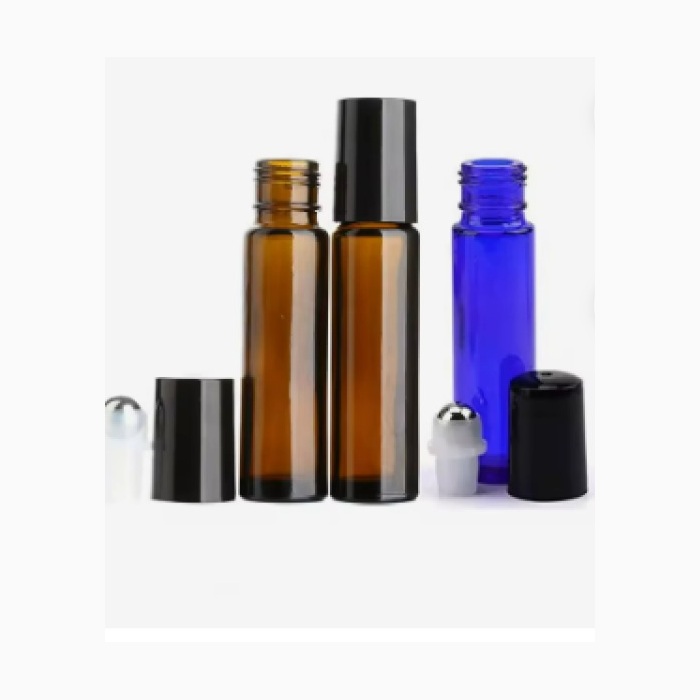
10 ml glass roller bottles, steel ball
Amber and blue glass vials at 10 ml with a plastic insert and a stainless steel ball fitted, plus a black cap.
- Role: Alibaba sourcing candidate
- 10 ml
- Steel ball fitted
- Amber or blue
- MOQ: From 100 pieces
Common mistakes
-
Mixing parts by neck size alone. The same diameter can hide a different thread [5][7].
-
Choosing a plastic ball for a strong blend without testing. Retailers say it can pit [10].
-
Overfilling. The insert needs headspace [5].
-
Pressing on the ball. Use a tool and press on the housing [5][15].
-
Planning refills with a press-in insert. It is hard to remove [8].
FAQ
Can I use undiluted essential oil in a roller bottle?
AromaWeb says not to apply undiluted essential oils to the skin and refers readers to a dilution guide [1]. Dilution and safety are for your formulator, not the packaging supplier.
Does a roller bottle need a band or seal?
The insert is not tamper-evident. See the page on shrink bands for roller bottles.
Why does my ball squeak or stick?
A poor fit in the housing opening affects glide [1], and strong oils may affect plastic [10]. Try a stainless ball.
Can I fill a roller bottle with a thick cream?
Aromantic lists viscous products as unsuitable [8].
References
- AromaWeb, Buying essential oil roller bottles (reviewer view on ball material and parts). aromaweb.com (aromatherapy information site; one author’s opinion).
- A Packaging Group, What type of roller ball is best, stainless steel or plastic? apackaginggroup.com (packaging supplier blog).
- A Packaging Group, Can I put essential oils directly into a roller bottle? apackaginggroup.com (packaging supplier blog).
- Berlin Packaging, 2.7 dram (10 ml) glass vials with stainless steel roller ball and PP cap (clear and amber). berlinpackaging.com (packaging distributor).
- Voyageur Soap & Candle, 10 ml roller bottles, 18 mm roll-on insert (headspace, snap-in, installer tool; prices as displayed Nov 2026). voyageursoapandcandle.com (retailer).
- Uline, S-24344 glass roll-on bottle troubleshooting sheet (TS-24344). uline.com (supplier instruction sheet).
- Aromatools, SpringLock stainless steel rollers and 10 ml vials (prices as displayed). aromatools.com (retailer).
- Aromantic, Roll-on bottle 10 ml glass mini (fill tips; removal; viscous products). aromantic.co.uk (UK retailer).
- Etsy listing, rollerball press for 5 and 10 ml bottles. etsy.com (marketplace; single seller, price as displayed).
- Loving Essential Oils, Mistakes when buying empty essential oil roller bottles. lovingessentialoils.com (retailer blog).
- Miron Violetglass, Roll-on caps (glass, plastic and steel balls). miron.com (glass maker).
- Bramble Berry, Amber glass roller bottle 10 ml (dimensions). brambleberry.com (retailer).
- Hobby Lobby, Amber glass roller bottles (customer reviews). hobbylobby.com (retailer; anecdotal reviews).
- The Essential Guide to Roll On Bottles for Any Application (25 Dec 2025). business.mammothtimes.com (press-release article; low reliability).
- Desertcart listing, 10 ml amber roller bottles with stainless steel rollers (customer reviews). desertcart.co.th (marketplace; anecdotal reviews).
- Alibaba product insights, 20 ml roll-on bottles square (material compatibility caution). alibaba.com (supplier insights page; general statement).
Continue reading
Stand-Up Pouches: Fill Weight, Gusset and Usable Height
A pouch is listed by three numbers and none of them is the fill volume. Width, height and gusset describe a flat sheet of film, not the space left after the seal.
Spice Shaker Caps: Hole Size, Fit and Product Match
A shaker cap is three parts that are usually sold separately: the base, the rotating or flapping lid, and the liner. Buy them apart and the hole size is the last thing you check.
Metal Balm Tins: Fill Weight, Lid Type and Label Area
The ounce stamped on a balm tin is a trade size, not a fill weight. A 1 oz tin holds about 28 g of wax, and a little less of anything with oil in it.