Airless Pump Bottles: Fill, Dose and Compatibility Guide
An airless bottle has no dip tube and no air in the headspace. That fixes two problems and creates three new ones, all of them at the fill line.
 Lena Schmidt
In this guide
- How does an airless bottle work?
- How much of the product comes out?
- What dose per stroke should you expect?
- Does your formula suit an airless bottle?
- How should you fill an airless bottle?
- How do you prime it, and what if it sticks?
- What do they cost, and what do you have to buy?
- A trial for one afternoon
- Questions to ask the supplier
- Where to buy the bottles
- Common mistakes
- FAQ
- References
Quick answer. An airless bottle pushes a small piston up from the base as you pump, so product is drawn out without air coming in, and sellers claim 90 to 95 percent of the fill is delivered. Three things go wrong most often: an under-filled or bubbly fill that leaves the piston stuck, a formula the plastic parts do not tolerate, and a first-time user who does not know to prime the pump. Doses are small, from about 0.1 to 1 ml per stroke on the listings the sources reviewed show, so check the figure. Order five bottles, fill them the way you will fill the batch, prime them, and weigh ten strokes before you buy a case.
How does an airless bottle work?
There is no dip tube. A small plastic piston, a disc that sits against the inner wall at the base, rises as the product leaves. One packaging supplier describes it this way: pressing the actuator pushes product toward the nozzle, and in the bottle a small vacuum forms in the pump chamber, so the piston moves up [3]. Because nothing replaces the product with air, the formula stays away from oxygen between uses [8].
The same supplier points out a detail that confuses new users: the base of the bottle has a small air hole, which lets air in beneath the piston so that it can rise [3]. That hole is also the reason a trapped piston can be freed with a poke, which the priming section comes back to. And the pump and the bottle are designed as a pair and used strictly together [3], so you cannot swap a pump from one maker onto another bottle and expect it to work.
How much of the product comes out?
The main selling point is evacuation, the share of the fill the customer can actually use. A packaging supplier says the piston sweeps the bottle wall, so evacuation is typically in the region of 90 to 95 percent of the fill, against a dip-tube pump that routinely strands more [1]. A second article, citing a Cosmopacks figure, puts airless at up to 95 percent and a dip-tube bottle at 75 to 85 percent [4]. Both are sellers or seller-aligned writers. They give a believable range, but they are not tests, and a thick cream in an awkward bottle may do worse.
For you, the practical point is residue. If a 30 ml bottle returns 90 percent, the customer gets about 27 ml, and about 3 ml stays behind (the arithmetic here). If you advertise net contents, fill so that the declared amount is met with the bottle sealed, not with what the customer manages to pump out, and check the rules for your market on net quantity.
What dose per stroke should you expect?
| Airless product as listed | Dose | Sizes | Seller |
|---|---|---|---|
| PP/AS treatment bottle, 20/410 [10] | 0.25 cc | 30 and 50 ml | A Packaging Group |
| Aluminum airless bottle with pump [9] | 0.17 mL | 15, 30, 50 mL | US Plastic |
| White PP airless bottle [11] | 0.40 mL | 50 ml | FH Packaging |
| Pearl Mini Airless, 32 mm pump [12] | 0.45 ml | 15, 30, 50 ml | Silgan Dispensing |
| Pearl Airless, 48 mm pump [12] | 1 ml | 50 to 200 ml | Silgan Dispensing |
Doses and sizes as listed by each seller. Silgan lists the same product family at several outputs; this is not a complete survey.
Across the market the range is wider than the table. Packari lists airless dispensers from 0.2 ml (its Nano) to 2 ml (its Macro), set by the volume of the bellows [13], and a trade-magazine article describes outputs from 0.09 to 1.0 ml [13]. Jarsking explains the contrast with ordinary pumps: a body-lotion pump might deliver 0.5 to 3.0 ml per stroke, while a treatment pump typically sits in the 0.1 to 0.4 ml band [1].
A small dose is deliberate. A serum is applied in drops, so a 0.25 ml stroke is about right, and a 1 ml stroke would overshoot. The number to watch is how many strokes the bottle provides. A 30 ml bottle with a 0.25 cc pump gives about 120 strokes; with a 0.17 mL pump about 176 (the arithmetic here, before residue). If your label tells people to use two pumps a day, that is a matter of weeks, and the dose is part of what you promise.
Does the dose hold steady as the bottle empties? For a dispenser used by compounding pharmacists, the manufacturer’s instructions say testing showed weights per stroke near empty were almost identical to those when full, because the mechanism works by volume [16]. That is one product, and the claim comes from its maker, so treat it as a reason to test your own. Our weighing method is in the trial below.
Does your formula suit an airless bottle?
The answer depends on the formula and the parts. A Packaging Group advises confirming that the bottle, piston, diaphragm, pump and seals work with the formula’s ingredients, viscosity and pH [2]. Another supplier says to check material compatibility, such as polypropylene against polyethylene, to avoid swelling, leakage or unstable dispensing, and mentions that it often recommends PP for active serums [17]. A third says only liquid and cream products suit its airless bottle [17].
Read those as a checklist. Ask the seller what the piston and the seals are made of, and then ask your ingredient supplier whether your oils, solvents or alcohol attack those materials. Silgan said something similar about foam pumps, where some oils clog the mesh (see the page on foamer pumps); the mechanism differs, but the habit of asking is the same. If your product contains a high level of essential oil or alcohol, run the compatibility test before anything else, because a swollen piston will not fail on the first day.
How should you fill an airless bottle?
Filling is where most problems start. A Cosmetics Business article warns that if the bottle is under-filled and the pump does not cover the formula, suction is incomplete and the piston may not move all the way, which gives a poor experience [5]. A supplier blog adds that over-filling builds pressure that affects pump performance, and that air bubbles introduced while filling can disrupt the vacuum effect [6]. So the target is a full fill, without bubbles, to the line the manufacturer specifies.
Two ways of filling exist. Aptar Pharma describes top-fill and bottom-fill versions of its system, and offers to pre-position the piston to set the fill level and reduce waste [7]. Berlin Packaging describes standard top-fill designs for retail, and refillable bottom-fill systems where the inner cartridge can be replaced [8]. For a small brand the usual route is top-fill by hand or with a small filler, with these habits.
-
Reset the piston to the bottom before filling, if the bottle has one that can move.
-
Fill slowly down the wall of the bottle, not in a stream, to avoid bubbles. A thick cream can be filled with a piping bag or a syringe.
-
Stop at the fill line the supplier gives. If none is given, ask for it.
-
Tap the bottle on a pad to settle the product, then top up.
-
Fit the pump and seat it fully. A pump that is not tight lets air in, and the vacuum fails.
-
Prime each pump before it leaves you, if your process allows. A supplier blog recommends priming the pumps during filling where possible [6].
How do you prime it, and what if it sticks?
The first press of a new airless pump often produces nothing, and a supplier blog says that is not a defect: the vacuum seal has not engaged yet [6]. Instructions from brands that use these bottles vary. NOW Foods tells customers to pump slowly ten to fifteen times to activate the vacuum system [15]. Another brand says to cover the opening completely with a finger and pump slowly several times [15]. Adorn Cosmetics says to hold the bottle upside down while pumping to release trapped air [15].
If that fails, two brands describe freeing the piston. Del Mar Laboratories says to turn the bottle upside down, find the small hole in the base, and push a paperclip or toothpick into it to release the floor plate [15]. Adorn suggests a firm tap on a hard surface, then shaking and storing the bottle upside down overnight [15]. We have not tried either, and a tool in the air hole can damage a bottle, so treat these as brand advice and put the one that works for your bottle on the insert.
Put a line about priming on the carton or insert. It costs nothing and heads off the complaint that one supplier blog calls the most common with airless bottles, a pump that seems dead on first use [6].
What do they cost, and what do you have to buy?
US Plastic lists frosted and brushed aluminum airless bottles with pumps at $3.13 each for 15 mL, $2.80 for 30 mL and $3.62 for 50 mL, with discounts of 5 percent at 25 or more, 10 percent at 50 and 15 percent at 150, as displayed in November 2026 [9]. That makes a stocked item practical for a first batch. By contrast, a manufacturer listing for a treatment airless bottle states a minimum of 10,000 pieces [10]. For a first launch, a stocked catalogue item is the better route.
Plan the size too. New Directions lists a 30 ml airless bottle at 120.6 mm tall and a 50 ml at 158 mm, both 30.5 mm across [14], while FH Packaging lists a 50 ml bottle 135 mm tall and 31 mm across [11]. Bottle heights differ by maker, so check the carton before you design it.
A trial for one afternoon
-
Order five bottles of the model you intend to use, plus a few spare pumps.
-
Check compatibility first: soak a spare piston or seal sample, if the seller will supply one, in your formula for a week and look for swelling or softening.
-
Fill five bottles by your planned method, and note the fill level and any bubbles.
-
Prime and count how many presses it takes before product appears.
-
Weigh ten strokes on a scale and divide by ten, as the compounding instructions do [16]. Repeat when the bottle is about half empty and nearly empty.
-
Leave one bottle on its side and one upside down overnight and check for leaks at the neck and the base.
-
Empty one bottle completely and weigh what is left, to find your real residue.
Record the numbers, because they are what you tell your customers and what you give the supplier if a lot behaves differently.
One more habit pays off. Write the measured dose and the number of strokes on your own spec sheet, next to the lot number of the bottles. When a customer says the bottle ran out early, you can compare their usage with the number of strokes you measured, and you will know whether to look at the pump, the fill or the instructions.
Questions to ask the supplier
-
What are the piston, diaphragm and seal materials, and are they tested with my type of formula?
-
What is the dose per stroke and the fill line for each size?
-
Is it a top-fill or bottom-fill design?
-
How do you recommend priming, and is there a way to free a stuck piston?
-
What is the real evacuation, measured with a product like mine?
-
What are the bottle dimensions, with the pump on?
Where to buy the bottles
The listing below is a standard airless pack: a bottle, an inner piston and a pump, sold as one unit in sizes from 30 to 150 ml.
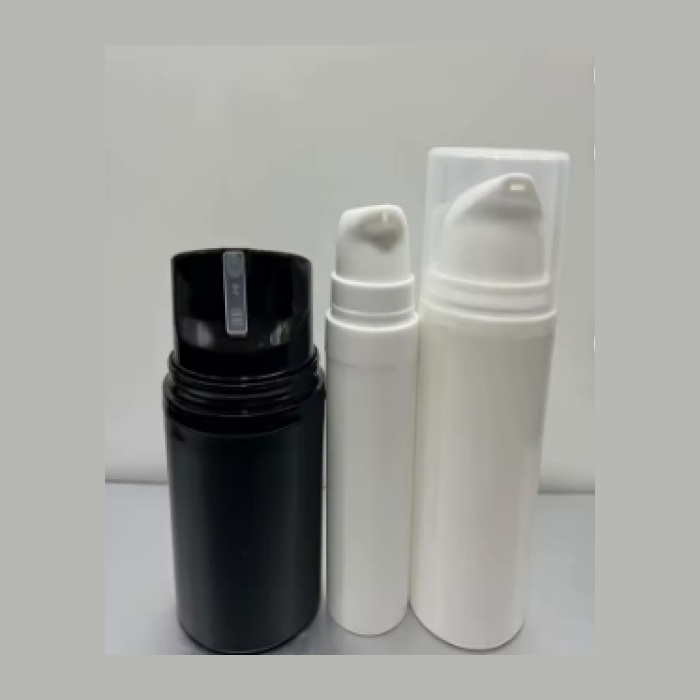
Airless pump bottles, 30 to 150 ml
Round airless bottles in black and white, 30 to 150 ml, with the piston and pump supplied as one unit.
- Role: Alibaba sourcing candidate
- 30 to 150 ml
- Piston inside
- Black or white
- MOQ: From 100 pieces
Common mistakes
-
Treating it like a lotion pump. There is no tube, and the fill matters [3][5].
-
Under-filling to save product. The piston may not travel properly [5].
-
Skipping the compatibility test. Ingredient damage shows up weeks later [2][17].
-
Not telling customers to prime. First-use failures are a common complaint [6].
-
Trusting the efficiency claim. Sellers say 90 to 95 percent; measure your own [1][4].
FAQ
Can I refill an airless bottle?
Some designs are made for it, such as refillable cartridges [8]. Others are not. Ask the seller before promising refills.
Why does mine stop working halfway?
Causes in the sources include a trapped piston, a leak at the neck that kills the vacuum, or a formula that attacked the parts [15][17]. Check the seal first.
Is airless better for preservation?
It limits air contact [8], which helps with oxygen-sensitive formulas. It is not a substitute for a preservative system, which is a question for your formulator.
What size should I start with?
Fifteen to fifty millilitres is the common range in the listings the sources reviewed show [9][10][13].
References
- Jarsking, dispenser guide (four jobs of a dispenser; airless evacuation 90 to 95 percent; treatment pump dose range). jarsking.com (packaging supplier; marketing content).
- A Packaging Group, How do airless pump bottles work? apackaginggroup.com (packaging supplier blog; compatibility factors).
- A Packaging Group, 100 ml airless pump bottle (air hole in the base; matched pump and bottle). apackaginggroup.com (packaging supplier blog).
- Nerdbot, The surprisingly clever engineering inside an airless pump bottle (2 Jul 2026), citing Cosmopacks figures. nerdbot.com (secondary article; seller claim).
- Cosmetics Business, The airless experience: everything you need to know. cosmeticsbusiness.com (trade publication).
- Cosmopacks, Airless pump bottle not working? (Dec 2025) and Common airless pump bottle problems (Feb 2026). cosmopackschina.blogspot.com (packaging supplier blog).
- Aptar Pharma, Airless+ top- and bottom-fill technology. aptar.com (dispensing manufacturer).
- Berlin Packaging APAC, Airless pump bottles. berlinpackagingapac.com (packaging distributor).
- U.S. Plastic Corp., Frosted/brushed aluminum airless bottles with pumps (0.17 mL per stroke; price breaks as displayed Nov 2026). usplastic.com (packaging distributor).
- A Packaging Group, PP/AS treatment airless pump bottle (0.25 cc) and Absolute Skin treatment pump bottle (MOQ 10,000). apackaginggroup.com (packaging supplier).
- FH Packaging, 50 ml white PP airless pump bottle (0.40 mL, 135 mm). fhpkg.com (packaging distributor).
- Silgan Dispensing, Pearl Airless brochure (Dec 2023). silgandispensing.com (dispensing manufacturer).
- Packari, Airless dispenser vs. pump dispenser; Beauty Packaging, Harnessing the advantages of airless packaging (May 2024). packari.com and beautypackaging.com (supplier blog and trade magazine).
- New Directions Aromatics, Airless dispenser refillable frosted bottle (30 ml and 50 ml dimensions). newdirectionsaromatics.ca (retailer).
- NOW Foods, Airless pump dispenser FAQs; Sun Coast Science and Del Mar Laboratories help pages; Adorn Cosmetics help pages. Brand support pages (priming and stuck-piston advice).
- HCL, Instructions for 10393 airless dispenser (weighing ten strokes; near-empty weight per stroke). gohcl.com (compounding supplier instructions).
- Topfeelpack, Airless pump jar not working? Quick fixes; Paramount Global, 30 ml clear PET airless pump bottle. topfeelpack.com and paramountglobal.com (packaging suppliers).
Continue reading
Stand-Up Pouches: Fill Weight, Gusset and Usable Height
A pouch is listed by three numbers and none of them is the fill volume. Width, height and gusset describe a flat sheet of film, not the space left after the seal.
Spice Shaker Caps: Hole Size, Fit and Product Match
A shaker cap is three parts that are usually sold separately: the base, the rotating or flapping lid, and the liner. Buy them apart and the hole size is the last thing you check.
Metal Balm Tins: Fill Weight, Lid Type and Label Area
The ounce stamped on a balm tin is a trade size, not a fill weight. A 1 oz tin holds about 28 g of wax, and a little less of anything with oil in it.