Dropper Assemblies: Bulb, Pipette Length and Dose Guide
A dropper assembly is a cap, a bulb and a pipette length that has to reach the bottom of your bottle. Buy the wrong one and it looks right until the first fill.
 Lena Schmidt
In this guide
- Which kind of dropper do you need?
- Which bulb material suits your formula?
- How long should the pipette be?
- How much does one squeeze deliver?
- Graduated, child-resistant and tamper-evident assemblies
- What does a dropper assembly cost?
- Matching the assembly to the product
- Where to buy the assemblies
- A two-week trial
- Questions to ask the supplier
- Common mistakes
- FAQ
- References
Quick answer. A dropper assembly is a cap, a bulb and a pipette. The bulb is the part most likely to fail with oils: O.Berk says natural rubber may not suit essential oils, silicone resists chemicals better, and TPE varies by formulation, and Miron recommends NBR for oil-based or highly acidic products. A standard dropper draws about 1 mL per pull, but drops per mL vary from roughly 15 to 30 or more with the liquid, so measure your own. Pipette length follows the bottle: one tincture guide pairs 56 mm with 10 ml, 67 mm with 15 ml and 77 mm with 30 ml. Test the bulb in your formula for two weeks, and check that printed graduation marks survive.
Which kind of dropper do you need?
Container and Packaging separates three formats. A dropper assembly is a cap, a rubber bulb and a pipette; the bulb creates suction to draw product out and it suits thick products, glass bottles and doses above a few drops, since a pipette holds about 1 mL per pull [2]. A Euro dropper is an inverted tip inserted into a Euro bottle, with no bulb or pipette, where gravity releases one drop at a time when the bottle is tipped; it is cheaper with fewer parts that can fail, but slow for larger doses [2]. A dropper tip is a small insert that snaps into a squeezable bottle, usually LDPE, and narrows the opening so a squeeze gives drops [2].
The choice follows the dose. If the customer takes a few drops, a Euro dropper or a tip is simple and cheap. If the dose is a full pipette, as with many tinctures, the assembly is the format. The same source adds a fit warning: Euro bottles use an 18-DIN finish with a longer neck and a ring for tamper-evident caps, and a standard 18-400 or 18-410 closure will thread on but will not seal properly or give a tamper-evident seal [2]. Our page on [the 18-400 versus 18-415 dropper fit] goes further into the thread codes.
Which bulb material suits your formula?
O.Berk lists the three common materials. Natural rubber is elastic and typically cost-effective, but it may not suit every formulation, especially ones with essential oils or certain preservatives. Silicone generally resists chemicals better and keeps its elasticity over a wider temperature range, which may suit oil-based or solvent-containing serums. TPE sits between the two, and its performance varies with the specific TPE formulation [1].
| Bulb | What the sources say | Caution |
|---|---|---|
| Natural rubber | Cost-effective and elastic; may not suit essential oils or some preservatives [1]; can swell, harden or transfer impurities with oil-based products [4] | The second claim comes from an encyclopedia-style site with no clear author |
| Silicone | Better chemical resistance; keeps elasticity over a wider temperature range [1]; used in the FH Packaging child-resistant assembly [7] | Not tested here |
| TPE | Intermediate; varies by formulation [1]; Miron calls it the standard bulb for alcohol-based and low-acidity products [3] | Supplier view |
| NBR | Miron says it is made for oil-based or highly acidic liquids and resists oils well [3] | Supplier view; Miron sells it |
Paraphrased from the cited pages. None of the sources reports a swelling test with a named formula.
Container and Packaging gives a plain warning: concentrated, high-terpene formulas can degrade standard bulbs well before the bottle wears out, so check compatibility first [2]. O.Berk makes the same point and recommends compatibility testing before commercialisation, since essential oils can swell some rubbers and low-pH formulas may affect certain bulbs over time [1]. The encyclopedia-style site goes further, saying swelling changes drop size and that relying only on supplier compatibility charts, without product-specific studies, is a mistake [4]. We cannot confirm that claim, but it matches the advice of the two suppliers to test with your own product.
Bulb firmness is a second choice. O.Berk says dropper bulbs typically range from 30 to 70 Shore A, softer bulbs compress more easily and firmer ones need more force [1]. A soft bulb draws more easily for an older customer; a firm bulb gives a more controlled squeeze. Ask for the hardness of the bulb, because a listing that says only “rubber” tells you little.
How long should the pipette be?
O.Berk says the tip should reach near the bottle bottom when the dropper is fully inserted, and that length depends on bottle height, desired evacuation and the bottle geometry; the page gives no numbers [1]. A tincture spec guide from eBottles does give pairings: 56 mm for a 10 ml bottle, 67 mm for 15 ml and 77 mm for 30 ml on an 18 mm neck, and 2.75 inches for 1 oz and 3.25 inches for 2 oz on a 20 mm neck [9]. Cary lists a 66 mm glass pipette for a 1/2 oz (15 ml) 18-400 Boston round bottle [6], and FH Packaging lists a 58 mm graduated pipette for its child-resistant 18-415 dropper [7].
| Bottle | Pipette length | Source |
|---|---|---|
| 10 ml, 18 mm neck | 56 mm | eBottles spec guide [9] |
| 15 ml (1/2 oz), 18 mm neck | 67 mm; also 66 mm for a Cary Boston round | eBottles [9]; Cary [6] |
| 30 ml, 18 mm neck | 77 mm | eBottles spec guide [9] |
| 1 oz and 2 oz, 20 mm neck | 2.75 in and 3.25 in | eBottles spec guide [9] |
Pairings from one tincture catalogue and one distributor; they will not fit every bottle shape. Measure your own.
The two numbers for 15 ml differ by a millimetre, which shows why you should treat these as a starting point. Bottle shapes vary: a Boston round, a Euro bottle and a tincture bottle can have different heights at the same capacity. Fill a sample bottle with the dropper fully seated and look at where the tip sits. It should be close to the base without pressing on it, so the last of the product can be drawn up.
The pipette must also match the bulb and the collar. Comar says the diameter of the pipette should match the intended bulb and closure sizes for a secure and functional fit, and that bulb size affects the volume drawn and so the accuracy of the dose [5].
How much does one squeeze deliver?
The headline dose is the bulb draw. Container and Packaging says a standard dropper delivers about 1 mL, roughly 20 drops, and that both numbers move with the viscosity of your formula and the width of the pipette [2]. A tincture catalogue says its bulbs hold 0.8 or 1 ml, enough for more than 10 to 20 drops per squeeze [9]. So a full pull is about 0.8 to 1 ml, and a smaller squeeze gives a partial dose.
Drops are less predictable. Craftybase puts the usual count at about 20 drops per mL with a spread of 15 to 25 depending on dropper type and liquid [13]. Gamut Packaging, a retailer, says oil-based liquids give 25 to 30 drops per ml while water-based give about 20 [12]. A trade encyclopedia says real values often range from 10 to 40 drops per mL depending on the orifice and the liquid [14]. These figures differ because they describe different droppers and different liquids, and none of them is yours.
| Bottle | At 20 drops/mL | At 25 drops/mL | At 30 drops/mL |
|---|---|---|---|
| 5 ml | 100 | 125 | 150 |
| 10 ml | 200 | 250 | 300 |
| 30 ml | 600 | 750 | 900 |
Drops per bottle, the arithmetic here from the drop counts quoted above, ignoring residue. Real counts depend on the formula and the pipette tip.
Tekni-Plex, which makes polyethylene dropper bottles, notes that its dropper tips come in regulated drop sizes of 0.03, 0.04 and 0.05 ml calibrated with water, or in 1 mm and 1.5 mm bore sizes for high-viscosity products [11]. A pipette assembly has a fixed bore, so a thick oil drops slowly and a thin tincture drops fast. The practical lesson is the one Container and Packaging gives: measure your own product rather than printing 20 on a label [2].
Graduated, child-resistant and tamper-evident assemblies
If the label tells the customer to fill the pipette to a line, the marks have to survive. Cary warns that products containing ethyl alcohol or pure essential oils may remove the printed graduation marks, and asks buyers to test for compatibility [6]. Container and Packaging says etched markers hold up better than printed ones, which can lift off in concentrated formulas [2].
Safety closures are common for oils and supplements. Cary sells a white child-resistant calibrated glass dropper with a polypropylene cap and a 66 mm glass pipette for 1/2 oz Boston round bottles, with graduation marks [6]. FH Packaging lists an 18-415 white polypropylene child-resistant and tamper-evident dropper with a 58 mm straight graduated glass pipette and a silicone bulb [7]. Container and Packaging sells a tamper-evident assembly designed for Euro-style Boston round bottles so that the tamper-evident ring works properly [10]. If you plan a child-resistant version, see the page on [shrink bands for child-resistant caps] and the earlier pages in this series about two-piece caps.
What does a dropper assembly cost?
Prices fall with volume, and small brands rarely reach the lowest tier. The eBottles spec guide prices its child-resistant droppers in tiers beginning at 25,000 pieces, in the range of about 15 to 18 cents each, though the columns in the snippet we saw are not fully clear [9]. At small quantities the same part costs more, and a marketplace seller or a distributor catalogue is the practical route. Nothing here was record a small-quantity price from a source, so ask for one, and ask what the minimum is.
Matching the assembly to the product
Put the formula first and the catalogue second. The table below is the reading here of the sources above, not a tested rule, so treat each row as a starting hypothesis for the trial that follows.
| Formula type | Bulb to try first | Why (basis) |
|---|---|---|
| Essential oil blends, high-terpene oils | NBR or silicone | Suppliers warn natural rubber may not suit essential oils [1][2][3] |
| Alcohol-based tinctures | TPE, or a plastic-pipette child-resistant set | Miron names TPE for alcohol-based products [3]; one tincture guide recommends plastic pipettes for ethanol [9] |
| Water-like serums | Smaller bore, any tested bulb | O.Berk says water-like serums can use smaller bores [1] |
| Thick oils and gels | Larger bore, test the draw time | O.Berk says higher-viscosity liquids need larger bores [1] |
Our summary of the cited statements; no source tests these pairings together.
Miron also lists a push-button pipette that doses by a button instead of a bulb, sold for cosmetic bottles in 18/415 and 24/410 threads [3]. It removes the bulb from the contact question but adds a different mechanism, so it needs its own trial. We have no dose data for it.
One practical point sits outside the sources. A customer who squeezes the bulb with the pipette still in the bottle will push air through the liquid, and one who tips the bottle upside down will wet the bulb with product. Both habits expose the bulb to your formula for longer than a clean use would, so print a short use line on the carton (“squeeze, lift, dose, return”) and keep your bulb test realistic by wetting the bulb the way a customer would, rather than only keeping it dry above the liquid.
Where to buy the assemblies
The listing below is the assembly on its own: cap, bulb and glass pipette, in the three neck finishes small bottles use.
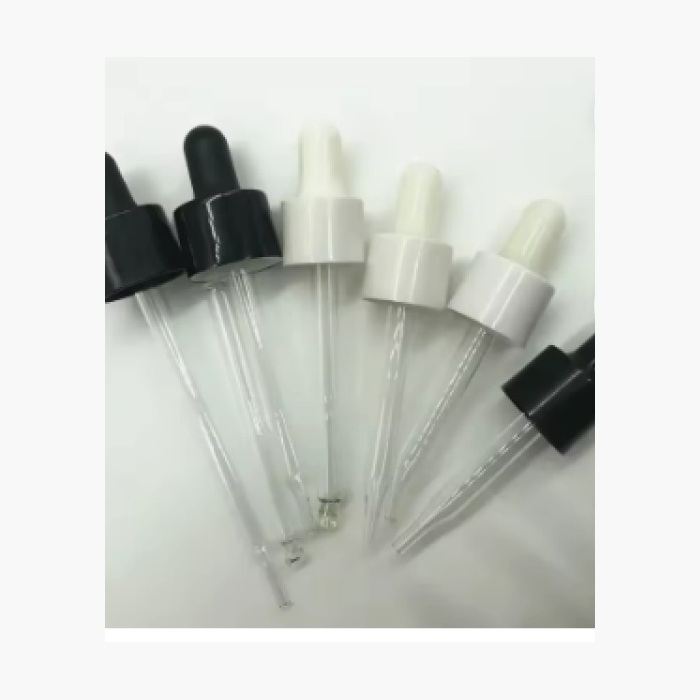
Dropper caps with glass pipette, 18/410 to 20/415
A plastic dropper cap with a nitrile bulb and a glass pipette, listed in 18/410, 18/415 and 20/415.
- Role: Alibaba sourcing candidate
- 18/410 to 20/415
- Glass pipette
- NBR bulb
- MOQ: From 1,000 pieces
A two-week trial
-
Choose two or three assemblies that differ in bulb material and ask for ten of each.
-
Fit them on sample bottles filled with your real formula, and note where the pipette tip sits.
-
Count drops per ml for each by dispensing a known volume, and weigh ten full pulls to find the real draw.
-
Leave the bottles upright for two weeks at room temperature, with the dropper in place and the bulb squeezed once a day.
-
Look at the bulbs: do they swell, soften, go sticky or change colour? Compare them with an unused bulb.
-
Check the printed marks, if any, and whether the pipette still fits snugly in the collar.
-
Leave two bottles in a warm place for a week and look again.
Write down the bulb material, the hardness if known, the pipette length and the dose you measured. These go on your specification sheet, and they are what you give the supplier if a later lot behaves differently.
Questions to ask the supplier
-
What is the bulb made of, and what is its hardness in Shore A?
-
Has this bulb been tested with essential oils, alcohol or my type of formula?
-
What is the pipette length, material and bore?
-
What is the draw per squeeze, and are the graduations printed or etched?
-
Is the assembly child-resistant or tamper-evident, and which bottle is it designed for?
-
What is the minimum order, and can I have samples?
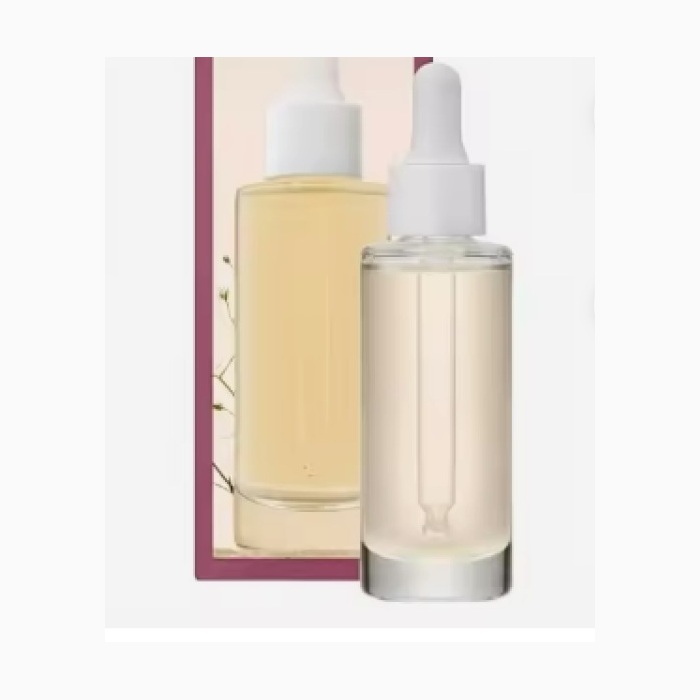
10 ml hyaluronic serum in a dropper bottle
The finished-product end of the same decision: a 10 ml serum supplied in a dropper bottle, which is what the assembly is eventually fitted to.
- Role: Alibaba sourcing candidate
- 10 ml
- Dropper bottle
- Finished product
- MOQ: From 6 pieces
Common mistakes
-
Choosing the bulb by price. Natural rubber may not suit oils [1][2].
-
Printing a drop count on the label. The count varies with the formula and the tip [2][12][13].
-
Using a standard closure on a Euro bottle. It will not seal or give tamper evidence [2].
-
Trusting printed graduations. Alcohol and oils can remove them [2][6].
-
Ordering by capacity alone. The pipette length follows the bottle shape [1][9].
FAQ
How many drops are in a mL?
About 20 is the usual figure, but sources give 15 to 25, and up to 25 to 30 for oils [12][13]. Measure your own.
Which bulb is best for essential oils?
Suppliers point to silicone or NBR over natural rubber [1][3]; test with your blend.
Does an assembly fit any 18 mm bottle?
No. Match the neck finish, as Container and Packaging advises [2], and check the pipette reaches the bottom.
Are glass pipettes better than plastic?
Glass is chemically inert but heavier and more fragile, and usually costs more [1]. Plastic suits ethanol-based products in some child-resistant designs, according to one tincture guide [9].
References
- O.Berk, Dropper assembly selection for serums: technical considerations for precision dispensing. oberk.com (packaging distributor; Crash Course).
- Container and Packaging, Know your dropper types: assemblies, Euro droppers and dropper tips. containerandpackaging.com (packaging distributor).
- Miron Violetglass, Pipette guide and pipette collections. miron.com (glass maker; sells the parts discussed).
- Racklify encyclopedia, Material science for sensitive liquids. racklify.com (encyclopedia-style site; no clear author; use as indicative only).
- Comar, Dropper assemblies: a comprehensive guide from materials to fit. comar.com (packaging maker).
- The Cary Company, 30WDW5 child-resistant calibrated glass dropper for 1/2 oz bottles. thecarycompany.com (packaging distributor).
- FH Packaging, 18-415 white PP child-resistant and tamper-evident dropper with 58 mm graduated glass pipette. fhpkg.com (packaging distributor).
- SGD Pharma, glass dropper bottles (not cited for figures; the table in the snippet was unclear). sgd-pharma.com (glass maker).
- eBottles, Pricing and spec guide 2024, tinctures v4.0 (pipette pairings; bulb volumes; price tiers from 25,000). ebottles via cdn.shopify.com (supplier PDF).
- Container and Packaging, tamper-evident dropper assembly M1510WH. containerandpackaging.com (product page).
- Tekni-Plex, Dropper bottles (drop sizes 0.03, 0.04, 0.05 ml). tekni-plex.com (manufacturer).
- Gamut Packaging, How many drops are in a milliliter, and How many drops are in a 10 ml bottle. gamutpackaging.com (retailer).
- Craftybase, mL to drops converter. craftybase.com (software maker; calculator).
- Racklify encyclopedia, The physics of controlled dispensing. racklify.com (encyclopedia-style site; indicative only).
Continue reading

Stand-Up Pouches: Fill Weight, Gusset and Usable Height
A pouch is listed by three numbers and none of them is the fill volume. Width, height and gusset describe a flat sheet of film, not the space left after the seal.
Spice Shaker Caps: Hole Size, Fit and Product Match
A shaker cap is three parts that are usually sold separately: the base, the rotating or flapping lid, and the liner. Buy them apart and the hole size is the last thing you check.
Metal Balm Tins: Fill Weight, Lid Type and Label Area
The ounce stamped on a balm tin is a trade size, not a fill weight. A 1 oz tin holds about 28 g of wax, and a little less of anything with oil in it.