Shrink Bands for Deli Containers: Sizes and Preform Bands
One band size covers the common round tubs from 8 to 32 oz. The catch is that sellers describe that one size three different ways, so you cannot compare listings until you convert them.
 Lena Schmidt
In this guide
- Why does one band fit tubs from 8 to 32 oz?
- Why do listings give three different numbers for one band?
- What is a preform band, and why use one?
- Which should you buy: preform or flat?
- How do you apply one cleanly?
- What tends to go wrong?
- Where should the date label go?
- What do they cost?
- Plain, coloured or printed?
- Is a band required on deli containers?
- Where to buy the bands
- Before you order a case
- FAQ
- References
Quick answer. Round deli and soup containers from 8 to 32 oz usually share one lid of about 4 5/8 inches, so one band fits them all. Look for a lay-flat width of 190 to 192 mm and a height of 25 to 28 mm, or 205 mm if your lid is closer to 4 3/4 inches. A “preform” band, written as 192 x 25 + 7 mm, has a small folded lip that sits on the lid and keeps the band in place while you heat it. Many preform bands have no perforation, so check how your customer will open it. Measure your own lid before ordering a case.
Why does one band fit tubs from 8 to 32 oz?
Because the tubs differ in height, not in mouth. An industrial supplier’s listing for a deli band says it is for 4, 8, 12, 16 and 24 oz containers that share a lid 4 5/8 inches across [1]. Marketplace packs make the same claim for 8 to 32 oz round soup and deli containers, and name one common container brand as an example [2]. A food-service supplier offers a 205 mm band for lids of 4 1/2 to 4 3/4 inches and ties it to the 409 and 410 series of containers and lids [3].
So the working assumption is one lid, about 117 mm across, for the whole family. It is an assumption, though. Square tubs, hinged containers and some heavier reusable tubs have other dimensions. Put a ruler across your own lid before you trust any “fits all” line.
Why do listings give three different numbers for one band?
Here are three real descriptions of what is, in effect, the same product:
-
192 mm x 25 mm. Lay-flat width and height. This is the convention most packaging distributors use [1][4].
-
4.5 inch. The lid diameter the band is meant for. One specialist lists its preform bands this way, with 190 mm lay-flat in the small print [5].
-
120 mm x 25 mm (4.75 inch). A marketplace pack uses a figure that matches the opened diameter of the band, not its lay-flat width [2].
The arithmetic ties them together. A band 192 mm wide when flat has a circumference of 384 mm, so it opens to a circle about 122 mm across, or 4.8 inches. A lid of 4 5/8 inches is 117.5 mm. The band therefore starts about 4 percent larger than the lid and needs very little shrink to grip it. A 205 mm band opens to about 130 mm, which is why it is sold for slightly larger lids [3].
Two sellers spell out the trap in their own listings: lay-flat width is not the same as container width [6]. If you see “120 mm” on one page and “190 mm” on another, they may well be the same band. If you see “120 mm” described as lay-flat, it is far too small for a deli tub.
What is a preform band, and why use one?
A flat band is a simple loop of film. A preform band has been partly shaped in the factory so that one edge turns inward, forming a narrow lip. Distributors write this as a third number: 192 mm x 25 mm + 7 mm, where the 7 mm is the lip [4].
The lip does a practical job. A wide, shallow band on a tub has nothing to rest on, so it slides down the side wall as soon as you let go. One buyer describes the difference well: the lip lets you set the band on the container and it stays put while you use the heat gun, where flat shrink film from a craft shop was hard to line up straight and keep in place [7]. Another notes that once the band is on the lid you do not need to hold it, which frees a hand to turn the tub [5].
A label maker’s data sheet makes a broader claim, that preform bands secure the lid to the container and work well on containers that are hard to seal [8]. That is a supplier’s description and it was not possible to test it. The film still has to be torn or cut to open the tub, which is the point of the exercise.
Which should you buy: preform or flat?
| Preform (192 x 25 + 7 mm) | Flat (190 or 205 x 28 mm, or taller) | |
|---|---|---|
| Placement | Lip rests on the lid; stays put [7] | Must be held or sits on the bench until it grips |
| Perforation | Several listings say none [5][9] | Commonly perforated [3][6] |
| Heights seen | 25 to 45 mm plus lip [4] | 28 mm and 56 mm [6] |
| Pack sizes seen | Sleeves of 250; cases of 4,000 to 5,000 [2][4][5] | Packs of 250; cases of 1,000 [3][6] |
| Colours and print | Clear, colours, and stock safety print [2][5] | Mostly clear |
Two details in that table deserve attention.
Perforation. Several preform bands are sold as non-perforated [5][9]. That is acceptable for a deli counter where staff expect customers to cut the film, but it is awkward for a retail buyer standing in their kitchen. If you want a tear-open band, look for the word “perforated” in the listing. Do not assume. One reviewer of a perforated flat band adds a counter-caution, that the perforations sometimes came apart on their own [10]. See the perforated vs non-perforated comparison for the trade-off.
Height. A 25 mm band covers the rim and little else. One buyer who seals salsa tubs wished for a band an inch wider [10]. Another prefers a 56 mm band on deli containers because the extra film gives more to grip and makes placement less fussy [6]. A taller band also covers more of your label, so look at where your label sits before choosing.
How do you apply one cleanly?
Sellers disagree about the heat source, and the numbers they give explain why. One food-service supplier says its band begins to shrink at 125°F with a recommended range of 200 to 320°F, and states that hair dryers do not get hot enough [3]. The industrial listing gives a shrink temperature of 160°F and a maximum shrink across the band of 35 to 40 percent [1]. A specialist seller, by contrast, says a hair dryer or a heat gun will do [5]. Since the band only has to close by a few percent, a hot dryer may manage it, but slowly. A heat gun on a low setting is the dependable choice.
-
Fill, lid and wipe the tub. Press the lid down all the way round, because a band will lock a half-seated lid in its half-seated position.
-
Drop the band over the lid. With a preform, the lip sits on top. With a flat band, centre it over the join between lid and tub.
-
Hold the gun a hand’s width away, on low, and turn the tub with your free hand so the heat travels around the rim [5].
-
Stop when the film is tight and smooth. Buyers describe this as a quick blast, not a long bake [10].
-
Check the lip. On a preform it should lie flat on the lid with no gap you can get a fingernail under.
A word on hot food. No source was found for a source giving a safe temperature for the tubs themselves, so this guide will not quote one. The cautious approach is to keep the gun moving, never aim it at one spot of the lid, and band soups after they have been lidded and the outside has been wiped dry. One reviewer says some bands break or warp during shrinking while better ones do not [5], which is a reason to try a sleeve of 250 before you buy a case. More on tools in heat gun vs hair dryer vs heat tunnel.
What tends to go wrong?
-
The band grips the tub but not the lid. It slid down before it shrank. Start the heat at the top edge, or use a preform.
-
The lid can still be lifted. The band is too short to reach over the lid’s edge, or the lip did not fold flat. Try a taller band and finish with a pass across the top.
-
The film splits at the perforation. Too much heat in one place, or a weak perforation [10]. Lower the setting and keep the tub turning.
-
Tubs will not stack. A wide lip or a ridge of film on the lid can stop the next tub seating. Check a stack of five before a market day.
-
Condensation under the film. The tub was banded while the outside was wet. Wipe it dry first.
These are practical inferences from the listings and reviews, not test results. For more symptoms, see shrink band problems and fixes.
Where should the date label go?
Not under a band the customer will tear off and throw away, and not on the band itself. Put the product label and any date or allergen label on the lid top or the tub wall, clear of the film. Then check that a 25 mm band does not cover the part of the label people need to read. We did not research food labelling rules for this article, so confirm what your label must carry with your local authority.
What do they cost?
| Listing | Price when checked | Per band |
|---|---|---|
| Preform 192 x 25 + 7 mm, clear, case of 5,000 [4] | from $182.90 | about 3.7 cents |
| Preform 190 x 25 x 7 mm, green, case of 4,000 [5] | $216.38 | about 5.4 cents |
| Flat 205 x 28 mm, perforated, case of 1,000 [3] | $84.59 | about 8.5 cents |
| 192 x 25 mm, black, non-perforated, pack of 250 [9] | $24.99 | 10 cents |
The pattern is the usual one. Cases bring the price under 6 cents and small packs sit near 10. If you sell forty tubs on a Saturday, a pack of 250 lasts six weeks and costs you about four dollars a week. Buy the case when you know the band fits and the film behaves. Our the cost section on this page covers quantity breaks in more detail.
Plain, coloured or printed?
Deli bands are one of the few places where stock printed bands are easy to find. Marketplace sleeves come with red text such as “Sealed for Your Protection” or “Quality Sealed” [2], and specialists sell solid colours [5]. A printed or coloured band is easier for a customer to notice than clear film on a clear tub, which is the whole purpose of a tamper signal. Stock wording is not your brand, though, and anyone can buy the same sleeve. If that matters, see custom printed shrink bands.
Is a band required on deli containers?
One marketplace listing states that a tamper-evident seal is required in most cases [6]. It was not possible to support that. The federal tamper-evident rules reviewed here cover over-the-counter drugs and two narrow kinds of cosmetics, and no source was found for a general federal rule for ordinary food; our page on whether shrink bands are required by law gives the detail. State and local food rules, rules for delivery services and the terms of a shop that stocks you may differ, and they were not checked here. Ask your local health department before you rely on either answer.
Be equally careful with “FDA-compliant” and “food-grade” on band listings [4]. They are sellers’ descriptions of the film. The band sits outside the lid and should not touch the food, but if that matters for your product, ask the seller for the statement in writing.
Where to buy the bands
The two listings below are the two shapes the table above compares: a preform with a lip, and a flat perforated band.
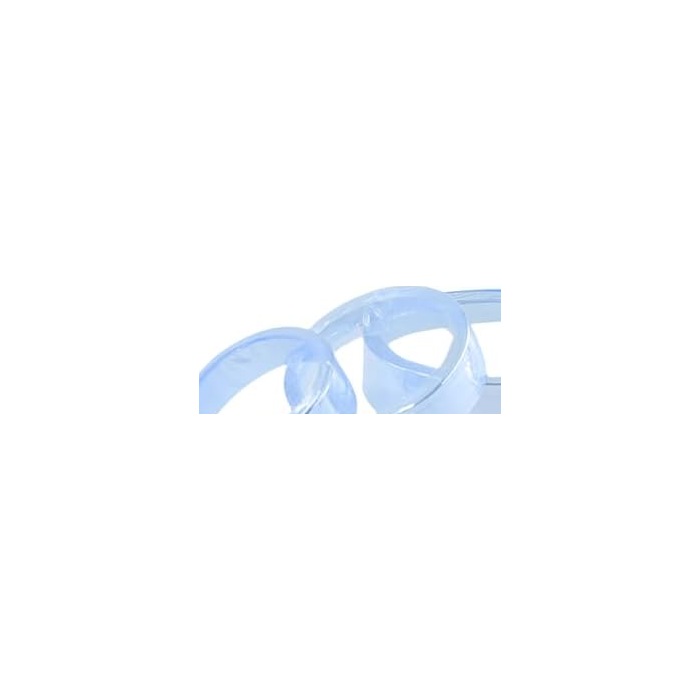
192 x 25 mm preformed perforated shrink bands, 250 pack
A preformed band with the turned lip that rests on a wide tub lid, 192 mm lay-flat and 25 mm deep, sold in 250-piece packs.
- Role: Amazon consumer option
- 192 x 25 mm
- Preformed lip
- 250 pack
- MOQ: Check current listing
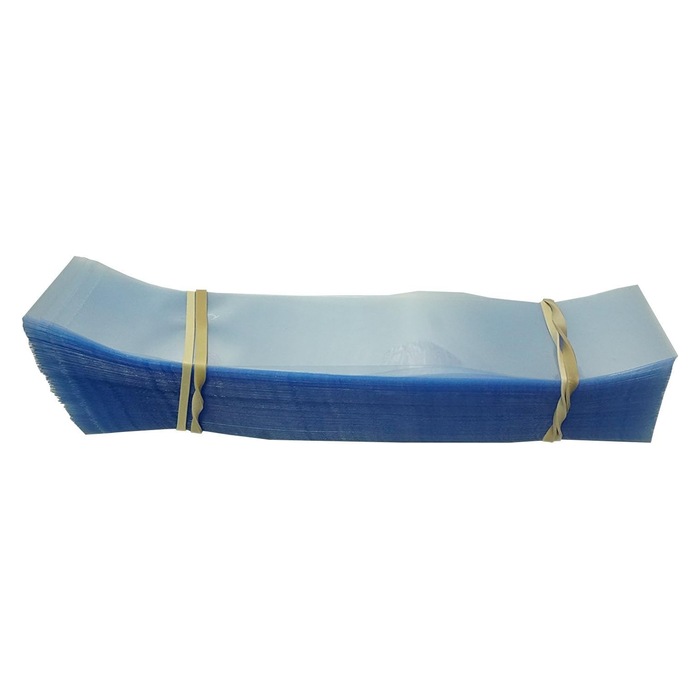
190 x 28 mm clear perforated shrink band for deli tubs
A flat perforated band, 190 mm wide when flat and 28 mm tall, for the same 4 11/16 inch lid.
- Role: Amazon consumer option
- 190 x 28 mm
- Perforated
- Flat band
- MOQ: Check current listing
Before you order a case
-
Measure across the lid at its widest point, in millimetres.
-
Multiply by 3.14 and halve it. The band’s lay-flat width should be a few millimetres above that figure. For a 117.5 mm lid the sum gives about 185 mm, so 190 to 192 mm fits.
-
Decide between preform and flat, and whether you need a perforation.
-
Choose a height that clears your label.
-
Buy one sleeve of 250. Band ten tubs, refrigerate them overnight, stack them, and open three the way a customer would.
-
Then buy the case.
FAQ
Will these fit square or rectangular tubs?
The round-lid bands are sized by circumference, so a square tub needs its own measurement: add the four sides, halve the total and look for a lay-flat width just above it. No square-tub bands were found in the listings reviewed.
Can I use a hair dryer?
One seller says yes and another says no [3][5]. Try it on a spare tub. If the film is still loose after ten seconds, use a heat gun.
Do the bands stay tight in the fridge or freezer?
No source was found for a supplier data on that. Run the overnight test above with your own product, and ask what suppliers say about PVC in the cold.
Why did my band slide down the tub?
It is a flat band with nothing to rest on. Hold it at the rim for the first second of heat, or switch to a preform.
References
- Zoro, Zoro Select Heat Activated Shrink Bands, 25 mm x 192 mm, for deli-pack containers with 4-5/8 in lid diameter. zoro.com (industrial supplier listing; two versions of the page give 35% and 40% maximum transverse shrink).
- Marketplace listings for clear and red-print heat shrink deli container bands, 250 per sleeve, on Walmart Marketplace and viewed via Desertcart. walmart.com, desertcart.com (seller text).
- ePackageSupply, Shrink Bands 205 mm x 28 mm, Perforated, case of 1,000. epackagesupply.com (packaging supplier).
- Interplas (International Plastics), Shrink Bands category page with preform sizes and case prices. interplas.com (packaging distributor).
- The Brenmar Company, Shrink Band for Deli Container 4.5 in Preform, product pages with customer reviews. brenmarco.com (packaging supplier; reviews are individual buyers).
- Marketplace listings for 190 x 56 mm clear perforated shrink bands for tubs and deli containers, with buyer reviews, viewed on third-party retail pages. (seller text and individual reviews; confirm on the original listing).
- Buyer reviews of PACTOGO clear shrink bands for deli containers, viewed via Desertcart. desertcart.com (individual reviews).
- MPI Label Systems, Shrink Preform Bands data sheet, via GlobalSpec. globalspec.com (label and shrink maker).
- WebstaurantStore, 192 mm x 25 mm Black Non-Perforated Shrink Band, 250 per pack. webstaurantstore.com (food-service supplier).
- Buyer reviews of 190 x 28 mm clear perforated shrink bands for tubs, viewed via Desertcart. desertcart.com (individual reviews).
Continue reading

Shrink Bands for Mason Jars: Regular vs Wide Mouth, and Which Size to Test
Regular-mouth lids are about 70 mm and wide-mouth lids about 86 mm. A band sized for one cannot go on the other, and here is the arithmetic, the published sizes, and the six-jar test that settles it.

Lift-Tab vs Ring-Peel Induction Seal Liners: How to Specify an Easy-Open Foil Seal
A practical buyer guide for choosing lift-tab, pull-tab and ring-peel induction liners without weakening the seal, confusing opening behavior, or paying for a feature the package does not need.

Pressure-Sensitive Liner vs Induction Seal Liner: Which Should You Use?
A practical comparison for buyers deciding whether a cap-applied adhesive liner is enough, or whether the package needs a true induction-sealed foil membrane and a controlled sealing process.